Guo Ling, Wang Lifeng, Zhao Qiang, Ye Liyan, Ye Kun, Ma Yanning, Shen Dingxia, Yang Jiyong
Department of Laboratory Medicine, First Medical Center of Chinese PLA General Hospital, Beijing, China.
Front Microbiol. 2022 Jun 16;13:929826. doi: 10.3389/fmicb.2022.929826. eCollection 2022.
Carbapenem-resistant (CRKP) is an important pathogen causing hospital-associated outbreaks worldwide. The spread of carbapenemase-2 (KPC-2)-producing CRKP is primarily associated with sequence type (ST) 11.
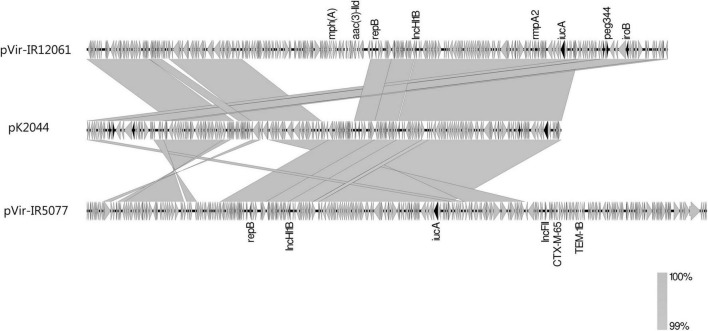
A total of 152 KPC-2-producing ST11 isolates were collected from the respiratory department of a tertiary care hospital in Beijing, China between 2009 and 2018. The genome sequencing of these isolates was performed on the HiSeq X Ten sequencer. Multilocus sequence typing (MLST), capsular type, plasmid replicon types and resistance genes were identified. Fifteen isolates were selected for the subsequent single-molecule real-time (SMRT) sequencing on the PacBio RS II. Alignment of the complete sequences of the plasmids carrying and/or virulence genes was performed by using BRIG and Easyfig.
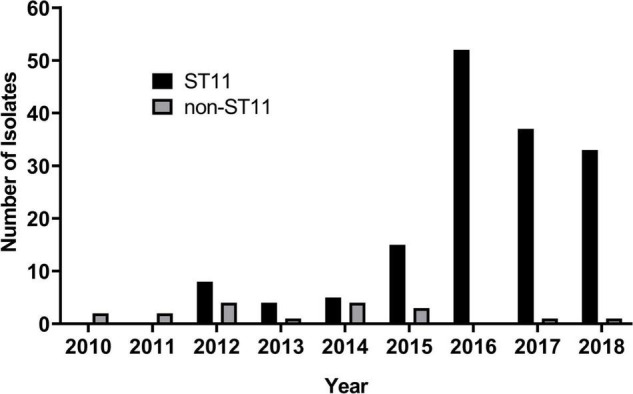
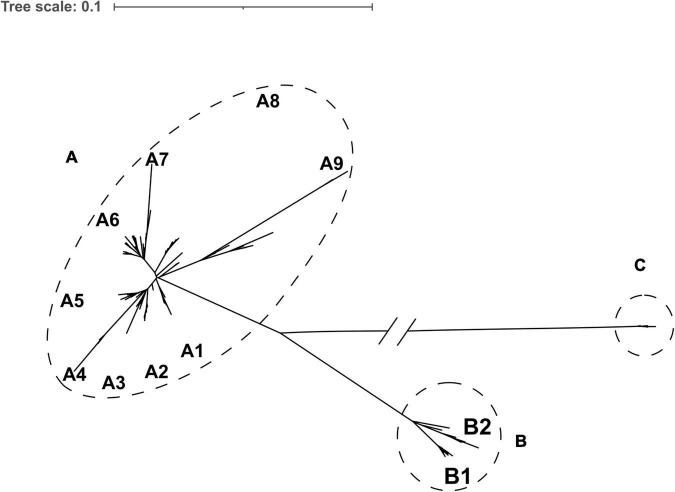
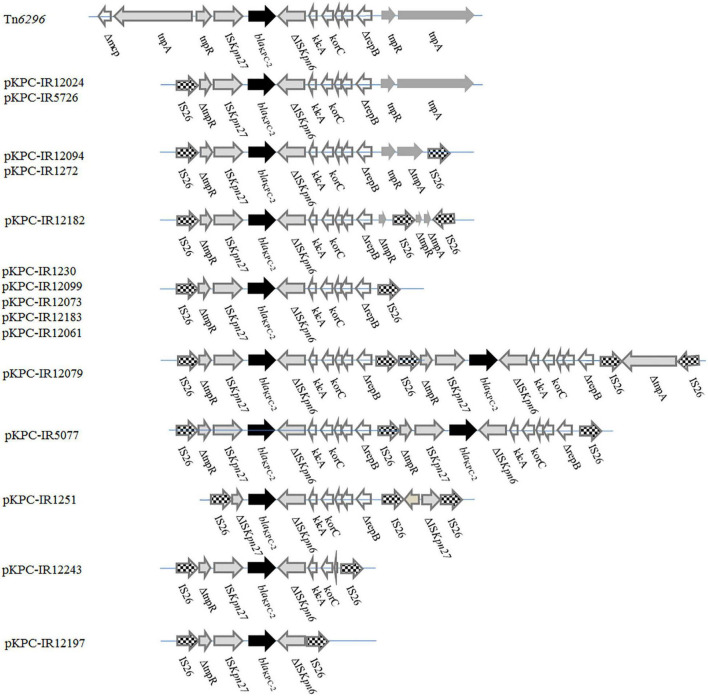
From 2012 to 2018, the detection rate of the -carrying CRKP rose rapidly from 3.3 to 28.1%. KPC-2-producing ST11 isolates were dominant in CRKP, which emerged in 2012 and caused several outbreaks. Most isolates exhibited multidrug-resistant to commonly used antibiotics, while all the isolates remained susceptible to tigecycline and polymyxin B. The single nucleotide polymorphism (SNP) analysis showed that all these 152 KPC-2-producing ST11 isolates could be divided into three genetically distinct clades (A, B, and C) and eleven subclades (A1-A9 and B1-B2). The majority belonged to clade A with KL47 serotype ( = 117, 77.0%), while KL64 and KL16 were identified in clades B and C, respectively. The -carrying plasmids exhibited diverse types, namely, IncFII (pHN7A8)/IncR(6/15), IncFII (pHN7A8)/Inc (5/15), IncFII (pHN7A8) (1/15), IncR (1/15), and Inc (1/15). The genetic environment of showed nine IS-based composite transposons, which had a basic core structure IS -ΔIS. About 27.6% (42/152) isolates co-carried 2 to 4 virulence marker genes (namely, , , , , and ) for hvKp strains. At least three isolates were identified to harbor virulence gene-carrying plasmids.
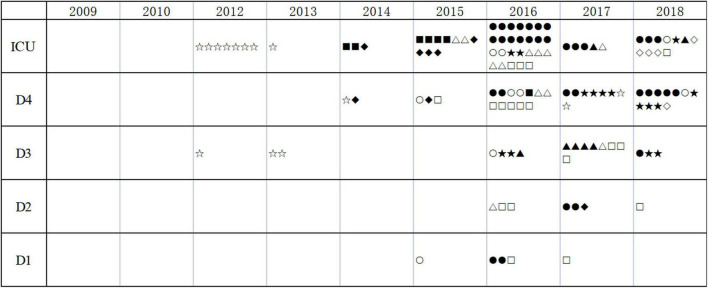
KPC-2-producing ST11 was highly heterogeneous in our hospital. Transmission of these strains was mainly mediated by twelve high-risk clones. The -carrying plasmids and genetic environment of genes exhibited active evolution in ST11. More attention should be paid to the tendency of KPC-2-ST11 to acquire hypervirulent plasmids.
耐碳青霉烯类肺炎克雷伯菌(CRKP)是一种在全球范围内引起医院感染暴发的重要病原体。产碳青霉烯酶-2(KPC-2)的CRKP传播主要与序列型(ST)11相关。
2009年至2018年期间,从中国北京一家三级甲等医院呼吸科收集了152株产KPC-2的ST11分离株。这些分离株的基因组测序在HiSeq X Ten测序仪上进行。进行多位点序列分型(MLST)、荚膜类型、质粒复制子类型和耐药基因鉴定。选择15株分离株进行后续的PacBio RS II单分子实时(SMRT)测序。使用BRIG和Easyfig对携带毒力基因的质粒完整序列进行比对。
2012年至2018年,携带blaKPC-2的CRKP检出率从3.3%迅速上升至28.1%。产KPC-2的ST11分离株在CRKP中占主导地位,于2012年出现并引发了几次暴发。大多数分离株对常用抗生素表现出多重耐药,而所有分离株对替加环素和多粘菌素B仍敏感。单核苷酸多态性(SNP)分析表明,这152株产KPC-2的ST11分离株可分为三个遗传上不同的分支(A、B和C)和11个亚分支(A1-A9和B1-B2)。大多数属于A分支,血清型为KL47(n = 117,77.0%),而在B和C分支中分别鉴定出KL64和KL16。携带blaKPC-2的质粒表现出多种类型,即IncFII(pHN7A8)/IncR(6/15)、IncFII(pHN7A8)/IncN(5/15)、IncFII(pHN7A8)(1/15)、IncR(1/15)和IncN(1/15)。blaKPC-2的遗传环境显示有9个基于插入序列的复合转座子,其基本核心结构为ISKpn27-ΔISKpn6。约27.6%(42/152)的分离株共携带2至4个高毒力肺炎克雷伯菌(hvKp)菌株的毒力标记基因(即wabG、ureC、kfu、iutA和mrkD)至少有3株分离株被鉴定为携带毒力基因的质粒。
我院产KPC-2的ST11具有高度异质性。这些菌株的传播主要由12个高风险克隆介导。携带blaKPC-2的质粒和blaKPC-2基因的遗传环境在ST11中呈现活跃进化。应更多关注KPC-2-ST11获得高毒力质粒的趋势。