Iglesia Rebeca Piatniczka, Prado Mariana Brandão, Alves Rodrigo Nunes, Escobar Maria Isabel Melo, Fernandes Camila Felix de Lima, Fortes Ailine Cibele Dos Santos, Souza Maria Clara da Silva, Boccacino Jacqueline Marcia, Cangiano Giovanni, Soares Samuel Ribeiro, de Araújo João Pedro Alves, Tiek Deanna Marie, Goenka Anshika, Song Xiao, Keady Jack Ryan, Hu Bo, Cheng Shi Yuan, Lopes Marilene Hohmuth
Laboratory of Neurobiology and Stem Cells, Department of Cell and Developmental Biology, Institute of Biomedical Sciences, University of São Paulo, São Paulo, Brazil.
The Robert H. Lurie Comprehensive Cancer Center, The Ken and Ruth Davee Department of Neurology, Lou and Jean Malnati Brain Tumor Institute at Northwestern Medicine, Northwestern University Feinberg School of Medicine, Chicago, IL, United States.
Front Cell Dev Biol. 2022 Jun 15;10:907423. doi: 10.3389/fcell.2022.907423. eCollection 2022.
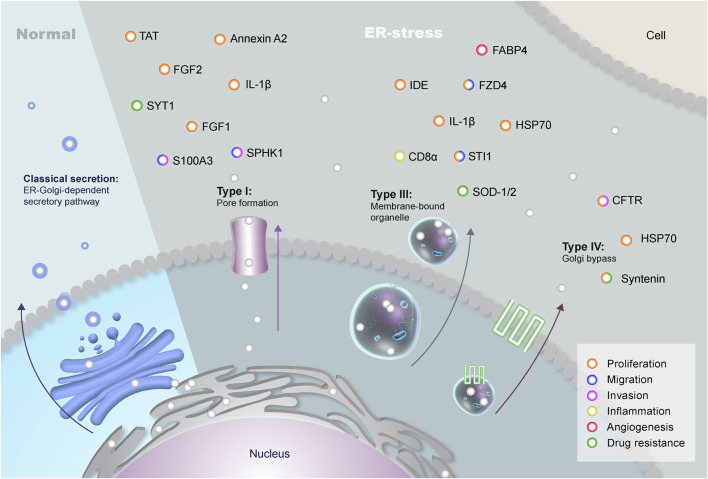
Non-canonical secretion pathways, collectively known as unconventional protein secretion (UPS), are alternative secretory mechanisms usually associated with stress-inducing conditions. UPS allows proteins that lack a signal peptide to be secreted, avoiding the conventional endoplasmic reticulum-Golgi complex secretory pathway. Molecules that generally rely on the canonical pathway to be secreted may also use the Golgi bypass, one of the unconventional routes, to reach the extracellular space. UPS studies have been increasingly growing in the literature, including its implication in the biology of several diseases. Intercellular communication between brain tumor cells and the tumor microenvironment is orchestrated by various molecules, including canonical and non-canonical secreted proteins that modulate tumor growth, proliferation, and invasion. Adult brain tumors such as gliomas, which are aggressive and fatal cancers with a dismal prognosis, could exploit UPS mechanisms to communicate with their microenvironment. Herein, we provide functional insights into the UPS machinery in the context of tumor biology, with a particular focus on the secreted proteins by alternative routes as key regulators in the maintenance of brain tumors.
非经典分泌途径,统称为非常规蛋白质分泌(UPS),是通常与应激诱导条件相关的替代性分泌机制。UPS允许缺乏信号肽的蛋白质被分泌,从而避开传统的内质网-高尔基体复合体分泌途径。通常依赖经典途径分泌的分子也可能利用非常规途径之一的高尔基体旁路到达细胞外空间。关于UPS的研究在文献中越来越多,包括其在几种疾病生物学中的意义。脑肿瘤细胞与肿瘤微环境之间的细胞间通讯由各种分子协调,包括调节肿瘤生长、增殖和侵袭的经典和非经典分泌蛋白。成人大脑肿瘤,如胶质瘤,是具有侵袭性和致命性且预后不佳的癌症,可能利用UPS机制与它们的微环境进行通讯。在此,我们在肿瘤生物学背景下提供了对UPS机制的功能见解,特别关注通过替代途径分泌的蛋白质作为维持脑肿瘤的关键调节因子。