Department of Cell and Developmental Biology, Institute of Biomedical Sciences, University of São Paulo, Av. Prof. Lineu Prestes, 1524 room 431, Sao Paulo, 05508000, Brazil.
Department of Automation and Systems, Technological Center, Federal University of Santa Catarina, Florianópolis, Santa Catarina, Brazil.
BMC Cancer. 2024 Feb 13;24(1):199. doi: 10.1186/s12885-024-11914-6.
Glioblastoma (GBM) is an aggressive brain tumor that exhibits resistance to current treatment, making the identification of novel therapeutic targets essential. In this context, cellular prion protein (PrP) stands out as a potential candidate for new therapies. Encoded by the PRNP gene, PrP can present increased expression levels in GBM, impacting cell proliferation, growth, migration, invasion and stemness. Nevertheless, the exact molecular mechanisms through which PRNP/PrP modulates key aspects of GBM biology remain elusive.
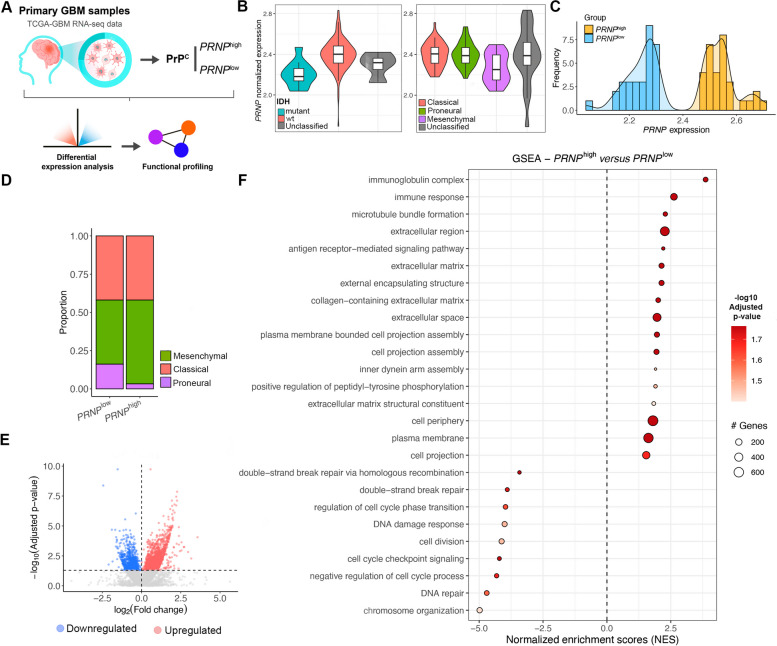
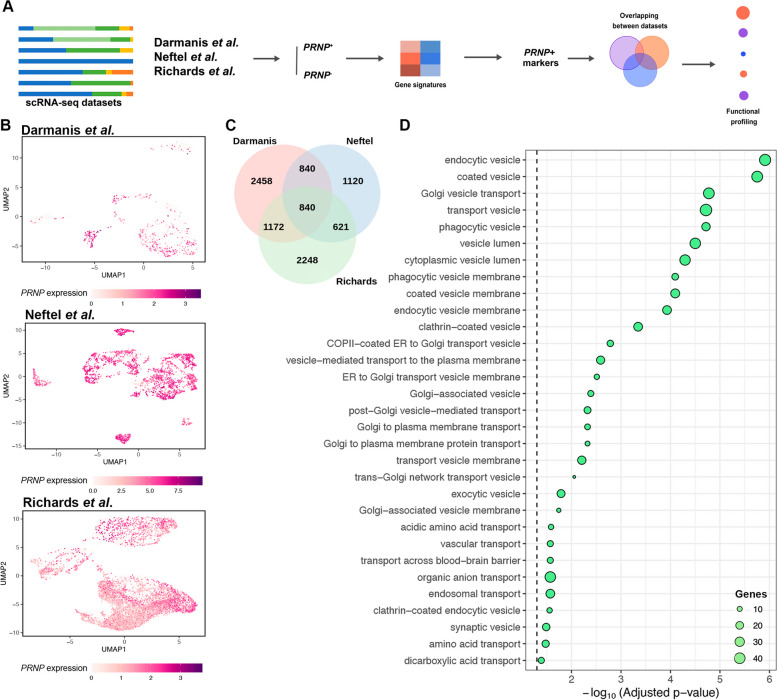
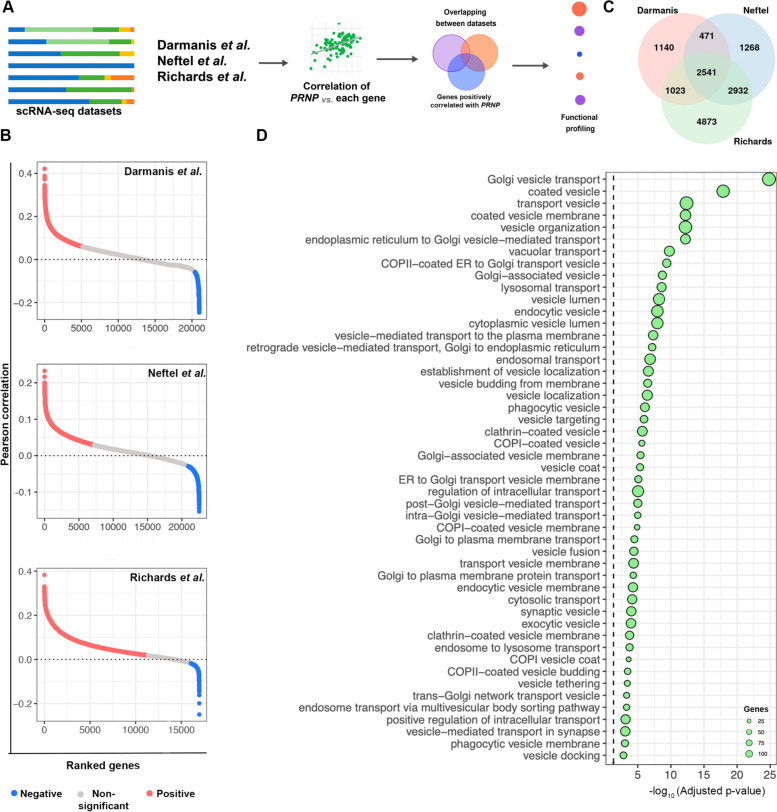
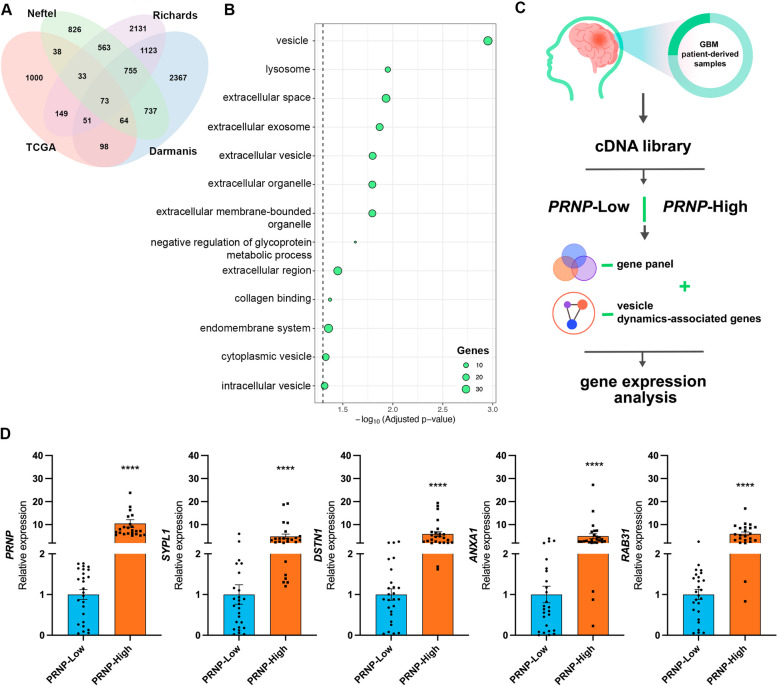
To elucidate the implications of PRNP/PrP in the biology of this cancer, we analyzed publicly available RNA sequencing (RNA-seq) data of patient-derived GBMs from four independent studies. First, we ranked samples profiled by bulk RNA-seq as PRNP and PRNP and compared their transcriptomic landscape. Then, we analyzed PRNP and PRNP GBM cells profiled by single-cell RNA-seq to further understand the molecular context within which PRNP/PrP might function in this tumor. We explored an additional proteomics dataset, applying similar comparative approaches, to corroborate our findings.
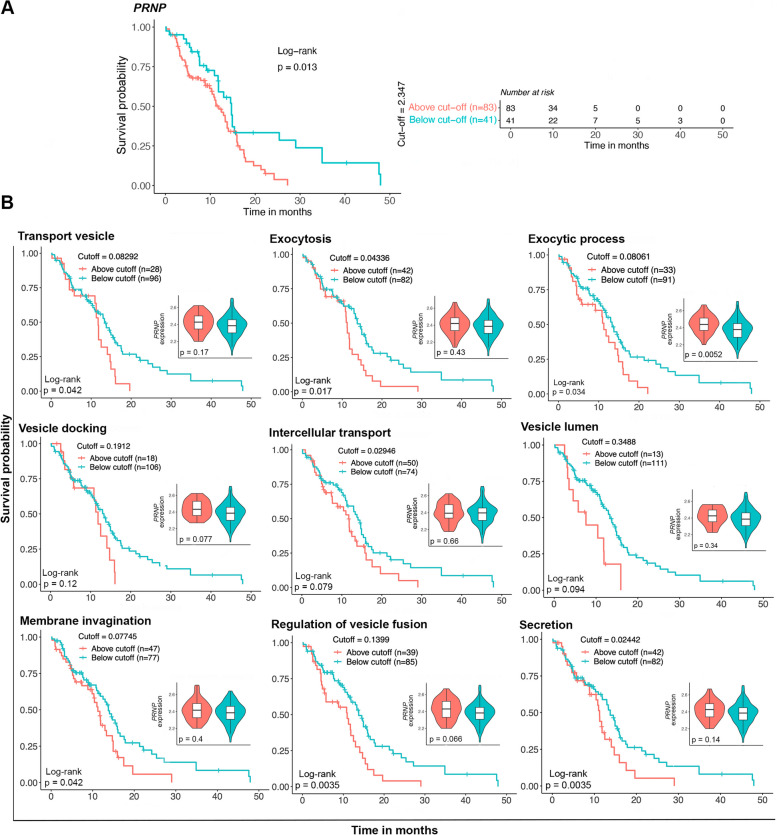
Functional profiling revealed that vesicular dynamics signatures are strongly correlated with PRNP/PrP levels in GBM. We found a panel of 73 genes, enriched in vesicle-related pathways, whose expression levels are increased in PRNP/PRNP cells across all RNA-seq datasets. Vesicle-associated genes, ANXA1, RAB31, DSTN and SYPL1, were found to be upregulated in vitro in an in-house collection of patient-derived GBM. Moreover, proteome analysis of patient-derived samples reinforces the findings of enhanced vesicle biogenesis, processing and trafficking in PRNP/PRNP GBM cells.
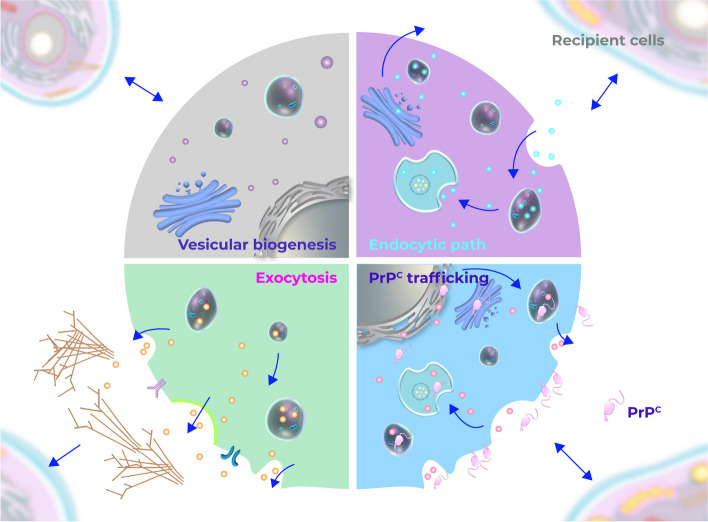
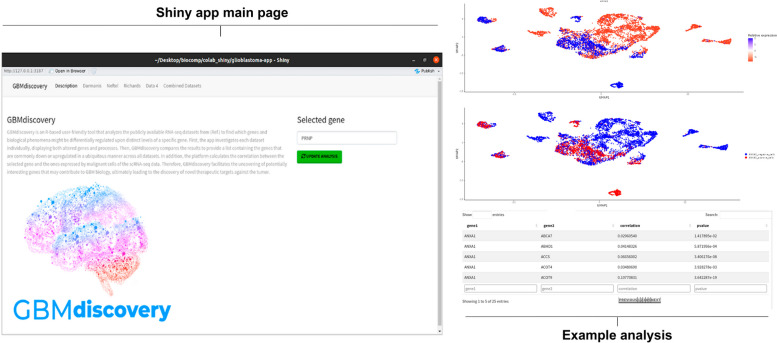
Together, our findings shed light on a novel role for PrP as a potential modulator of vesicle biology in GBM, which is pivotal for intercellular communication and cancer maintenance. We also introduce GBMdiscovery, a novel user-friendly tool that allows the investigation of specific genes in GBM biology.
胶质母细胞瘤(GBM)是一种侵袭性脑肿瘤,对当前的治疗方法具有耐药性,因此确定新的治疗靶点至关重要。在这种情况下,细胞朊病毒蛋白(PrP)作为新疗法的潜在候选者脱颖而出。PrP 由 PRNP 基因编码,在 GBM 中可表现出表达水平升高,影响细胞增殖、生长、迁移、侵袭和干性。然而,PRNP/PrP 调节 GBM 生物学关键方面的确切分子机制仍不清楚。
为了阐明 PRNP/PrP 在这种癌症生物学中的意义,我们分析了来自四个独立研究的患者来源的 GBM 的公共可用 RNA 测序(RNA-seq)数据。首先,我们按批量 RNA-seq 对样本进行排序,确定 PRNP 和 PRNP 表达水平,并比较它们的转录组图谱。然后,我们分析了单细胞 RNA-seq 中 PRNP 和 PRNP GBM 细胞,以进一步了解 PRNP/PrP 可能在该肿瘤中发挥作用的分子背景。我们还探索了另一个蛋白质组学数据集,应用类似的比较方法来证实我们的发现。
功能谱分析表明,囊泡动力学特征与 GBM 中的 PRNP/PrP 水平强烈相关。我们发现了一组 73 个基因,这些基因在囊泡相关途径中富集,其表达水平在所有 RNA-seq 数据集中均在 PRNP/PRNP 细胞中升高。在我们内部收集的患者来源的 GBM 中,囊泡相关基因 ANXA1、RAB31、DSTN 和 SYPL1 被发现体外上调。此外,对患者来源样本的蛋白质组分析进一步证实了 PRNP/PRNP GBM 细胞中增强的囊泡生物发生、加工和转运的发现。
总之,我们的研究结果揭示了 PrP 作为 GBM 中囊泡生物学潜在调节剂的新作用,这对于细胞间通讯和癌症维持至关重要。我们还介绍了 GBMdiscovery,这是一种新的用户友好工具,允许研究 GBM 生物学中的特定基因。