College of Politics and Law, Shaoyang University, Shaoyang, 422000, Hunan, China.
Department of Psychology, Faculty of Human Sciences, Lorestan University, Khorramabad, Iran.
Cogn Process. 2022 Nov;23(4):569-581. doi: 10.1007/s10339-022-01101-5. Epub 2022 Jul 5.
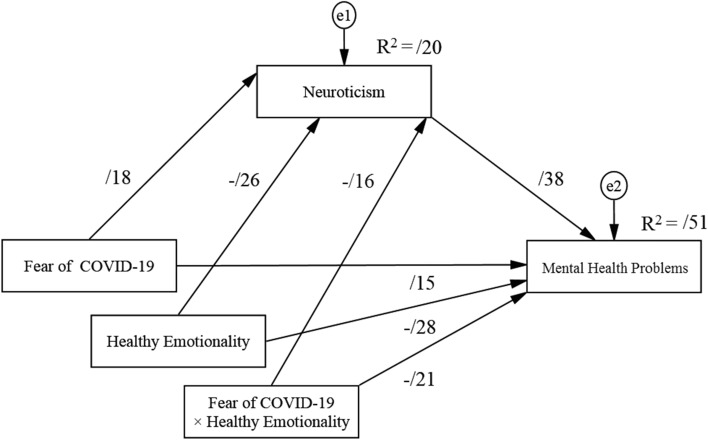
Understanding pandemic-related psychopathology development is limited due to numerous individual and contextual factors. It is widely accepted that individual differences to endure or cope with distress predict psychopathology development. The present study investigated the influence of individual differences in neuroticism and healthy emotionality concerning the association between fear of COVID-19 and mental health problems. It was hypothesized that healthy emotionality would moderate the mediated link between fear of COVID-19 and mental health problems. A sample of 752 participants (351 males and 401 females) completed an online survey including the Emotional Style Questionnaire, Fear of COVID-19 Scale, the Neuroticism subscale of the Big Five Inventory, and General Health Questionnaire. The results showed that the fear of COVID-19 positively predicted mental health problems (β = .43, SE = .05, p < .001, Cohen's f = .24). Neuroticism also showed a significant mediation effect on the relationship between fear of COVID-19 and mental health problems. Fear of COVID-19 indirectly predicted psychopathology through neuroticism (β = - .16, SE = .04, p < .001, t = 4.53, 95% CI [0.11, 0.23]). Moreover, healthy emotionality had a moderating effect on the relationship between fear of COVID-19 and mental health problems, β = - .21, SE = .03, p < .001, t = 5.91, 95% CI [- 0.26, - 0.14]. The study's findings are expected to contribute to a better understanding of the roles of both individual differences in personality traits and healthy emotionality in psychopathology development during the current pandemic.
理解与大流行相关的精神病理学发展受到众多个体和情境因素的限制。人们普遍认为,个体差异在承受或应对痛苦方面的差异预测了精神病理学的发展。本研究调查了神经质和健康情绪的个体差异对恐惧 COVID-19 与心理健康问题之间关联的影响。研究假设健康情绪会调节恐惧 COVID-19 与心理健康问题之间的中介联系。研究共纳入了 752 名参与者(351 名男性和 401 名女性),他们完成了一项在线调查,包括情绪风格问卷、恐惧 COVID-19 量表、大五人格问卷的神经质分量表和一般健康问卷。结果表明,对 COVID-19 的恐惧正向预测心理健康问题(β=.43,SE=.05,p<.001,Cohen's f=.24)。神经质在恐惧 COVID-19 与心理健康问题之间的关系中也表现出显著的中介效应。恐惧 COVID-19 通过神经质间接预测精神病理学(β=−.16,SE=.04,p<.001,t=4.53,95%CI[0.11, 0.23])。此外,健康情绪对恐惧 COVID-19 与心理健康问题之间的关系具有调节作用,β=−.21,SE=.03,p<.001,t=5.91,95%CI[-0.26, -0.14]。本研究的发现有望增进对人格特质个体差异和健康情绪在当前大流行期间精神病理学发展中的作用的理解。