Nazari Nabi, Zekiy Angelina Olegovna, Feng Lin-Sen, Griffiths Mark D
Department of Psychology, Faculty of Literature and Human Sciences, Lorestan University, Khorramabad, Iran.
Department of Prosthetic Dentistry, Sechenov First Moscow State Medical University, Moscow, Russian Federation.
Int J Ment Health Addict. 2022;20(5):2665-2680. doi: 10.1007/s11469-021-00540-z. Epub 2021 May 14.
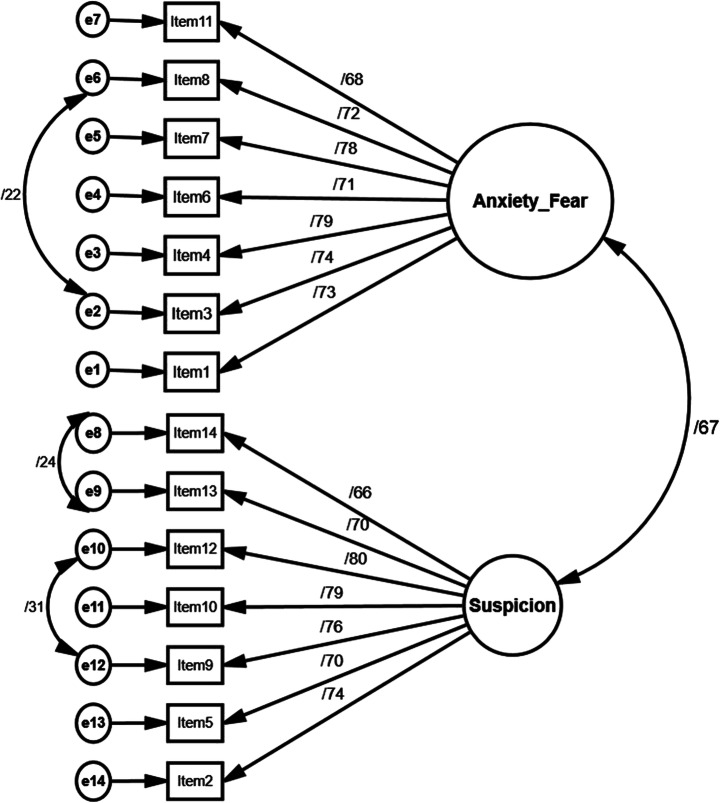
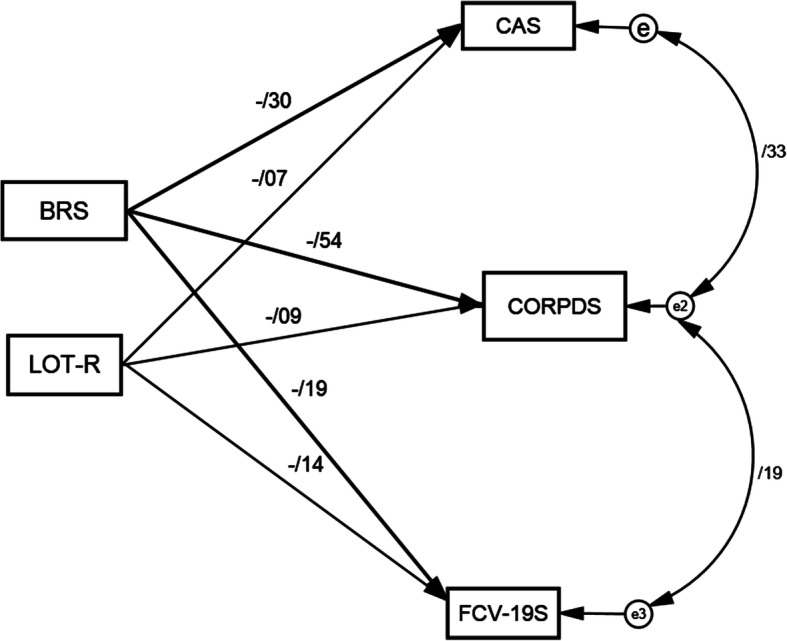
The outbreak of the coronavirus disease-2019 (COVID-19) has resulted in a global health crisis. The COVID-19 pandemic has caused psychological distress, both in infected and uninfected individuals. The present study evaluated the validity and factor structure of the COVID-19-Related Psychological Distress Scale (CORPDS) among the general public of the Persian-speaking population. The original version of the CORPDS was translated and back-translated into Persian, followed by a pilot study. A total sample ( = 623) completed an online survey including the CORPDS, Fear of COVID-19 Scale (FCV-19S), Coronavirus Anxiety Scale (CAS), Kessler Psychological Distress Scale (K10), Life Orientation Test-Revised (LOT-R), and Brief Resilience Scale (BRS). The Persian CORPDS had very good internal consistency and moderate test-retest reliability after 4 weeks. Maximum likelihood confirmatory factor analysis (CFA) was conducted to test construct validity (χ/df = 2.39, CFI = 0.95, SRMR = 0.046, PCLOSE = 0.67 > 0.05, RMSEA = 0.047, 90% CI [0.038, 0.056]). Measurement invariance was performed across gender, including configural invariance, metric invariance, scalar invariance, and error variance invariance, and yielded further support for the two-factor structure of the CORPDS. The CORPDS correlated with the score on the K10 ( = 0.46, < 0.01, 95% CI [0.43, 0.48]), CAS ( = 0.43, < 0.01, 95% CI [0.37, 0.45]), FCV-19S ( = 0.29, < 0.01, 95% CI [0.27, 0.32]), LOT-R ( = - 0.19, < 0.01, 95% CI [- 0.15, - 0.24]) and BRS ( = - 0.56, < 0.01, 95% CI [- 0.50, - 0.61]). Resilience was associated with lower psychological distress ( = - 0.54, = 0.05, < 0.001). The findings provide evidence that CORPDS is a reliable and valid instrument for assessing psychological distress generated by COVID-19 among a healthy Persian-speaking population.
2019年冠状病毒病(COVID-19)的爆发引发了一场全球健康危机。COVID-19大流行给感染者和未感染者都带来了心理困扰。本研究评估了COVID-19相关心理困扰量表(CORPDS)在讲波斯语人群中的有效性和因子结构。CORPDS的原始版本被翻译成波斯语并进行了回译,随后进行了一项预试验。总样本量(n = 623)完成了一项在线调查,其中包括CORPDS、COVID-19恐惧量表(FCV-19S)、冠状病毒焦虑量表(CAS)、凯斯勒心理困扰量表(K10)、生活取向测试修订版(LOT-R)和简易复原力量表(BRS)。波斯语版的CORPDS具有非常好的内部一致性,4周后的重测信度适中。进行了最大似然验证性因子分析(CFA)以检验结构效度(χ²/df = 2.39,CFI = 0.95,SRMR = 0.046,PCLOSE = 0.67 > 0.05,RMSEA = (此处原文有误,应是0.047),90%置信区间[0.038, 0.056])。在性别间进行了测量不变性检验,包括构型不变性、度量不变性、标量不变性和误差方差不变性,进一步支持了CORPDS的两因子结构。CORPDS与K10得分相关(r = 0.46,p < 0.01,95%置信区间[0.43, 0.48])、CAS(r = 0.43,p < 0.01,95%置信区间[0.37, 0.45])、FCV-19S(r = 0.29,p < 0.01,95%置信区间[0.27, 0.32])、LOT-R(r = -0.19,p < 0.01,95%置信区间[-0.15, -0.24])和BRS(r = -0.56,p < 0.01,95%置信区间[-0.50, -0.61])。复原力与较低的心理困扰相关(r = -0.54,p = 0.05,p < 0.001)。研究结果表明,CORPDS是评估健康的讲波斯语人群中由COVID-19产生的心理困扰的可靠且有效的工具。