Medical Oncology Department, Hospital Universitario Puerta de Hierro-Majadahonda, C/ Manuel de Falla 1, Majadahonda, 28222, Madrid, Spain.
Hospital Regional Universitario de Málaga, Málaga, Spain.
BMC Cancer. 2022 Jul 5;22(1):732. doi: 10.1186/s12885-022-09830-8.
The survival of patients with lung cancer has substantially increased in the last decade by about 15%. This increase is, basically, due to targeted therapies available for advanced stages and the emergence of immunotherapy itself. This work aims to study the situation of biomarker testing in Spain.
The Thoracic Tumours Registry (TTR) is an observational, prospective, registry-based study that included patients diagnosed with lung cancer and other thoracic tumours, from September 2016 to 2020. This TTR study was sponsored by the Spanish Lung Cancer Group (GECP) Foundation, an independent, scientific, multidisciplinary oncology society that coordinates more than 550 experts and 182 hospitals across the Spanish territory.
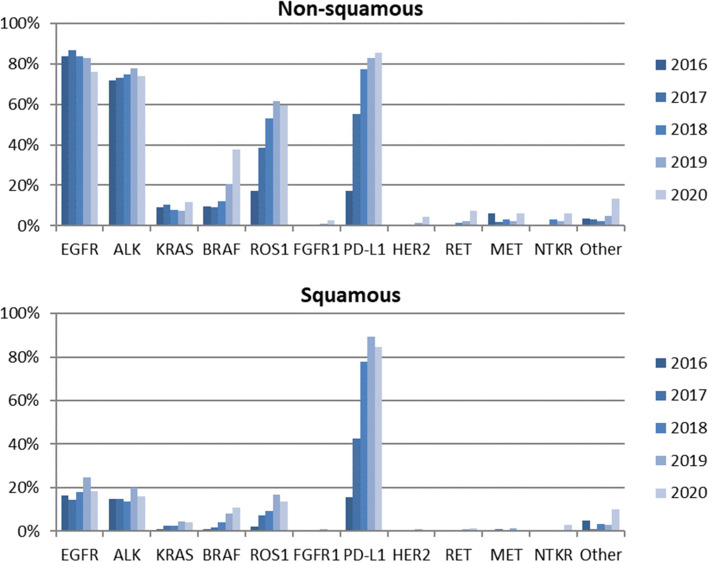
Nine thousand two hundred thirty-nine patients diagnosed with stage IV non-small cell lung cancer (NSCLC) between 2106 and 2020 were analysed. 7,467 (80.8%) were non-squamous and 1,772 (19.2%) were squamous. Tumour marker testing was performed in 85.0% of patients with non-squamous tumours vs 56.3% in those with squamous tumours (p-value < 0.001). The global testing of EGFR, ALK, and ROS1 was 78.9, 64.7, 35.6% respectively, in non-squamous histology. PDL1 was determined globally in the same period (46.9%), although if we focus on the last 3 years it exceeds 85%. There has been a significant increase in the last few years of all determinations and there are even close to 10% of molecular determinations that do not yet have targeted drug approval but will have it in the near future. 4,115 cases had a positive result (44.5%) for either EGFR, ALK, KRAS, BRAF, ROS1, or high PDL1.
Despite the lack of a national project and standard protocol in Spain that regulates the determination of biomarkers, the situation is similar to other European countries. Given the growing number of different determinations and their high positivity, national strategies are urgently needed to implement next-generation sequencing (NGS) in an integrated and cost-effective way in lung cancer.
过去十年,肺癌患者的生存率提高了约 15%。这一增长主要归因于晚期靶向治疗药物的出现和免疫疗法本身的出现。本研究旨在研究西班牙的生物标志物检测情况。
胸部肿瘤登记处(TTR)是一项观察性、前瞻性、基于登记的研究,纳入了 2016 年 9 月至 2020 年期间诊断为肺癌和其他胸部肿瘤的患者。这项 TTR 研究由西班牙肺癌小组(GECP)基金会赞助,该基金会是一个独立的、科学的、多学科的肿瘤学会,协调了西班牙境内 550 多名专家和 182 家医院。
分析了 2016 年至 2020 年间诊断为 IV 期非小细胞肺癌(NSCLC)的 9239 例患者。7467 例(80.8%)为非鳞状细胞癌,1772 例(19.2%)为鳞状细胞癌。非鳞状肿瘤患者的肿瘤标志物检测率为 85.0%,而鳞状肿瘤患者为 56.3%(p<0.001)。在非鳞状组织学中,EGFR、ALK 和 ROS1 的全球检测率分别为 78.9%、64.7%和 35.6%。同期,PDL1 也被全球确定(46.9%),但如果我们关注过去 3 年,其比例超过 85%。在过去几年中,所有的检测都有显著增加,甚至有近 10%的分子检测尚未获得靶向药物批准,但在不久的将来会获得批准。4115 例患者(44.5%)的 EGFR、ALK、KRAS、BRAF、ROS1 或高 PDL1 检测结果为阳性。
尽管西班牙缺乏监管生物标志物测定的国家项目和标准方案,但情况与其他欧洲国家相似。鉴于不同测定的数量不断增加且阳性率较高,迫切需要制定国家战略,以经济有效的方式在肺癌中实施下一代测序(NGS)。