Yang Jiaomei, Chang Qianqian, Tian Xueye, Zhang Binyan, Zeng Lingxia, Yan Hong, Dang Shaonong, Li Yue-Hua
Department of Epidemiology and Health Statistics, School of Public Health, Xi'an Jiaotong University Health Science Center, Xi'an, Shaanxi, China.
Department of Obstetrics and Gynaecology, The First Affiliated Hospital of Xi'an Jiaotong University, Xi'an, Shaanxi, China.
Nutr Metab (Lond). 2022 Jul 5;19(1):43. doi: 10.1186/s12986-022-00678-0.
Previous studies have yielded inconsistent results on the association between maternal dietary protein intake and birth weight. Moreover, little is known about the effects of dietary protein intake from different sources on fetal growth. This study aimed to investigate the associations of different dietary protein sources (total protein, animal protein, plant protein, and major dietary protein sources) during pregnancy with birth weight and the related adverse birth outcomes.
7310 women were recruited using a stratified multistage random sampling method at 0-12 months (median: 3; 10-90th percentile: 0-7) after delivery in Shaanxi, China. Maternal diets were gathered by a validated FFQ and other characteristics were collected by a standard questionnaire. Multilevel linear or logistic regression models were used to estimate birth weight changes or ORs (95% CIs) for adverse birth outcomes associated with different dietary protein sources during pregnancy.
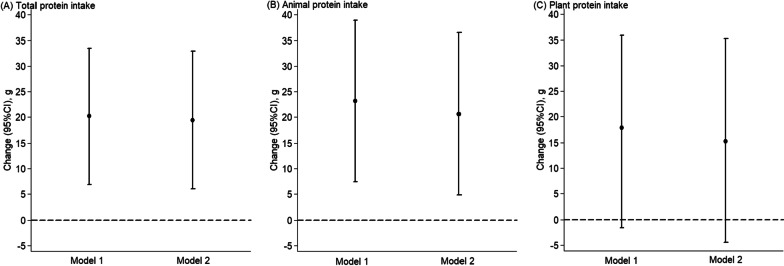
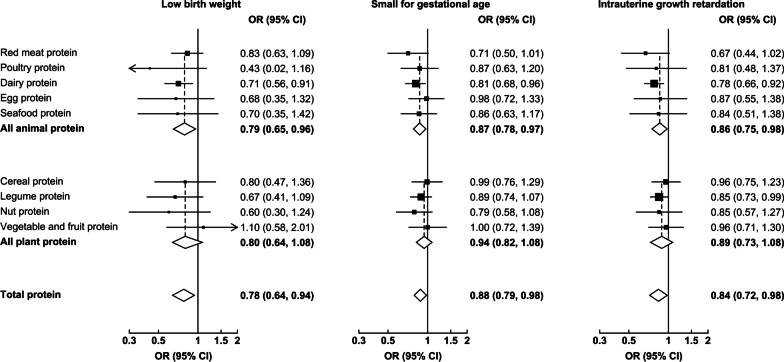
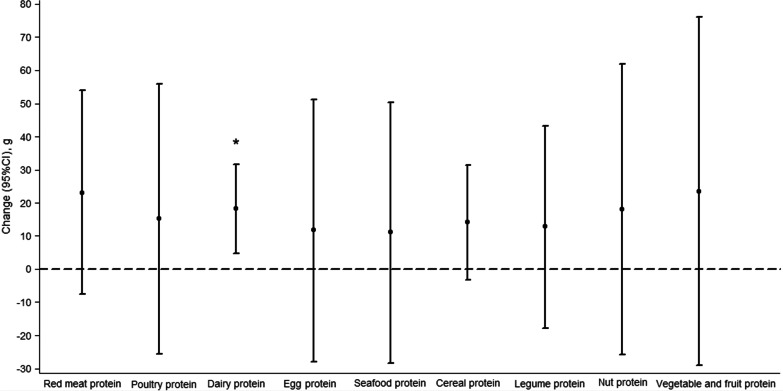
The mean percentage of energy from total protein was 11.4% (SD 2.2), with only 27.4% of total protein derived from animal protein. Per 3% increase in energy from total protein, animal protein, and dairy protein was associated with birth weight increases of 19.4 g (95% CI 6.0-32.9), 20.6 g (4.8-36.5), and 18.2 g (4.7-31.7), respectively. Per 3% increase in energy from total protein, animal protein, and dairy protein was also associated with lower risks of low birth weight (LBW) (total protein: OR = 0.78, 95% CI 0.64-0.94; animal protein: 0.79, 0.65-0.96; dairy protein: 0.71, 0.56-0.91), small for gestational age (SGA) (total protein: 0.88, 0.79-0.98; animal protein: 0.87, 0.78-0.97; dairy protein: 0.81, 0.68-0.96), and intrauterine growth retardation (IUGR) (total protein: 0.84, 0.72-0.98; animal protein: 0.86, 0.75-0.98; dairy protein: 0.78, 0.66-0.92). We observed no associations of plant protein and other major dietary protein sources with birth weight and the above birth outcomes. The results did not change when maternal protein was substituted for fat or carbohydrate.
Among Chinese pregnant women with low intake of protein, higher intake of dietary protein, in particular animal protein and dairy protein, is associated with higher birth weight and lower risks of LBW, SGA, and IUGR.
先前的研究在孕妇膳食蛋白质摄入量与出生体重之间的关联上得出了不一致的结果。此外,对于不同来源的膳食蛋白质摄入对胎儿生长的影响知之甚少。本研究旨在调查孕期不同膳食蛋白质来源(总蛋白质、动物蛋白、植物蛋白和主要膳食蛋白质来源)与出生体重及相关不良出生结局之间的关联。
在中国陕西,采用分层多阶段随机抽样方法,在产后0至12个月(中位数:3;第10 - 90百分位数:0 - 7)招募了7310名妇女。通过经过验证的食物频率问卷收集孕妇饮食情况,并通过标准问卷收集其他特征。使用多水平线性或逻辑回归模型来估计孕期不同膳食蛋白质来源与出生体重变化或不良出生结局的比值比(95%置信区间)。
总蛋白质提供的能量平均百分比为11.4%(标准差2.2),其中仅27.4%的总蛋白质来自动物蛋白。总蛋白质、动物蛋白和乳制品蛋白提供的能量每增加3%,分别与出生体重增加19.4克(95%置信区间6.0 - 32.9)、20.6克(4.8 - 36.5)和18.2克(4.7 - 31.7)相关。总蛋白质、动物蛋白和乳制品蛋白提供的能量每增加3%,还与低出生体重(LBW)风险降低相关(总蛋白质:比值比 = 0.78,95%置信区间0.64 - 0.94;动物蛋白:0.79,0.65 - 0.96;乳制品蛋白:0.71,0.56 - 0.91)、小于胎龄儿(SGA)风险降低相关(总蛋白质:0.88,0.79 - 0.98;动物蛋白:0.87,0.78 - 0.97;乳制品蛋白:0.81,0.68 - 0.96)以及宫内生长受限(IUGR)风险降低相关(总蛋白质:0.84,0.72 - 0.98;动物蛋白:0.86,0.75 - 0.98;乳制品蛋白:0.78,0.66 - 0.92)。我们未观察到植物蛋白和其他主要膳食蛋白质来源与出生体重及上述出生结局之间存在关联。当用母体蛋白质替代脂肪或碳水化合物时,结果没有变化。
在中国蛋白质摄入量较低的孕妇中,较高的膳食蛋白质摄入量,尤其是动物蛋白和乳制品蛋白的摄入量,与较高的出生体重以及较低的低出生体重、小于胎龄儿和宫内生长受限风险相关。