Carpena M, Garcia-Perez P, Garcia-Oliveira P, Chamorro F, Otero Paz, Lourenço-Lopes C, Cao Hui, Simal-Gandara J, Prieto M A
Nutrition and Bromatology Group, Department of Analytical Chemistry and Food Science, Faculty of Science, Universidade de Vigo, E-32004 Ourense, Spain.
Centro de Investigação de Montanha (CIMO), Instituto Politécnico de Bragança, Campus de Santa Apolonia, 5300-253 Bragança, Portugal.
Phytochem Rev. 2022 Jul 1:1-32. doi: 10.1007/s11101-022-09826-z.
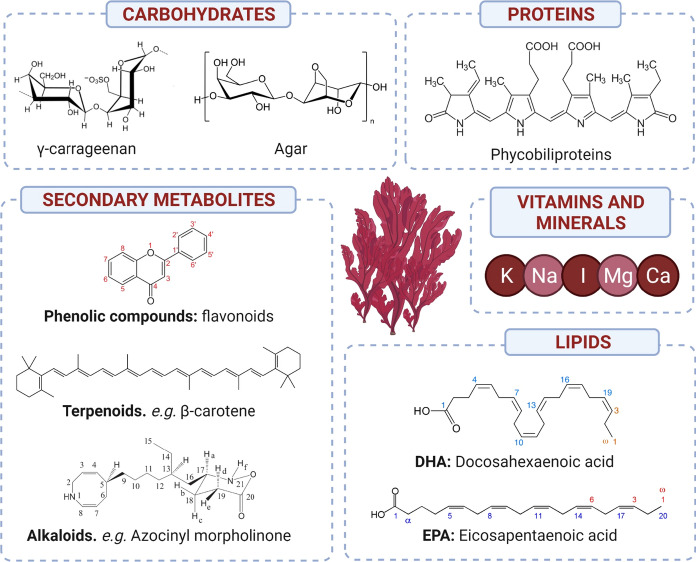
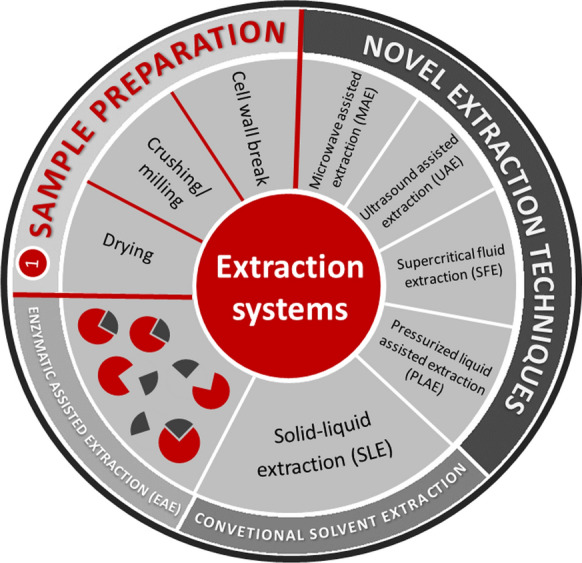
Macroalgae have been recently used for different applications in the food, cosmetic and pharmaceutical industry since they do not compete for land and freshwater against other resources. Moreover, they have been highlighted as a potential source of bioactive compounds. Red algae (Rhodophyta) are the largest group of seaweeds, including around 6000 different species, thus it can be hypothesized that they are a potential source of bioactive compounds. Sulfated polysaccharides, mainly agar and carrageenans, are the most relevant and exploited compounds of red algae. Other potential molecules are essential fatty acids, phycobiliproteins, vitamins, minerals, and other secondary metabolites. All these compounds have been demonstrated to exert several biological activities, among which antioxidant, anti-inflammatory, antitumor, and antimicrobial properties can be highlighted. Nevertheless, these properties need to be further tested on in vivo experiments and go in-depth in the study of the mechanism of action of the specific molecules and the understanding of the structure-activity relation. At last, the extraction technologies are essential for the correct isolation of the molecules, in a cost-effective way, to facilitate the scale-up of the processes and their further application by the industry. This manuscript is aimed at describing the fundamental composition of red algae and their most studied biological properties to pave the way to the utilization of this underused resource.
大型藻类最近已被用于食品、化妆品和制药行业的不同应用中,因为它们不与其他资源争夺土地和淡水。此外,它们已被视为生物活性化合物的潜在来源。红藻(红藻门)是最大的海藻群体,包括约6000个不同物种,因此可以推测它们是生物活性化合物的潜在来源。硫酸化多糖,主要是琼脂和卡拉胶,是红藻中最相关且被开发利用的化合物。其他潜在分子包括必需脂肪酸、藻胆蛋白、维生素、矿物质和其他次生代谢产物。所有这些化合物都已被证明具有多种生物活性,其中抗氧化、抗炎、抗肿瘤和抗菌特性尤为突出。然而,这些特性需要在体内实验中进一步测试,并深入研究特定分子的作用机制以及对结构-活性关系的理解。最后,提取技术对于以经济高效的方式正确分离分子至关重要,以便促进工艺的扩大规模及其在工业上的进一步应用。本手稿旨在描述红藻的基本组成及其研究最多的生物学特性,为利用这一未充分利用的资源铺平道路。