Waggershauser Cristian N, Taberlet Pierre, Coissac Eric, Kortland Kenny, Hambly Catherine, Lambin Xavier
School of Biological Sciences University of Aberdeen Aberdeen UK.
Laboratoire d'Ecologie Alpine, CNRS Université Grenoble Alpes Saint-Martin-d'Heres France.
Ecol Evol. 2022 Jul 3;12(7):e9029. doi: 10.1002/ece3.9029. eCollection 2022 Jul.
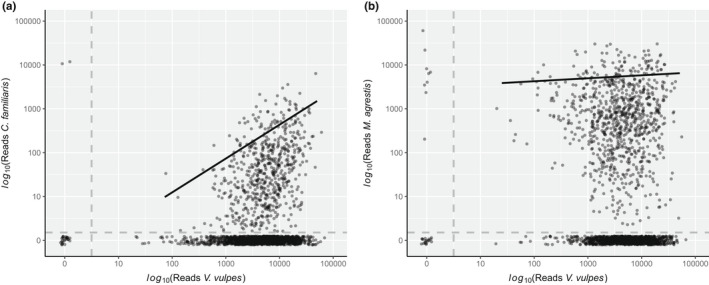
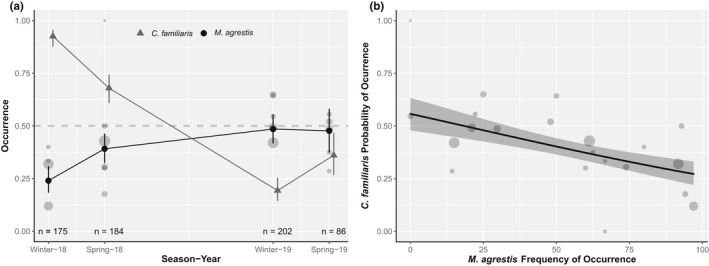
Vertebrate animals are known to consume other species' faeces, yet the role of such coprophagy in species dynamics remains unknown, not least due to the methodological challenges of documenting it. In a large-scale metabarcoding study of red fox and pine marten scats, we document a high occurrence of domestic dog DNA in red fox scats and investigate if it can be attributed to interspecific coprophagia. We tested whether experimental artifacts or other sources of DNA could account for dog DNA, regressed dog occurrence in the diet of fox against that of the fox's main prey, short-tailed field voles, and consider whether predation or scavenging could explain the presence of dog DNA. Additionally, we determined the calorific value of dog faeces through calorimetric explosion. The high occurrence of dog DNA in the diet of fox, the timing of its increase, and the negative relationship between dog and the fox's main prey, point to dog faeces as the source of DNA in fox scats. Dog faeces being highly calorific, we found that foxes, but not pine martens, regularly exploit them, seemingly as an alternative resource to fluctuating prey. Scattered accounts from the literature may suggest that interspecific coprophagia is a potentially frequent and widespread form of interaction among vertebrates. However, further work should address its prevalence in other systems and the implications for ecological communities. Tools such as metabarcoding offer a way forward.
脊椎动物会食用其他物种的粪便,然而这种食粪行为在物种动态中的作用仍然未知,尤其是因为记录它存在方法上的挑战。在一项对赤狐和松貂粪便的大规模代谢条形码研究中,我们记录到赤狐粪便中家犬DNA的高出现率,并研究其是否可归因于种间食粪行为。我们测试了实验假象或其他DNA来源是否能解释犬类DNA的存在,将狐狸饮食中犬类的出现频率与狐狸的主要猎物——短尾田鼠的出现频率进行回归分析,并考虑捕食或 scavenging(原文此处可能有误,推测为scavenging,意为食腐)是否能解释犬类DNA的存在。此外,我们通过量热爆炸测定了犬类粪便的热值。狐狸饮食中犬类DNA的高出现率、其增加的时间以及犬类与狐狸主要猎物之间的负相关关系,表明犬类粪便就是狐狸粪便中DNA的来源。由于犬类粪便具有高热量,我们发现狐狸会定期食用它们,而松貂则不会,这似乎是狐狸在猎物数量波动时的一种替代资源。文献中的零散记载可能表明种间食粪行为是脊椎动物之间一种潜在频繁且广泛的互动形式。然而,进一步的研究应探讨其在其他系统中的普遍性以及对生态群落的影响。代谢条形码等工具为未来的研究提供了一条途径。