Omoke Njoku Isaac, Ekumankama Francis Oji
Department of Surgery, Ebonyi State University/Federal Teaching Hospital, Abakaliki, Ebonyi State, Nigeria.
Department of Surgery, Federal Teaching Hospital, Abakaliki, Ebonyi State, Nigeria.
Niger J Surg. 2020 Jan-Jun;26(1):28-34. doi: 10.4103/njs.NJS_42_19. Epub 2020 Feb 10.
Extremity fracture is an important component of musculoskeletal injury worldwide. The distributions of etiological factors and types of extremity fractures vary from and within subregions and have implications in preventive and treatment strategies. This study aimed at determining the incidence and pattern of extremity fractures seen in accident and emergency department (A and ED) of a teaching hospital in a developing country.
This was a prospective study of all patients with extremity fractures seen in A and ED of Federal Teaching Hospital Abakaliki over 12 months between February 1, 2016 and January 31, 2017.
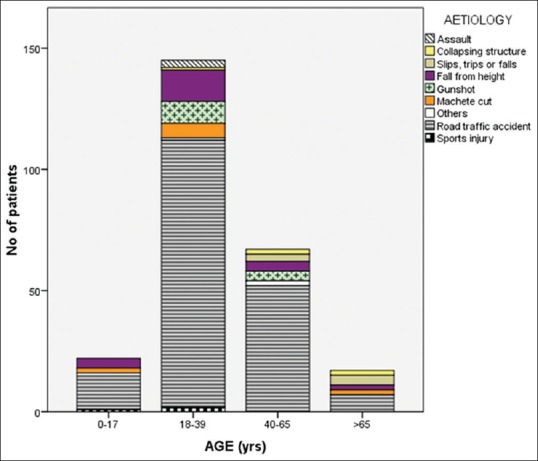
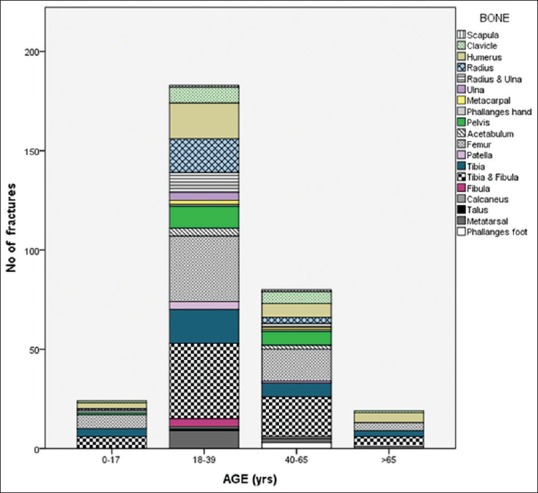
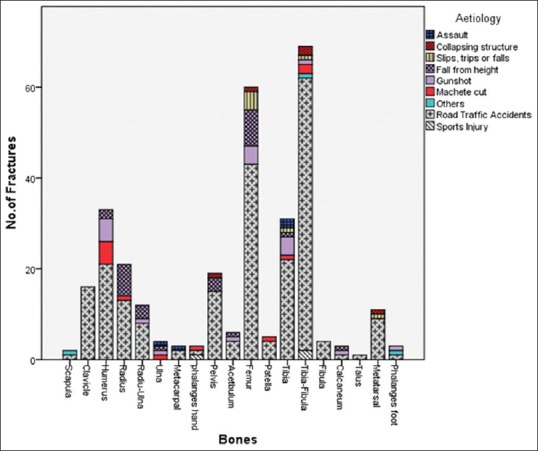
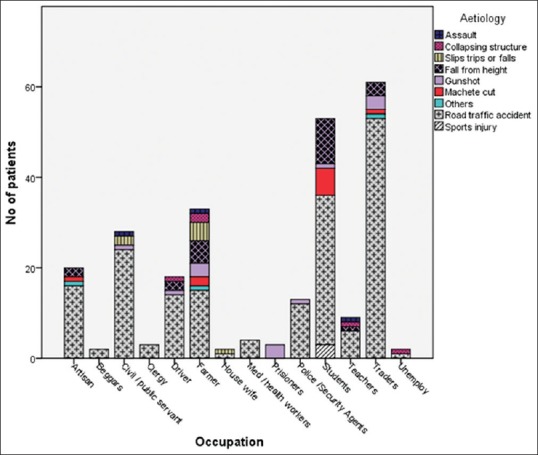
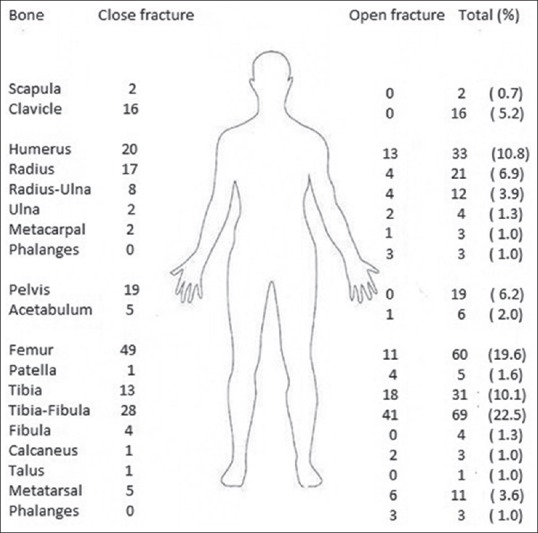
Extremity fractures necessitated visit in 251 patients with 306 fractures giving an incidence of 22.6/1000/year of A and ED attendances (39.2/1000 males and 9.2/1000 females), with age range of 2-90 years and a mean of 35.6 ± 16.7 years. Road traffic accident (RTA) (184, 73.3%), fall from height (23, 9.2%), and gunshot (13, 5.2%) were the three top causes of fractures, whereas tibia, femur, and humerus were three top bones involved. Of the 306 fractures, 270 (88%) involved the long bones, 193 (63.1%) were close, and 113 (36.9%) were open fractures. Forty-four (17.5%) of them were multiply injured patient and head injury in 32 (12.8%) the topmost associated injury. One hundred and ninety-four (77.3%) were admitted into surgical ward and 28 (11.2%) self-discharged against medical advice.
Appropriate preventive mechanisms based on the observed pattern is needed; a policy response to curb the menace of RTAs may invariably reduce the incidence of extremity fractures. Treatment strategies entail appropriate facilities and skilled workforce to deal with fractures of varying degrees of severity and complexity observed.
四肢骨折是全球肌肉骨骼损伤的重要组成部分。四肢骨折的病因和类型分布在不同次区域之间及内部存在差异,对预防和治疗策略具有重要意义。本研究旨在确定一家发展中国家教学医院急诊科所见四肢骨折的发病率和模式。
这是一项对2016年2月1日至2017年1月31日期间在阿巴卡利基联邦教学医院急诊科所见所有四肢骨折患者进行的前瞻性研究。
251例患者因四肢骨折前来就诊,共发生306处骨折,急诊科就诊患者中四肢骨折的发病率为每年22.6/1000(男性为39.2/1000,女性为9.2/1000),年龄范围为2至90岁,平均年龄为35.6±16.7岁。道路交通事故(RTA)(184例,73.3%)、高处坠落(23例,9.2%)和枪伤(13例,5.2%)是骨折的三大主要原因,而胫骨、股骨和肱骨是受累的三大主要骨骼。在306处骨折中,270处(88%)累及长骨,193处(63.1%)为闭合性骨折,113处(36.9%)为开放性骨折。其中44例(17.5%)为多发伤患者,最常见的相关损伤是32例(12.8%)头部受伤。194例(77.3%)患者入住外科病房,28例(11.2%)患者违反医嘱自行出院。
需要根据观察到的模式建立适当的预防机制;遏制道路交通事故威胁的政策应对措施可能会降低四肢骨折的发病率。治疗策略需要适当的设施和技术熟练的工作人员,以应对观察到的不同严重程度和复杂性的骨折。