• 文献检索
  • 文档翻译
  • 深度研究
  • 学术资讯
  • Suppr Zotero 插件Zotero 插件
  • 邀请有礼
  • 套餐&价格
  • 历史记录
应用&插件
Suppr Zotero 插件Zotero 插件浏览器插件Mac 客户端Windows 客户端微信小程序
定价
高级版会员购买积分包购买API积分包
服务
文献检索文档翻译深度研究API 文档MCP 服务
关于我们
关于 Suppr公司介绍联系我们用户协议隐私条款
关注我们

Suppr 超能文献

核心技术专利:CN118964589B侵权必究
粤ICP备2023148730 号-1Suppr @ 2026

文献检索

告别复杂PubMed语法,用中文像聊天一样搜索,搜遍4000万医学文献。AI智能推荐,让科研检索更轻松。

立即免费搜索

文件翻译

保留排版,准确专业,支持PDF/Word/PPT等文件格式,支持 12+语言互译。

免费翻译文档

深度研究

AI帮你快速写综述,25分钟生成高质量综述,智能提取关键信息,辅助科研写作。

立即免费体验

一种基于临床可解释计算机视觉的帕金森病步态量化方法。

A Clinically Interpretable Computer-Vision Based Method for Quantifying Gait in Parkinson's Disease.

机构信息

Machine Medicine Technologies Ltd., The Leather Market Unit 1.1.4, 11/13 Weston Street, London SE1 3ER, UK.

Department of Clinical and Movement Neurosciences, Institute of Neurology, University College London, Queen Square, London WC1N 3BG, UK.

出版信息

Sensors (Basel). 2021 Aug 12;21(16):5437. doi: 10.3390/s21165437.

DOI:10.3390/s21165437
PMID:34450879
原文链接:https://pmc.ncbi.nlm.nih.gov/articles/PMC8399017/
Abstract

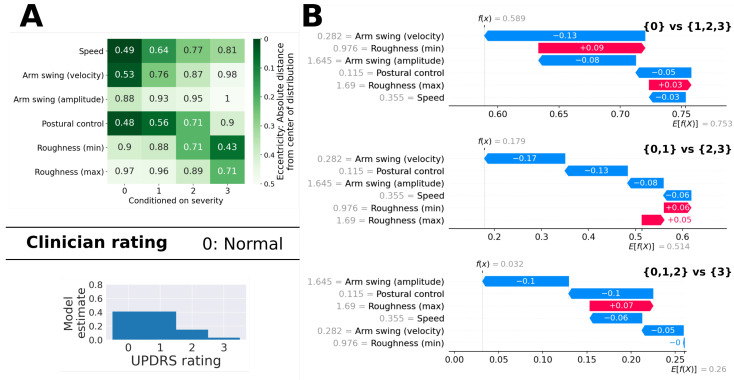
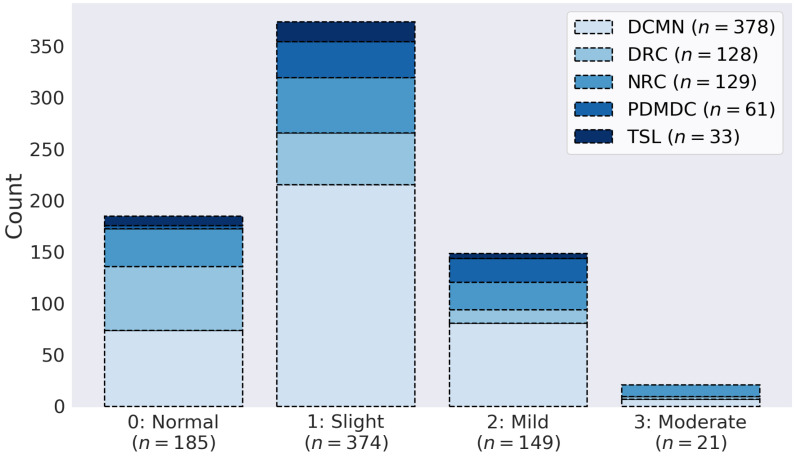
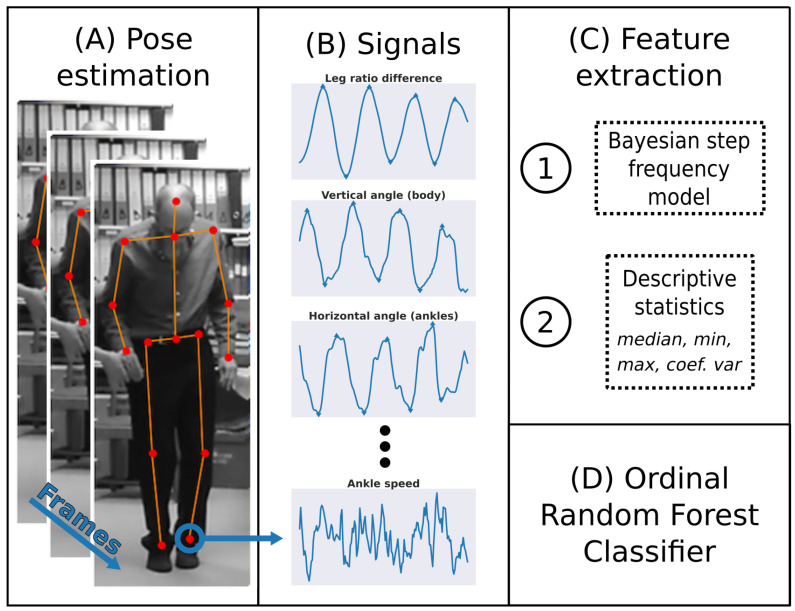
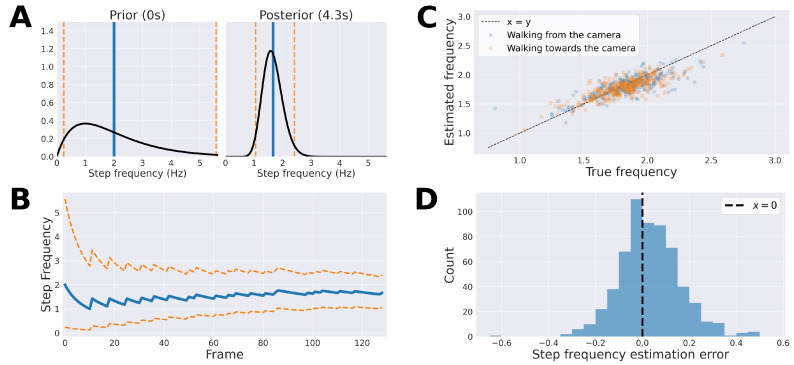
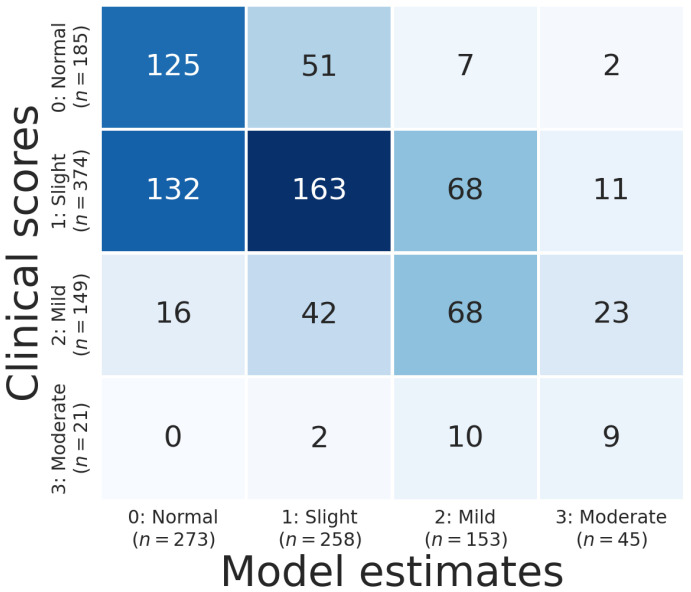
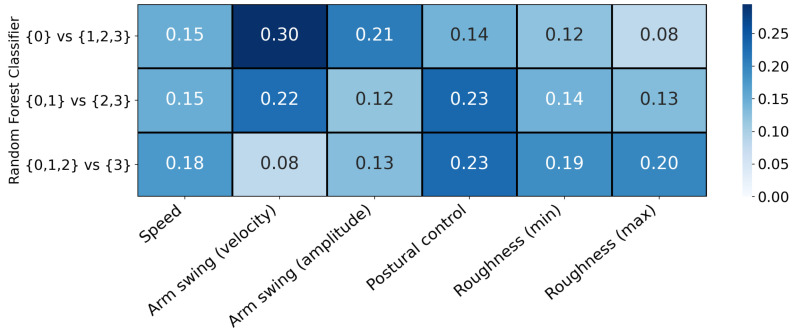
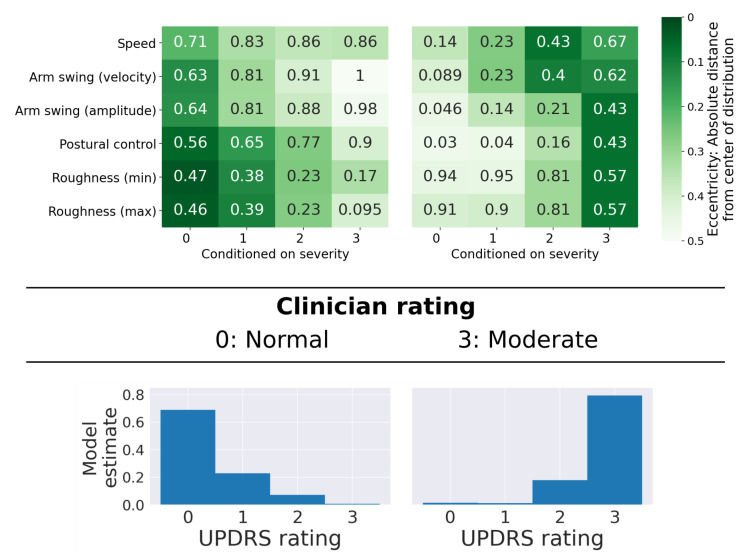
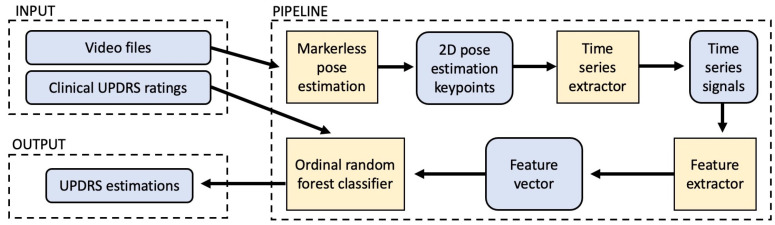
Gait is a core motor function and is impaired in numerous neurological diseases, including Parkinson's disease (PD). Treatment changes in PD are frequently driven by gait assessments in the clinic, commonly rated as part of the Movement Disorder Society (MDS) Unified PD Rating Scale (UPDRS) assessment (item 3.10). We proposed and evaluated a novel approach for estimating severity of gait impairment in Parkinson's disease using a computer vision-based methodology. The system we developed can be used to obtain an estimate for a rating to catch potential errors, or to gain an initial rating in the absence of a trained clinician-for example, during remote home assessments. Videos (n=729) were collected as part of routine MDS-UPDRS gait assessments of Parkinson's patients, and a deep learning library was used to extract body key-point coordinates for each frame. Data were recorded at five clinical sites using commercially available mobile phones or tablets, and had an associated severity rating from a trained clinician. Six features were calculated from time-series signals of the extracted key-points. These features characterized key aspects of the movement including speed (step frequency, estimated using a novel Gamma-Poisson Bayesian model), arm swing, postural control and smoothness (or roughness) of movement. An ordinal random forest classification model (with one class for each of the possible ratings) was trained and evaluated using 10-fold cross validation. Step frequency point estimates from the Bayesian model were highly correlated with manually labelled step frequencies of 606 video clips showing patients walking towards or away from the camera (Pearson's r=0.80, p<0.001). Our classifier achieved a balanced accuracy of 50% (chance = 25%). Estimated UPDRS ratings were within one of the clinicians' ratings in 95% of cases. There was a significant correlation between clinician labels and model estimates (Spearman's ρ=0.52, p<0.001). We show how the interpretability of the feature values could be used by clinicians to support their decision-making and provide insight into the model's objective UPDRS rating estimation. The severity of gait impairment in Parkinson's disease can be estimated using a single patient video, recorded using a consumer mobile device and within standard clinical settings; i.e., videos were recorded in various hospital hallways and offices rather than gait laboratories. This approach can support clinicians during routine assessments by providing an objective rating (or second opinion), and has the potential to be used for remote home assessments, which would allow for more frequent monitoring.

摘要

步态是一种核心运动功能,在许多神经疾病中都受到损害,包括帕金森病(PD)。PD 中的治疗变化通常由临床中的步态评估驱动,通常作为运动障碍协会(MDS)统一 PD 评分量表(UPDRS)评估的一部分进行评估(项目 3.10)。我们提出并评估了一种使用基于计算机视觉的方法来估计帕金森病步态障碍严重程度的新方法。我们开发的系统可用于获得评分估计值以捕捉潜在错误,或在没有经过培训的临床医生的情况下获得初始评分-例如,在远程家庭评估期间。视频(n=729)是作为帕金森病患者 MDS-UPDRS 步态评估的一部分收集的,并且使用深度学习库提取每个帧的身体关键点坐标。数据是使用商业上可用的移动电话或平板电脑在五个临床地点记录的,并具有经过培训的临床医生的相关严重程度评分。从提取关键点的时间序列信号中计算了六个特征。这些特征描述了运动的关键方面,包括速度(使用新的伽马泊松贝叶斯模型估计的步频)、手臂摆动、姿势控制和运动的平滑度(或粗糙度)。使用 10 倍交叉验证训练和评估了一个有序随机森林分类模型(每个可能的评分一个类)。贝叶斯模型的步频点估计值与显示患者向相机或远离相机行走的 606 个视频剪辑的手动标记步频高度相关(Pearson r=0.80,p<0.001)。我们的分类器达到了 50%的平衡准确性(机会=25%)。在 95%的情况下,估计的 UPDRS 评分与临床医生的评分相差一位。临床医生标签和模型估计值之间存在显著相关性(Spearman ρ=0.52,p<0.001)。我们展示了临床医生如何使用特征值的可解释性来支持他们的决策,并深入了解模型的客观 UPDRS 评分估计。可以使用单个患者视频,使用消费类移动设备并在标准临床环境中记录来估计帕金森病患者的步态障碍严重程度;即,视频是在各种医院走廊和办公室而不是步态实验室中记录的。这种方法可以通过提供客观评分(或第二意见)来支持临床医生进行常规评估,并有可能用于远程家庭评估,从而可以更频繁地进行监测。
https://cdn.ncbi.nlm.nih.gov/pmc/blobs/fbf3/8399017/b35dc542e7cf/sensors-21-05437-g011.jpg
https://cdn.ncbi.nlm.nih.gov/pmc/blobs/fbf3/8399017/605d8af9f9bc/sensors-21-05437-g001.jpg
https://cdn.ncbi.nlm.nih.gov/pmc/blobs/fbf3/8399017/946f107998a1/sensors-21-05437-g002.jpg
https://cdn.ncbi.nlm.nih.gov/pmc/blobs/fbf3/8399017/6b4390332acc/sensors-21-05437-g003.jpg
https://cdn.ncbi.nlm.nih.gov/pmc/blobs/fbf3/8399017/e9d6b34aa2bd/sensors-21-05437-g004.jpg
https://cdn.ncbi.nlm.nih.gov/pmc/blobs/fbf3/8399017/b6d3c3fe2ecf/sensors-21-05437-g005.jpg
https://cdn.ncbi.nlm.nih.gov/pmc/blobs/fbf3/8399017/89b721c6ffeb/sensors-21-05437-g006.jpg
https://cdn.ncbi.nlm.nih.gov/pmc/blobs/fbf3/8399017/628165b156ff/sensors-21-05437-g007.jpg
https://cdn.ncbi.nlm.nih.gov/pmc/blobs/fbf3/8399017/2285c378cbdb/sensors-21-05437-g008.jpg
https://cdn.ncbi.nlm.nih.gov/pmc/blobs/fbf3/8399017/c55a913c25f4/sensors-21-05437-g009.jpg
https://cdn.ncbi.nlm.nih.gov/pmc/blobs/fbf3/8399017/be2155c2f321/sensors-21-05437-g010.jpg
https://cdn.ncbi.nlm.nih.gov/pmc/blobs/fbf3/8399017/b35dc542e7cf/sensors-21-05437-g011.jpg
https://cdn.ncbi.nlm.nih.gov/pmc/blobs/fbf3/8399017/605d8af9f9bc/sensors-21-05437-g001.jpg
https://cdn.ncbi.nlm.nih.gov/pmc/blobs/fbf3/8399017/946f107998a1/sensors-21-05437-g002.jpg
https://cdn.ncbi.nlm.nih.gov/pmc/blobs/fbf3/8399017/6b4390332acc/sensors-21-05437-g003.jpg
https://cdn.ncbi.nlm.nih.gov/pmc/blobs/fbf3/8399017/e9d6b34aa2bd/sensors-21-05437-g004.jpg
https://cdn.ncbi.nlm.nih.gov/pmc/blobs/fbf3/8399017/b6d3c3fe2ecf/sensors-21-05437-g005.jpg
https://cdn.ncbi.nlm.nih.gov/pmc/blobs/fbf3/8399017/89b721c6ffeb/sensors-21-05437-g006.jpg
https://cdn.ncbi.nlm.nih.gov/pmc/blobs/fbf3/8399017/628165b156ff/sensors-21-05437-g007.jpg
https://cdn.ncbi.nlm.nih.gov/pmc/blobs/fbf3/8399017/2285c378cbdb/sensors-21-05437-g008.jpg
https://cdn.ncbi.nlm.nih.gov/pmc/blobs/fbf3/8399017/c55a913c25f4/sensors-21-05437-g009.jpg
https://cdn.ncbi.nlm.nih.gov/pmc/blobs/fbf3/8399017/be2155c2f321/sensors-21-05437-g010.jpg
https://cdn.ncbi.nlm.nih.gov/pmc/blobs/fbf3/8399017/b35dc542e7cf/sensors-21-05437-g011.jpg

相似文献

1
A Clinically Interpretable Computer-Vision Based Method for Quantifying Gait in Parkinson's Disease.一种基于临床可解释计算机视觉的帕金森病步态量化方法。
Sensors (Basel). 2021 Aug 12;21(16):5437. doi: 10.3390/s21165437.
2
Quantifying Parkinson's disease motor severity under uncertainty using MDS-UPDRS videos.使用 MDS-UPDRS 视频对帕金森病运动严重程度进行不确定性量化。
Med Image Anal. 2021 Oct;73:102179. doi: 10.1016/j.media.2021.102179. Epub 2021 Jul 21.
3
Gait video-based prediction of unified Parkinson's disease rating scale score: a retrospective study.基于步态视频的统一帕金森病评定量表评分预测:一项回顾性研究。
BMC Neurol. 2023 Oct 5;23(1):358. doi: 10.1186/s12883-023-03385-2.
4
A low-cost vision system based on the analysis of motor features for recognition and severity rating of Parkinson's Disease.基于运动特征分析的低成本视觉系统,用于识别和严重程度评估帕金森病。
BMC Med Inform Decis Mak. 2019 Dec 12;19(Suppl 9):243. doi: 10.1186/s12911-019-0987-5.
5
Machine learning-based motor assessment of Parkinson's disease using postural sway, gait and lifestyle features on crowdsourced smartphone data.基于机器学习的帕金森病运动评估,使用众包智能手机数据的姿势摆动、步态和生活方式特征。
Biomed Phys Eng Express. 2020 Mar 4;6(3):035005. doi: 10.1088/2057-1976/ab39a8.
6
Can Gait Features Help in Differentiating Parkinson's Disease Medication States and Severity Levels? A Machine Learning Approach.步态特征能否有助于区分帕金森病的药物状态和严重程度?一种机器学习方法。
Sensors (Basel). 2022 Dec 16;22(24):9937. doi: 10.3390/s22249937.
7
Automatic labeling of Parkinson's Disease gait videos with weak supervision.帕金森病步态视频的弱监督自动标注。
Med Image Anal. 2023 Oct;89:102871. doi: 10.1016/j.media.2023.102871. Epub 2023 Jun 25.
8
Predicting the Progression of Parkinson's Disease MDS-UPDRS-III Motor Severity Score from Gait Data using Deep Learning.利用深度学习从步态数据预测帕金森病MDS-UPDRS-III运动严重程度评分的进展情况
Annu Int Conf IEEE Eng Med Biol Soc. 2021 Nov;2021:249-252. doi: 10.1109/EMBC46164.2021.9630769.
9
Treatment Detection and Movement Disorder Society-Unified Parkinson's Disease Rating Scale, Part III Estimation Using Finger Tapping Tasks.使用手指叩击任务评估治疗检测与运动障碍学会-统一帕金森病评定量表第三部分。
Mov Disord. 2023 Oct;38(10):1795-1805. doi: 10.1002/mds.29520. Epub 2023 Jul 4.
10
A novel method for automatic classification of Parkinson gait severity using front-view video analysis.一种使用正视图视频分析对帕金森步态严重程度进行自动分类的新方法。
Technol Health Care. 2021;29(4):643-653. doi: 10.3233/THC-191960.

引用本文的文献

1
Modeling and optimizing deep brain stimulation to enhance gait in Parkinson's disease: personalized treatment with neurophysiological insights.帕金森病中模拟和优化深部脑刺激以改善步态:基于神经生理学见解的个性化治疗
NPJ Parkinsons Dis. 2025 Jun 18;11(1):173. doi: 10.1038/s41531-025-00990-5.
2
Modernizing the Staging of Parkinson Disease Using Digital Health Technology.利用数字健康技术实现帕金森病分期的现代化。
J Med Internet Res. 2025 Apr 4;27:e63105. doi: 10.2196/63105.
3
Towards Transforming Neurorehabilitation: The Impact of Artificial Intelligence on Diagnosis and Treatment of Neurological Disorders.

本文引用的文献

1
An Enhanced Joint Hilbert Embedding-Based Metric to Support Mocap Data Classification with Preserved Interpretability.基于增强型联合希尔伯特嵌入的度量方法,支持具有可解释性保持的运动捕捉数据分类。
Sensors (Basel). 2021 Jun 29;21(13):4443. doi: 10.3390/s21134443.
2
Two-dimensional video-based analysis of human gait using pose estimation.基于二维视频的人体步态姿势估计分析。
PLoS Comput Biol. 2021 Apr 23;17(4):e1008935. doi: 10.1371/journal.pcbi.1008935. eCollection 2021 Apr.
3
Vision-based Estimation of MDS-UPDRS Gait Scores for Assessing Parkinson's Disease Motor Severity.
迈向变革性神经康复:人工智能对神经系统疾病诊断和治疗的影响。
Biomedicines. 2024 Oct 21;12(10):2415. doi: 10.3390/biomedicines12102415.
4
The Role of Deep Learning and Gait Analysis in Parkinson's Disease: A Systematic Review.深度学习和步态分析在帕金森病中的作用:系统评价。
Sensors (Basel). 2024 Sep 13;24(18):5957. doi: 10.3390/s24185957.
5
Markerless Motion Capture to Quantify Functional Performance in Neurodegeneration: Systematic Review.无标记运动捕捉在神经退行性疾病中的功能表现量化:系统综述。
JMIR Aging. 2024 Aug 6;7:e52582. doi: 10.2196/52582.
6
Integrating OpenPose and SVM for Quantitative Postural Analysis in Young Adults: A Temporal-Spatial Approach.整合OpenPose和支持向量机用于年轻人的定量姿势分析:一种时空方法。
Bioengineering (Basel). 2024 May 28;11(6):548. doi: 10.3390/bioengineering11060548.
7
Interpretable video-based tracking and quantification of parkinsonism clinical motor states.基于视频的帕金森病临床运动状态的可解释跟踪与量化
NPJ Parkinsons Dis. 2024 Jun 25;10(1):122. doi: 10.1038/s41531-024-00742-x.
8
FastEval Parkinsonism: an instant deep learning-assisted video-based online system for Parkinsonian motor symptom evaluation.快速评估帕金森病:一种即时的基于深度学习辅助视频的帕金森运动症状在线评估系统。
NPJ Digit Med. 2024 Feb 8;7(1):31. doi: 10.1038/s41746-024-01022-x.
9
Evaluating the ability of a predictive vision-based machine learning model to measure changes in gait in response to medication and DBS within individuals with Parkinson's disease.评估基于预测性视觉的机器学习模型在个体帕金森病患者中测量药物和 DBS 反应引起的步态变化的能力。
Biomed Eng Online. 2023 Dec 11;22(1):120. doi: 10.1186/s12938-023-01175-y.
10
A systematic review of the applications of markerless motion capture (MMC) technology for clinical measurement in rehabilitation.基于无标记运动捕捉(MMC)技术的临床康复测量应用的系统综述。
J Neuroeng Rehabil. 2023 May 2;20(1):57. doi: 10.1186/s12984-023-01186-9.
基于视觉的MDS-UPDRS步态评分估计用于评估帕金森病运动严重程度
Med Image Comput Comput Assist Interv. 2020 Oct;12263:637-647. doi: 10.1007/978-3-030-59716-0_61. Epub 2020 Sep 29.
4
Interpretability of Input Representations for Gait Classification in Patients after Total Hip Arthroplasty.全髋关节置换术后步态分类中输入表示的可解释性。
Sensors (Basel). 2020 Aug 6;20(16):4385. doi: 10.3390/s20164385.
5
Assessment of Parkinsonian gait in older adults with dementia via human pose tracking in video data.利用视频数据中的人体姿态跟踪评估老年痴呆症患者的帕金森步态。
J Neuroeng Rehabil. 2020 Jul 14;17(1):97. doi: 10.1186/s12984-020-00728-9.
6
From Local Explanations to Global Understanding with Explainable AI for Trees.利用可解释人工智能实现从局部解释到树木的全局理解
Nat Mach Intell. 2020 Jan;2(1):56-67. doi: 10.1038/s42256-019-0138-9. Epub 2020 Jan 17.
7
Gait Analysis in Parkinson's Disease: An Overview of the Most Accurate Markers for Diagnosis and Symptoms Monitoring.帕金森病步态分析:用于诊断和症状监测的最准确标志物概述。
Sensors (Basel). 2020 Jun 22;20(12):3529. doi: 10.3390/s20123529.
8
Two-dimensional video gait analysis: A systematic review of reliability, validity, and best practice considerations.二维视频步态分析:可靠性、有效性及最佳实践考虑因素的系统评价。
Prosthet Orthot Int. 2020 Aug;44(4):245-262. doi: 10.1177/0309364620921290. Epub 2020 Jun 7.
9
Selecting Clinically Relevant Gait Characteristics for Classification of Early Parkinson's Disease: A Comprehensive Machine Learning Approach.选择具有临床相关性的步态特征用于早期帕金森病分类:一种全面的机器学习方法。
Sci Rep. 2019 Nov 21;9(1):17269. doi: 10.1038/s41598-019-53656-7.
10
OpenPose: Realtime Multi-Person 2D Pose Estimation Using Part Affinity Fields.OpenPose:基于部件亲和力字段的实时多人 2D 姿态估计。
IEEE Trans Pattern Anal Mach Intell. 2021 Jan;43(1):172-186. doi: 10.1109/TPAMI.2019.2929257. Epub 2020 Dec 4.