Department of Biomedical and Chemical Engineering and SciencesFlorida Institute of Technology Melbourne FL 32901 USA.
Department of Biomedical EngineeringRutgers University New Brunswick NJ 08901 USA.
IEEE J Transl Eng Health Med. 2022 Jun 2;10:4901008. doi: 10.1109/JTEHM.2022.3179874. eCollection 2022.
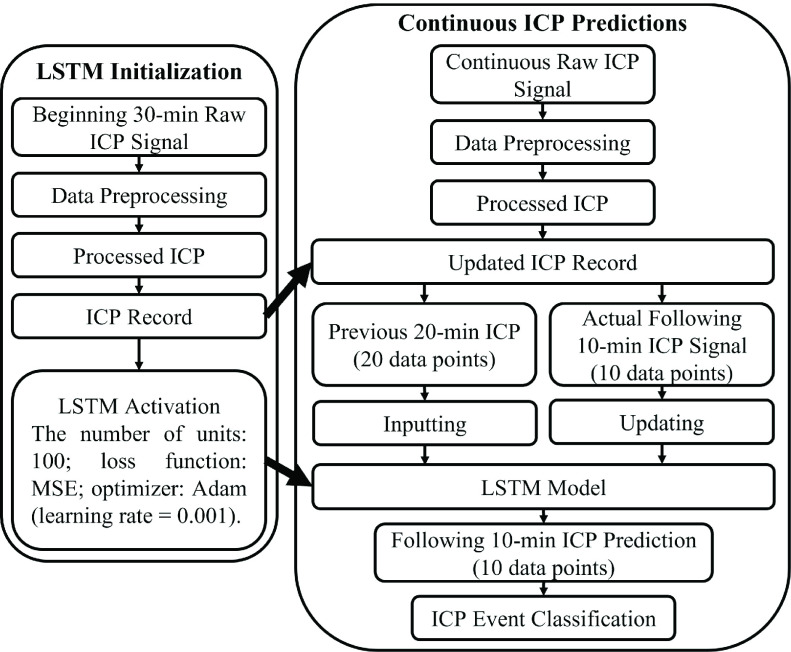
: Abnormal elevation of intracranial pressure (ICP) can cause dangerous or even fatal outcomes. The early detection of high intracranial pressure events can be crucial in saving lives in an intensive care unit (ICU). Despite many applications of machine learning (ML) techniques related to clinical diagnosis, ML applications for continuous ICP detection or short-term predictions have been rarely reported. This study proposes an efficient method of applying an artificial recurrent neural network on the early prediction of ICP evaluation continuously for TBI patients. : After ICP data preprocessing, the learning model is generated for thirteen patients to continuously predict the ICP signal occurrence and classify events for the upcoming 10 minutes by inputting the previous 20-minutes of the ICP signal. : As the overall model performance, the average accuracy is 94.62%, the average sensitivity is 74.91%, the average specificity is 94.83%, and the average root mean square error is approximately 2.18 mmHg. : This research addresses a significant clinical problem with the management of traumatic brain injury patients. The machine learning model data enables early prediction of ICP continuously in a real-time fashion, which is crucial for appropriate clinical interventions. The results show that our machine learning-based model has high adaptive performance, accuracy, and efficiency.
颅内压(ICP)异常升高可导致危险甚至致命后果。在重症监护病房(ICU)中,尽早发现颅内压升高事件对于挽救生命至关重要。尽管机器学习(ML)技术在临床诊断中有许多应用,但用于连续 ICP 检测或短期预测的 ML 应用却很少有报道。本研究提出了一种有效的方法,即将人工递归神经网络应用于 TBI 患者的 ICP 评估的早期预测。
在 ICP 数据预处理后,为十三名患者生成学习模型,通过输入 ICP 信号的前 20 分钟来连续预测 ICP 信号的发生,并对接下来的 10 分钟进行分类。
作为整体模型性能,平均准确率为 94.62%,平均灵敏度为 74.91%,平均特异性为 94.83%,平均均方根误差约为 2.18mmHg。
本研究解决了外伤性脑损伤患者管理中的一个重大临床问题。机器学习模型数据可实时连续预测 ICP,这对于适当的临床干预至关重要。结果表明,我们的基于机器学习的模型具有较高的自适应性能、准确性和效率。