Department of Internal Medicine, Division of Nephrology, University of Groningen, University Medical Center Groningen, Groningen, The Netherlands.
Department of Viroscience, Erasmus Medical Center, Rotterdam, The Netherlands.
Clin Infect Dis. 2023 Feb 8;76(3):e188-e199. doi: 10.1093/cid/ciac557.
The immune response to COVID-19 vaccination is inferior in kidney transplant recipients (KTRs) and to a lesser extent in patients on dialysis or with chronic kidney disease (CKD). We assessed the immune response 6 months after mRNA-1273 vaccination in kidney patients and compared this to controls.
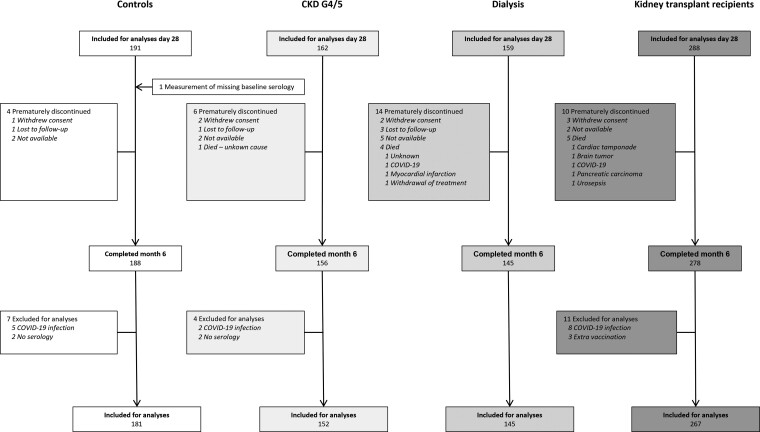
A total of 152 participants with CKD stages G4/5 (eGFR <30 mL/min/1.73 m2), 145 participants on dialysis, 267 KTRs, and 181 controls were included. SARS-CoV-2 Spike S1 specific IgG antibodies were measured using fluorescent bead-based multiplex-immunoassay, neutralizing antibodies to ancestral, Delta, and Omicron (BA.1) variants by plaque reduction, and T-cell responses by interferon-γ release assay.
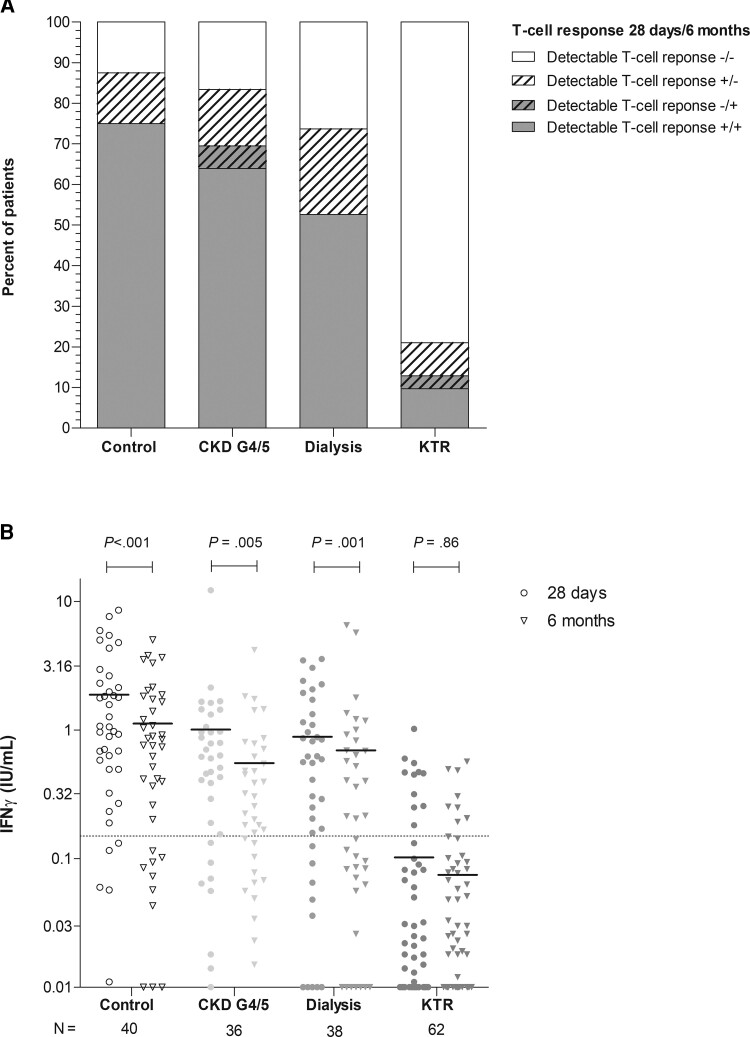
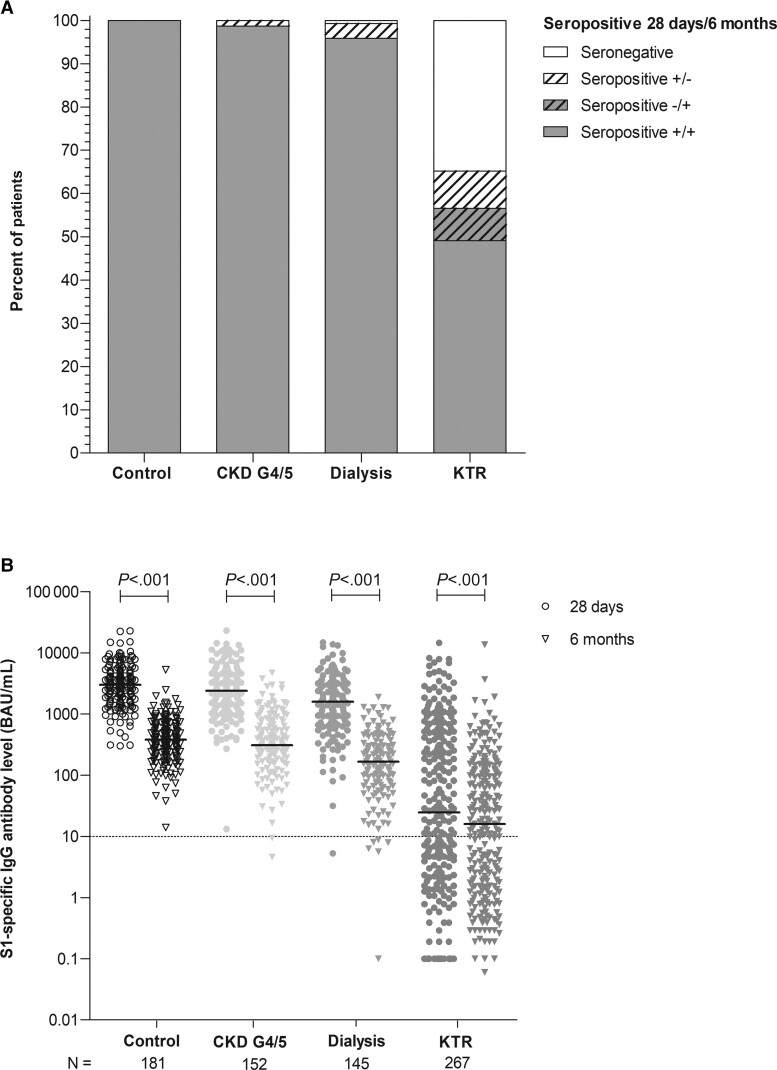
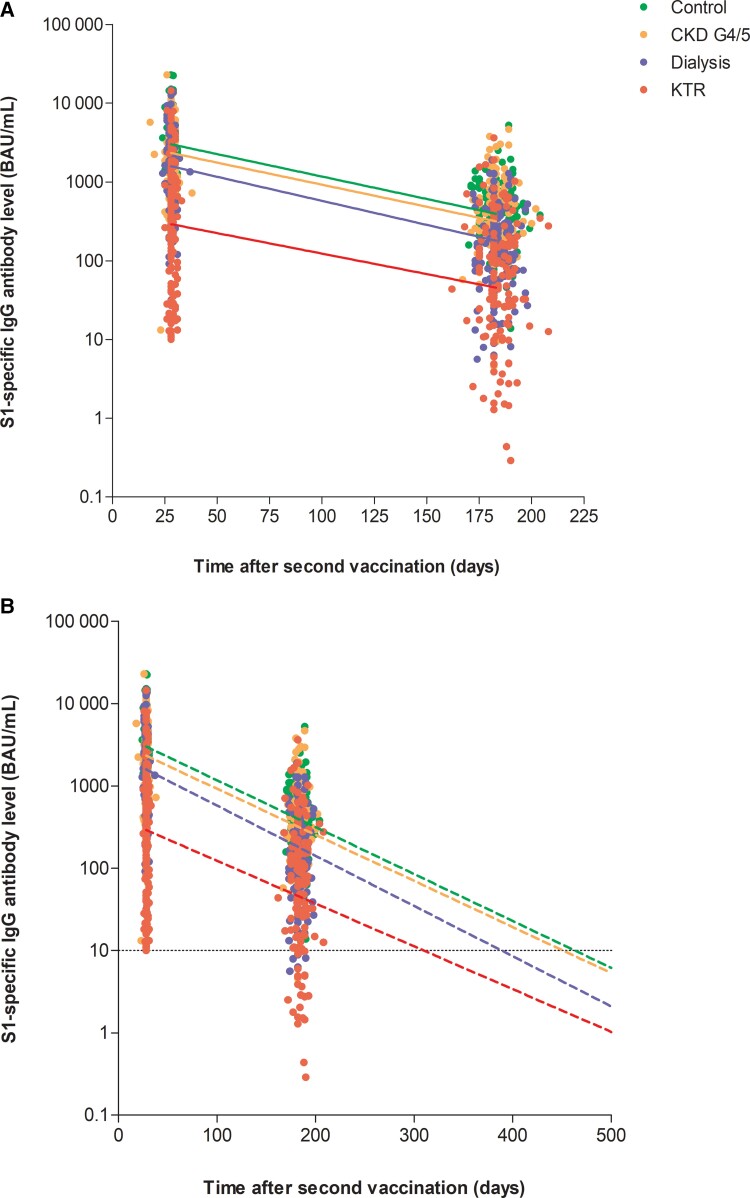
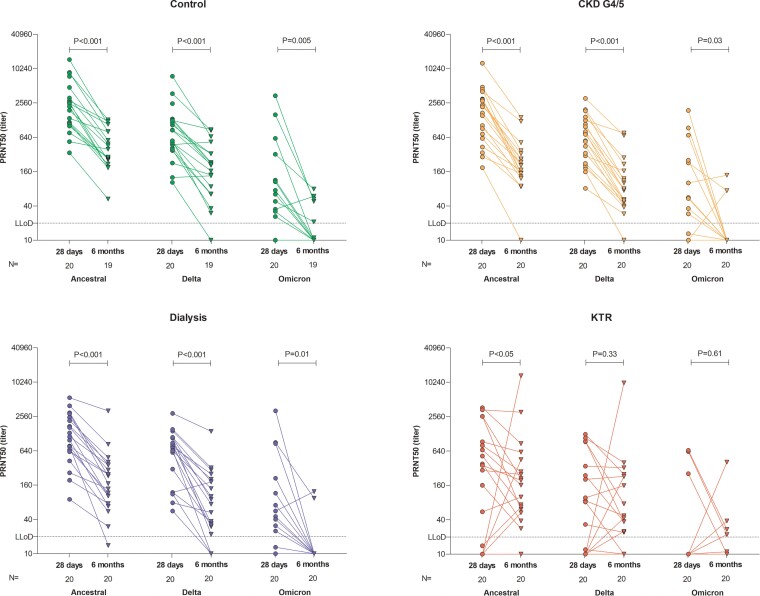
At 6 months after vaccination, S1-specific antibodies were detected in 100% of controls, 98.7% of CKD G4/5 patients, 95.1% of dialysis patients, and 56.6% of KTRs. These figures were comparable to the response rates at 28 days, but antibody levels waned significantly. Neutralization of the ancestral and Delta variants was detected in most participants, whereas neutralization of Omicron was mostly absent. S-specific T-cell responses were detected at 6 months in 75.0% of controls, 69.4% of CKD G4/5 patients, 52.6% of dialysis patients, and 12.9% of KTRs. T-cell responses at 6 months were significantly lower than responses at 28 days.
Although seropositivity rates at 6 months were comparable to rates at 28 days after vaccination, significantly decreased antibody levels and T-cell responses were observed. The combination of low antibody levels, reduced T-cell responses, and absent neutralization of the newly emerging variants indicates the need for additional boosts or alternative vaccination strategies in KTRs.
NCT04741386.
COVID-19 疫苗接种在肾移植受者(KTR)中的免疫反应较差,在透析患者或慢性肾脏病(CKD)患者中的免疫反应较差。我们评估了肾患者接种 mRNA-1273 疫苗 6 个月后的免疫反应,并将其与对照组进行了比较。
共纳入 152 名 CKD 分期 G4/5(eGFR<30 mL/min/1.73 m2)患者、145 名透析患者、267 名 KTR 和 181 名对照者。使用荧光珠基多重免疫分析测定 SARS-CoV-2 刺突 S1 特异性 IgG 抗体,通过蚀斑减少法测定针对原始、Delta 和奥密克戎(BA.1)变异株的中和抗体,通过干扰素-γ释放试验测定 T 细胞反应。
接种后 6 个月,对照组、CKD G4/5 患者、透析患者和 KTR 的 S1 特异性抗体分别为 100%、98.7%、95.1%和 56.6%。这些数字与 28 天时的反应率相当,但抗体水平显著下降。大多数参与者检测到对原始和 Delta 变异株的中和作用,而对奥密克戎的中和作用大多不存在。6 个月时,对照组、CKD G4/5 患者、透析患者和 KTR 的 S 特异性 T 细胞反应分别为 75.0%、69.4%、52.6%和 12.9%。6 个月时的 T 细胞反应明显低于 28 天时的反应。
尽管 6 个月时的血清阳性率与接种后 28 天时的血清阳性率相当,但观察到抗体水平和 T 细胞反应显著下降。新出现的变异株低抗体水平、减少的 T 细胞反应和中和作用缺失表明 KTR 需要额外的加强针或替代疫苗接种策略。
NCT04741386。