Friedman School of Nutrition Science and Policy, Tufts University, Boston, Massachusetts, USA.
Friedman School of Nutrition Science and Policy, Tufts University, Boston, Massachusetts, USA.
J Am Coll Cardiol. 2022 Jul 12;80(2):138-151. doi: 10.1016/j.jacc.2022.04.046.
Few studies have assessed U.S. cardiometabolic health trends-optimal levels of multiple risk factors and absence of clinical cardiovascular disease (CVD)-or its impact on health disparities.
The purpose of this study was to investigate U.S. trends in optimal cardiometabolic health from 1999 to 2018.
We assessed proportions of adults with optimal cardiometabolic health, based on adiposity, blood glucose, blood lipids, blood pressure, and clinical CVD; and optimal, intermediate, and poor levels of each component among 55,081 U.S. adults in the National Health and Nutrition Examination Survey.
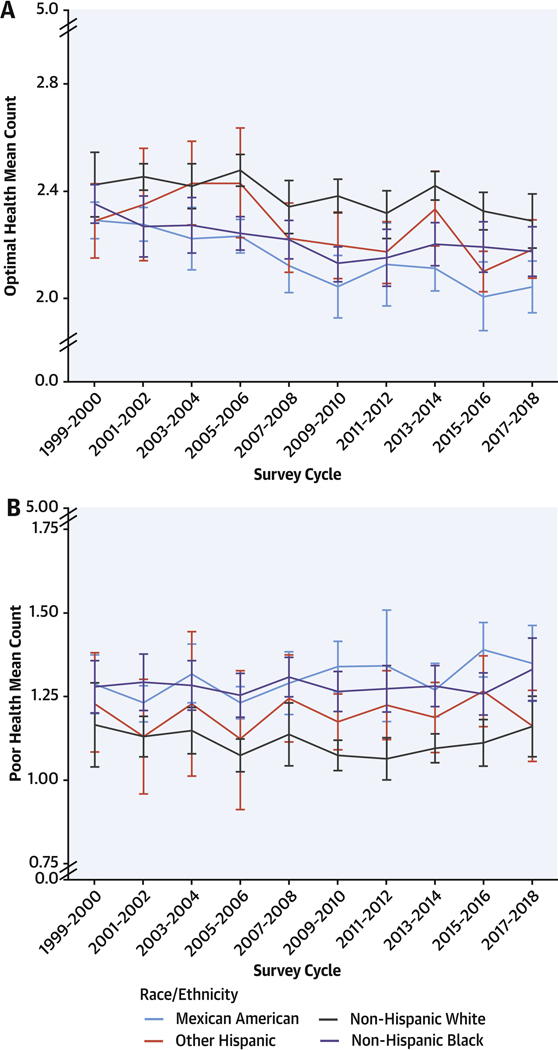
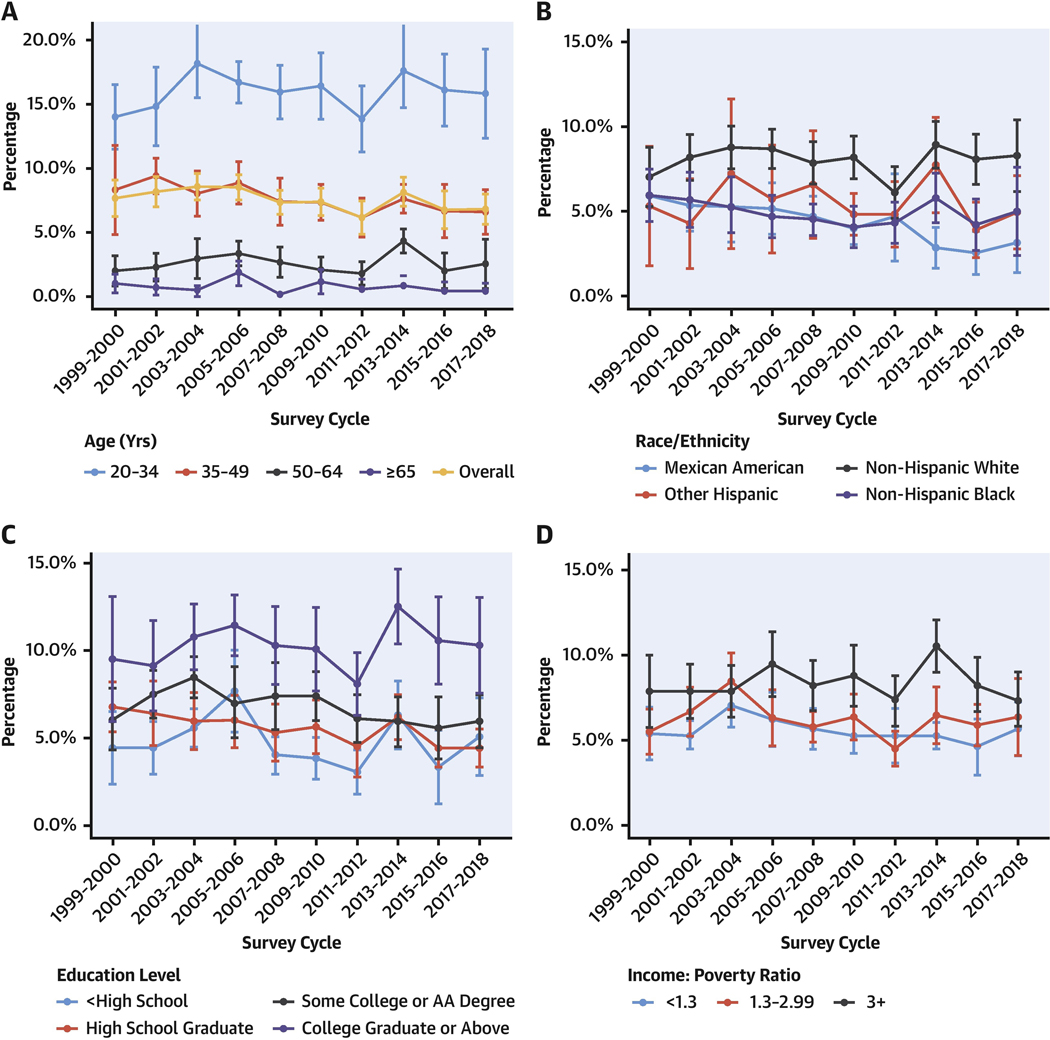
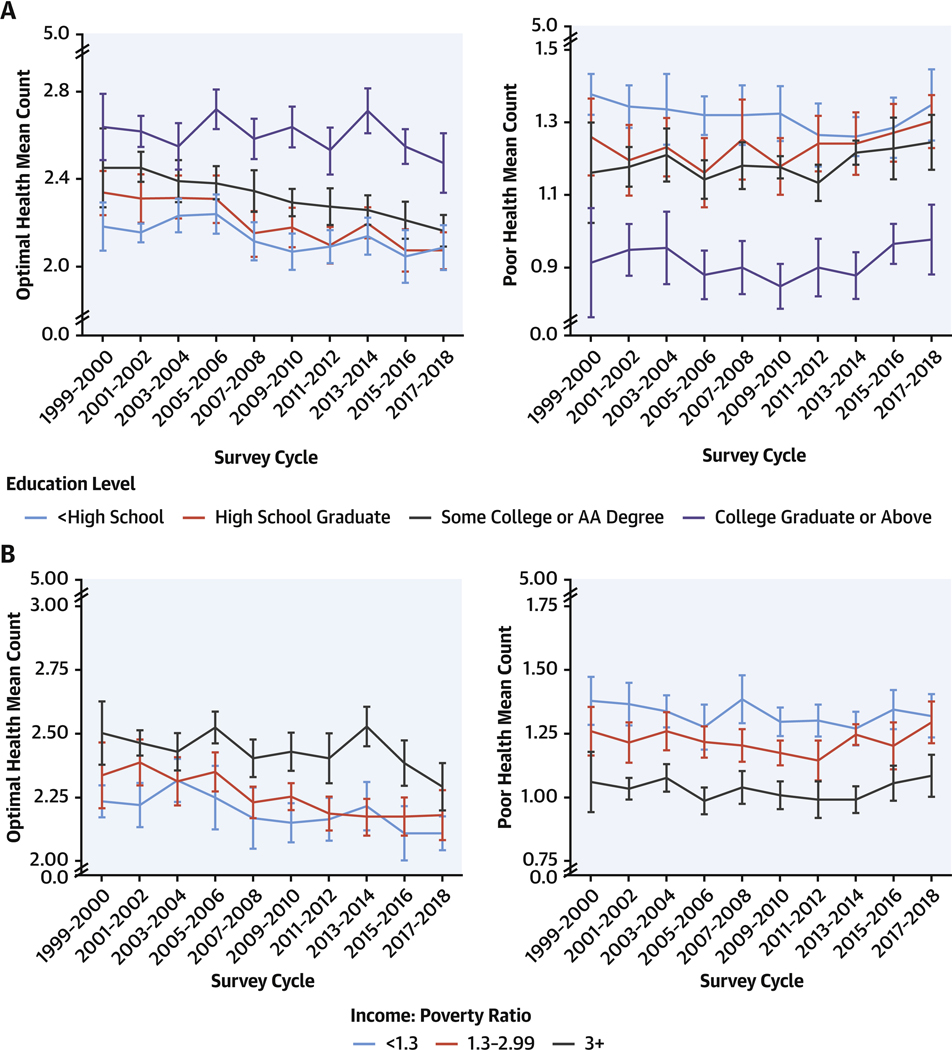
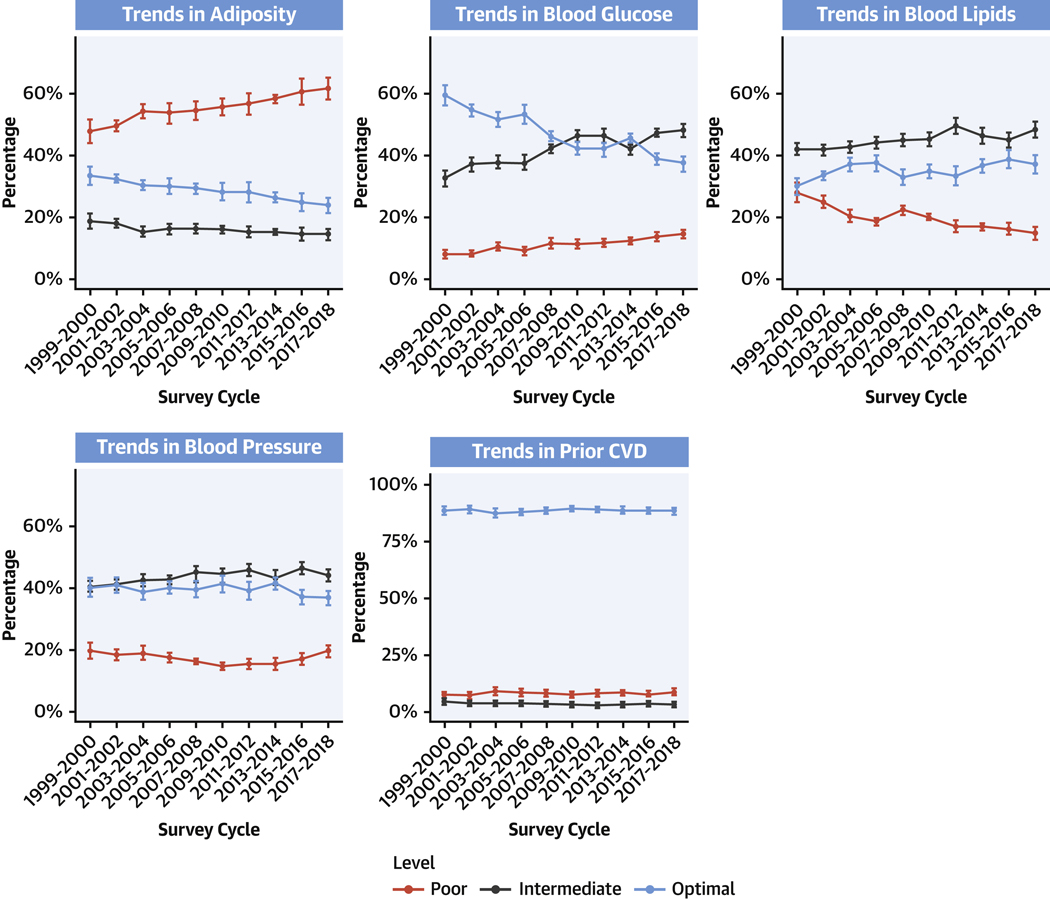
In 2017-2018, only 6.8% (95% CI: 5.4%-8.1%) of U.S. adults had optimal cardiometabolic health, declining from 1999-2000 (P trend = 0.02). Among components of cardiometabolic health, the largest declines were for adiposity (optimal levels: 33.8%-24.0%; poor levels: 47.7%-61.9%) and glucose (optimal levels: 59.4%-36.9%; poor levels: 8.6%-13.7%) (P trend <0.001 for each). Optimal levels of blood lipids increased from 29.9%-37.0%, whereas poor decreased from 28.3%-14.7% (P trend <0.001). Trends over time for blood pressure and CVD were smaller. Disparities by age, sex, education, and race/ethnicity were evident in all years, and generally worsened over time. By 2017-2018, prevalence of optimal cardiometabolic health was lower among Americans with lower (5.0% [95% CI: 2.8%-7.2%]) vs higher education (10.3% [95% CI: 7.6%-13.0%]); and among Mexican American (3.2% [95% CI: 1.4%-4.9%]) vs non-Hispanic White (8.4% [95% CI: 6.3%-10.4%]) adults.
Between 1999 and 2000 and 2017 and 2018, U.S. cardiometabolic health has been poor and worsening, with only 6.8% of adults having optimal cardiometabolic health, and disparities by age, sex, education, and race/ethnicity. These novel findings inform the need for nationwide clinical and public health interventions to improve cardiometabolic health and health equity.
很少有研究评估美国的心血管代谢健康趋势——即多种风险因素的最佳水平和无临床心血管疾病(CVD)——或其对健康差异的影响。
本研究旨在调查 1999 年至 2018 年美国最佳心血管代谢健康的趋势。
我们根据肥胖、血糖、血脂、血压和临床 CVD,评估了美国 55081 名成年人中最佳心血管代谢健康的比例;以及在全国健康和营养检查调查中,每种成分的最佳、中间和较差水平。
2017-2018 年,仅有 6.8%(95%CI:5.4%-8.1%)的美国成年人拥有最佳的心血管代谢健康,与 1999-2000 年相比有所下降(趋势 P=0.02)。在心血管代谢健康的组成部分中,最大的下降是肥胖(最佳水平:33.8%-24.0%;较差水平:47.7%-61.9%)和血糖(最佳水平:59.4%-36.9%;较差水平:8.6%-13.7%)(每个趋势 P<0.001)。血脂的最佳水平从 29.9%-37.0%增加,而较差水平从 28.3%-14.7%下降(趋势 P<0.001)。血压和 CVD 的随时间变化趋势较小。所有年份都存在年龄、性别、教育程度和种族/族裔的差异,并且随着时间的推移通常会恶化。到 2017-2018 年,受教育程度较低(5.0%[95%CI:2.8%-7.2%])的美国人与受教育程度较高(10.3%[95%CI:7.6%-13.0%])的美国人相比,最佳心血管代谢健康的患病率较低;与非西班牙裔白人(8.4%[95%CI:6.3%-10.4%])成年人相比,墨西哥裔美国人(3.2%[95%CI:1.4%-4.9%])的最佳心血管代谢健康的患病率较低。
在 1999 年至 2000 年和 2017 年至 2018 年期间,美国的心血管代谢健康状况较差且不断恶化,仅有 6.8%的成年人拥有最佳的心血管代谢健康,并且存在年龄、性别、教育程度和种族/族裔差异。这些新发现表明,需要在全国范围内开展临床和公共卫生干预措施,以改善心血管代谢健康和健康公平。