School of Public Administration, Inner Mongolia University, Hohhot 010070, China.
Int J Environ Res Public Health. 2022 Jun 21;19(13):7570. doi: 10.3390/ijerph19137570.
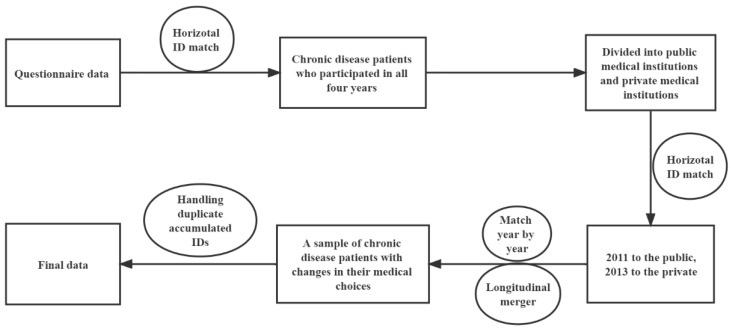
(1) Background: The discussion on how to reduce the health costs of chronic disease patients has become an important public health issue. Limited research has been conducted on how chronic disease patients' medical choice of public and private medical institutions affect health costs. (2) Methods: This study used the panel data composed of the China Health and Retirement Longitudinal Survey (CHARLS) from 2011 to 2018, adopted the quasi-natural experimental research method, and set up a control group and an experimental group that chose public medical institutions and private medical institutions, to analyze the association between the medical choice and health costs of chronic disease patients. (3) Results: Compared with chronic disease patients who chose private medical institutions, patients who chose public medical institutions increased their total cost by 44.9%, total out-of-pocket cost by 22.9%, and decreased the total out-of-pocket ratio by 0.117%, total drug cost out-of-pocket ratio by 0.075%, and drug cost ratio by 0.102%. (4) Conclusions: According to the triple principal-agent relationships, the resource advantages given by the government to public medical institutions, the salary incentive system of medical institutions, and the information asymmetry advantage held by physicians may be important factors for the increase in health costs for chronic disease patients.
(1)背景:如何降低慢性病患者的医疗费用已成为一个重要的公共卫生问题。关于慢性病患者选择公立和私立医疗机构对医疗费用的影响,相关研究有限。(2)方法:本研究利用 2011 年至 2018 年中国健康与养老追踪调查(CHARLS)的数据,采用准自然实验研究方法,设立选择公立医疗机构和私立医疗机构的对照组和实验组,分析慢性病患者医疗选择与医疗费用之间的关系。(3)结果:与选择私立医疗机构的慢性病患者相比,选择公立医疗机构的患者总费用增加了 44.9%,总自付费用增加了 22.9%,总自付比例降低了 0.117%,药品自付费用比例降低了 0.075%,药品费用比例降低了 0.102%。(4)结论:根据三重委托代理关系,政府赋予公立医疗机构的资源优势、医疗机构的薪酬激励制度以及医生掌握的信息不对称优势,可能是导致慢性病患者医疗费用增加的重要因素。