Institute of Disaster Prevention Science and Safety Technology, School of Civil Engineering, Central South University, Changsha 410075, China.
School of Resources and Safety Engineering, Central South University, Changsha 410083, China.
Int J Environ Res Public Health. 2022 Jun 27;19(13):7876. doi: 10.3390/ijerph19137876.
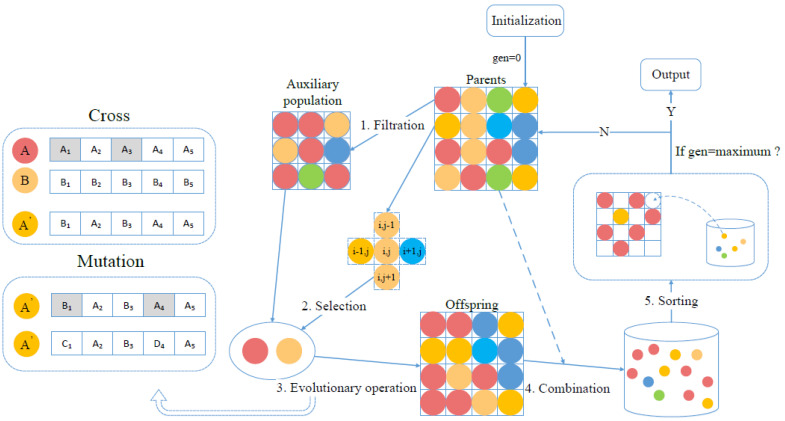
Public safety and health cannot be secured without the comprehensive recognition of characteristics and reliable emergency response schemes under the disaster chain. Distinct from emergency resource allocation that focuses primarily on a single disaster, dynamic response, periodic supply, and assisted decision-making are necessary. Therefore, we propose a multiobjective emergency resource allocation model considering uncertainty under the natural disaster chain. Resource allocation was creatively combined with path planning through the proposed multiobjective cellular genetic algorithm (MOCGA) and the improved A* algorithm with avoidance of unexpected road elements. Furthermore, timeliness, efficiency, and fairness in actual rescue were optimized by MOCGA. The visualization of emergency trips and intelligent avoidance of risk areas were achieved by the improved A* algorithm. The effects of logistics performance, coupling of disaster factors, and government regulation on emergency resource allocation were discussed based on different disaster chain scenarios. The results show that disruption in infrastructure support, cascading effect of disasters, and time urgency are additional environmental challenges. The proposed model and algorithm work in obtaining the optimal solution for potential regional coordination and resilient supply, with a 22.2% increase in the total supply rate. Cooperative allocation complemented by political regulation can be a positive action for successfully responding to disaster chains.
公共安全和健康如果不能全面认识灾害链下的特点和可靠的应急响应方案,就无法得到保障。与主要关注单一灾害的应急资源分配不同,需要进行动态响应、定期供应和辅助决策。因此,我们提出了一种考虑自然灾害链下不确定性的多目标应急资源分配模型。通过提出的多目标细胞遗传算法 (MOCGA) 和改进的带有避免意外道路元素的 A算法,创新性地将资源分配与路径规划结合在一起。此外,MOCGA 优化了实际救援中的及时性、效率和公平性。通过改进的 A算法实现了应急行程的可视化和风险区域的智能避让。基于不同的灾害链场景,讨论了物流绩效、灾害因素的耦合和政府监管对应急资源分配的影响。结果表明,基础设施支持的中断、灾害的级联效应和时间紧迫性是额外的环境挑战。所提出的模型和算法在获取潜在区域协调和弹性供应的最优解决方案方面效果显著,总供应率提高了 22.2%。政治监管的合作分配可以是成功应对灾害链的积极行动。