Endocrine and Metabolic Diseases Research Center, School of Medicine, University of Zulia, Maracaibo 4004, Venezuela.
Facultad de Ciencias Jurídicas y Sociales, Universidad Simón Bolívar, Cúcuta 540006, Colombia.
Int J Mol Sci. 2022 Jun 22;23(13):6918. doi: 10.3390/ijms23136918.
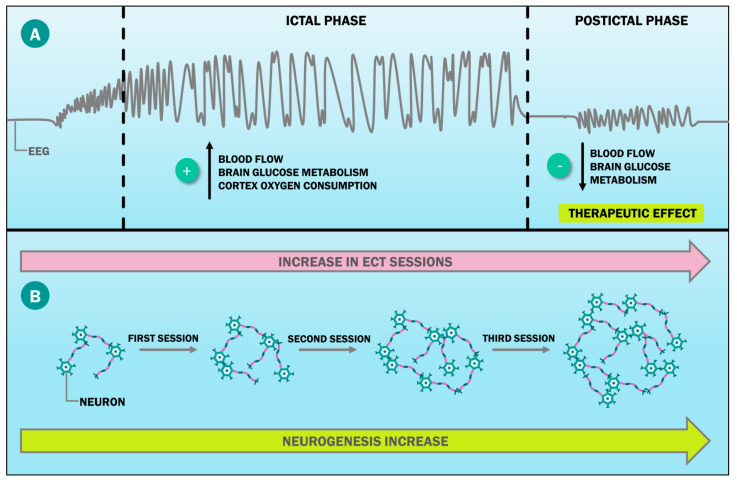
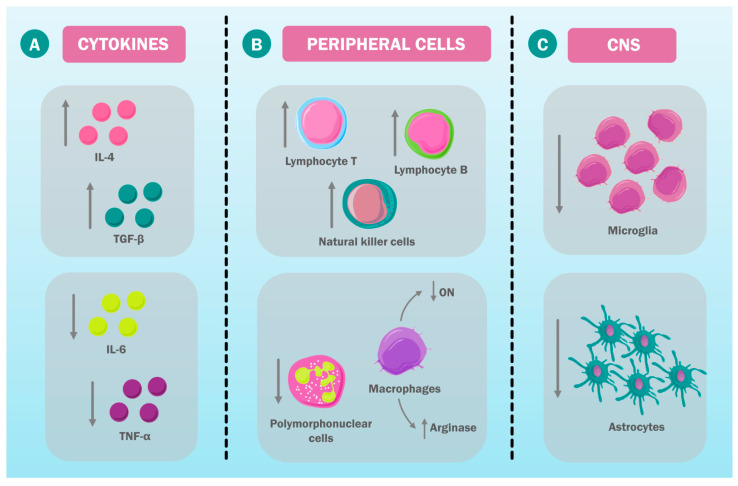
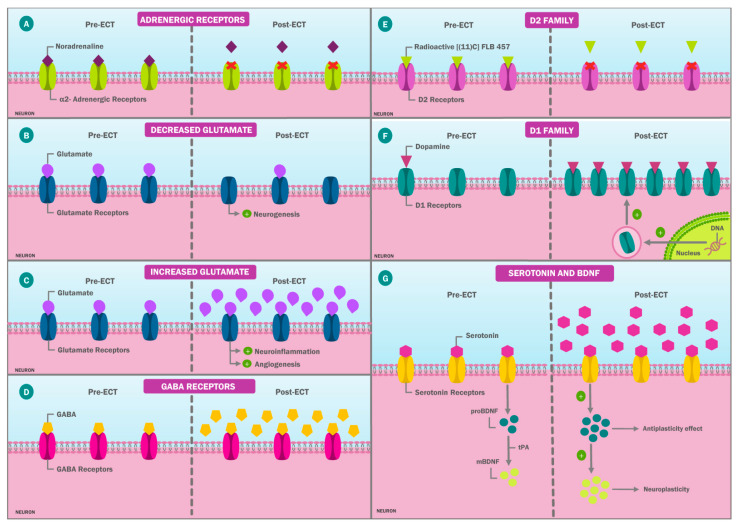
Electroconvulsive therapy (ECT) is based on conducting an electrical current through the brain to stimulate it and trigger generalized convulsion activity with therapeutic ends. Due to the efficient use of ECT during the last years, interest in the molecular bases involved in its mechanism of action has increased. Therefore, different hypotheses have emerged. In this context, the goal of this review is to describe the neurobiological, endocrine, and immune mechanisms involved in ECT and to detail its clinical efficacy in different psychiatric pathologies. This is a narrative review in which an extensive literature search was performed on the Scopus, Embase, PubMed, ISI Web of Science, and Google Scholar databases from inception to February 2022. The terms "electroconvulsive therapy", "neurobiological effects of electroconvulsive therapy", "molecular mechanisms in electroconvulsive therapy", and "psychiatric disorders" were among the keywords used in the search. The mechanisms of action of ECT include neurobiological function modifications and endocrine and immune changes that take place after ECT. Among these, the decrease in neural network hyperconnectivity, neuroinflammation reduction, neurogenesis promotion, modulation of different monoaminergic systems, and hypothalamus-hypophysis-adrenal and hypothalamus-hypophysis-thyroid axes normalization have been described. The majority of these elements are physiopathological components and therapeutic targets in different mental illnesses. Likewise, the use of ECT has recently expanded, with evidence of its use for other pathologies, such as Parkinson's disease psychosis, malignant neuroleptic syndrome, post-traumatic stress disorder, and obsessive-compulsive disorder. In conclusion, there is sufficient evidence to support the efficacy of ECT in the treatment of different psychiatric disorders, potentially through immune, endocrine, and neurobiological systems.
电抽搐治疗(ECT)基于通过大脑引导电流以刺激它并引发具有治疗目的的全身性抽搐活动。由于近年来 ECT 的有效应用,人们对其作用机制中涉及的分子基础的兴趣增加了。因此,出现了不同的假说。在这种情况下,本综述的目的是描述 ECT 涉及的神经生物学、内分泌和免疫机制,并详细说明其在不同精神病理学中的临床疗效。这是一篇叙述性综述,在 Scopus、Embase、PubMed、ISI Web of Science 和 Google Scholar 数据库中对从开始到 2022 年 2 月的广泛文献进行了搜索。搜索中使用的关键词包括“电抽搐治疗”、“电抽搐治疗的神经生物学效应”、“电抽搐治疗中的分子机制”和“精神障碍”。ECT 的作用机制包括 ECT 后发生的神经生物学功能改变以及内分泌和免疫变化。其中,描述了神经网络超连接性降低、神经炎症减少、神经发生促进、不同单胺能系统的调节以及下丘脑-垂体-肾上腺和下丘脑-垂体-甲状腺轴的正常化。这些元素中的大多数是不同精神疾病的生理病理学成分和治疗靶点。同样,ECT 的使用最近也有所扩大,有证据表明其可用于治疗其他疾病,如帕金森病精神病、恶性神经阻滞剂综合征、创伤后应激障碍和强迫症。总之,有足够的证据支持 ECT 在治疗不同精神障碍中的疗效,可能通过免疫、内分泌和神经生物学系统。