Krzywdzińska Agnieszka, Puła Bartosz, Szymczak Donata, Milanowska Aneta, Szeremet Agnieszka, Jamroziak Krzysztof
Laboratory of Immunophenotyping, Institute of Hematology and Transfusion Medicine, Indiry Gandhi 14, 02-776 Warsaw, Poland.
Department of Hematology, Institute of Hematology and Transfusion Medicine, Indiry Gandhi 14, 02-776 Warsaw, Poland.
J Clin Med. 2022 Jun 27;11(13):3722. doi: 10.3390/jcm11133722.
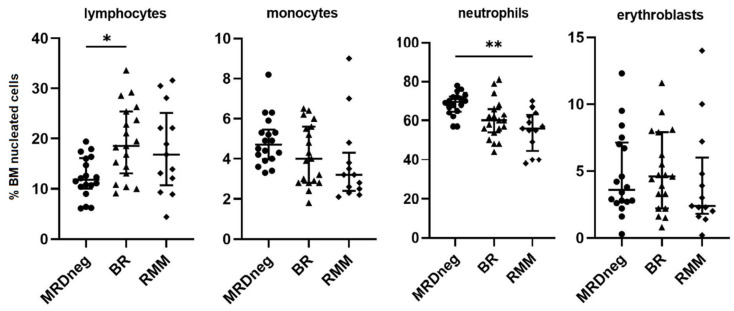
Multiple myeloma (MM) relapses are inevitable in the majority of patients, and in addition to genetic changes in the MM clone, the immune profile of the bone marrow (BM) plays a key role in this process. Biochemical progression or relapse (BR) precedes clinical relapse in a significant proportion of patients with MM. In the present study, we used flow cytometry to assess the cellular composition of the BM microenvironment in MM patients with confirmed BR. Fifteen distinct cells subsets in the BM were evaluated with the panel of antibodies used routinely for MRD monitoring in MM in 52 patients with MM (MRD-negative n = 20, BR n = 20, and clinically relapsed MM, RMM n = 12). The median percentage of MM cells detected in BR patients was 0.90% versus not detectable in MRD-negative patients and of 3.0% in RMM cohort. Compared to the MRD-negative group, BR status was associated with an increase in the percentage of lymphoid subpopulations, including memory B cells (p = 0.003), CD27+T cells (p = 0.002), and NK/NKT cells (p < 0.001). Moreover, a decrease in B-cell precursors (p < 0.001) and neutrophils (p = 0.006) was observed. There were no significant differences in the composition of the BM cell subpopulations between the BR and RMM groups. Our results indicate the involvement of B-, T-, and NK cells in the process of losing immune surveillance over the MM clone that leads to relapse. It can be speculated that similar studies of a larger cohort of BR patients can potentially identify a group of patients for which an early treatment intervention would be beneficial.
多发性骨髓瘤(MM)复发在大多数患者中是不可避免的,除了MM克隆中的基因变化外,骨髓(BM)的免疫特征在这一过程中起关键作用。在相当一部分MM患者中,生化进展或复发(BR)先于临床复发。在本研究中,我们使用流式细胞术评估确诊为BR的MM患者骨髓微环境的细胞组成。使用MM中常规用于微小残留病(MRD)监测的抗体组合,对52例MM患者(MRD阴性n = 20,BR n = 20,临床复发MM,RMM n = 12)的BM中的15个不同细胞亚群进行了评估。BR患者中检测到的MM细胞的中位百分比为0.90%,而MRD阴性患者中未检测到,RMM队列中为3.0%。与MRD阴性组相比,BR状态与淋巴亚群百分比增加相关,包括记忆B细胞(p = 0.003)、CD27 + T细胞(p = 0.002)和NK/NKT细胞(p < 0.001)。此外,观察到B细胞前体(p < 0.001)和中性粒细胞(p = 0.006)减少。BR组和RMM组之间的BM细胞亚群组成没有显著差异。我们的结果表明B细胞、T细胞和NK细胞参与了对导致复发的MM克隆失去免疫监视的过程。可以推测,对更大队列的BR患者进行类似研究可能会识别出一组早期治疗干预有益的患者。