Lopes Raquel, Caetano Joana, Ferreira Bruna, Barahona Filipa, Carneiro Emilie Arnault, João Cristina
Lymphoma and Myeloma Research Programme, Champalimaud Centre for the Unknown, 1400-038 Lisbon, Portugal.
Faculty of Medicine, University of Lisbon, 1649-028 Lisbon, Portugal.
Cancers (Basel). 2021 Feb 5;13(4):625. doi: 10.3390/cancers13040625.
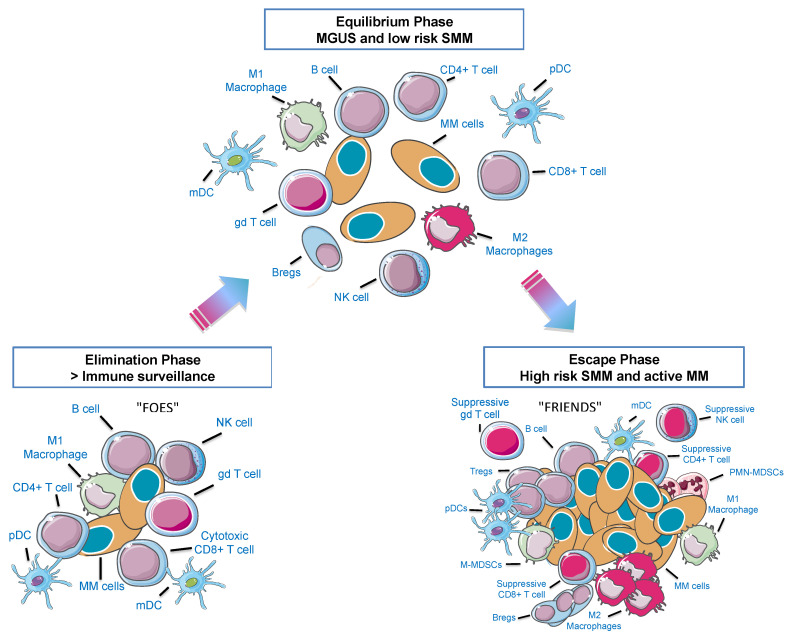
Multiple myeloma (MM) is one of the most prevalent hematological cancers worldwide, characterized by the clonal expansion of neoplastic plasma cells in the bone marrow (BM). A combination of factors is implicated in disease progression, including BM immune microenvironment changes. Increasing evidence suggests that the disruption of immunological processes responsible for myeloma control ultimately leads to the escape from immune surveillance and resistance to immune effector function, resulting in an active form of myeloma. In fact, one of the hallmarks of MM is the development of a permissive BM milieu that provides a growth advantage to the malignant cells. Consequently, a better understanding of how myeloma cells interact with the BM niche compartments and disrupt the immune homeostasis is of utmost importance to develop more effective treatments. This review focuses on the most up-to-date knowledge regarding microenvironment-related mechanisms behind MM immune evasion and suppression, as well as promising molecules that are currently under pre-clinical tests targeting immune populations.
多发性骨髓瘤(MM)是全球最常见的血液系统癌症之一,其特征是骨髓(BM)中肿瘤性浆细胞的克隆性扩增。多种因素与疾病进展有关,包括骨髓免疫微环境的变化。越来越多的证据表明,负责控制骨髓瘤的免疫过程的破坏最终导致骨髓瘤细胞逃避免疫监视并对免疫效应功能产生抗性,从而形成活跃形式的骨髓瘤。事实上,MM的标志之一是形成一种允许性的骨髓微环境,为恶性细胞提供生长优势。因此,更好地了解骨髓瘤细胞如何与骨髓生态位隔室相互作用并破坏免疫稳态对于开发更有效的治疗方法至关重要。本综述重点关注关于MM免疫逃逸和抑制背后的微环境相关机制的最新知识,以及目前正在针对免疫群体进行临床前测试的有前景的分子。