Department of Biostatistics and Epidemiology, School of Public Health, China Medical University, Shenyang 110122, China.
School of Public Health, Shanghai Jiao Tong University School of Medicine, Shanghai 200025, China.
Nutrients. 2022 Jun 24;14(13):2613. doi: 10.3390/nu14132613.
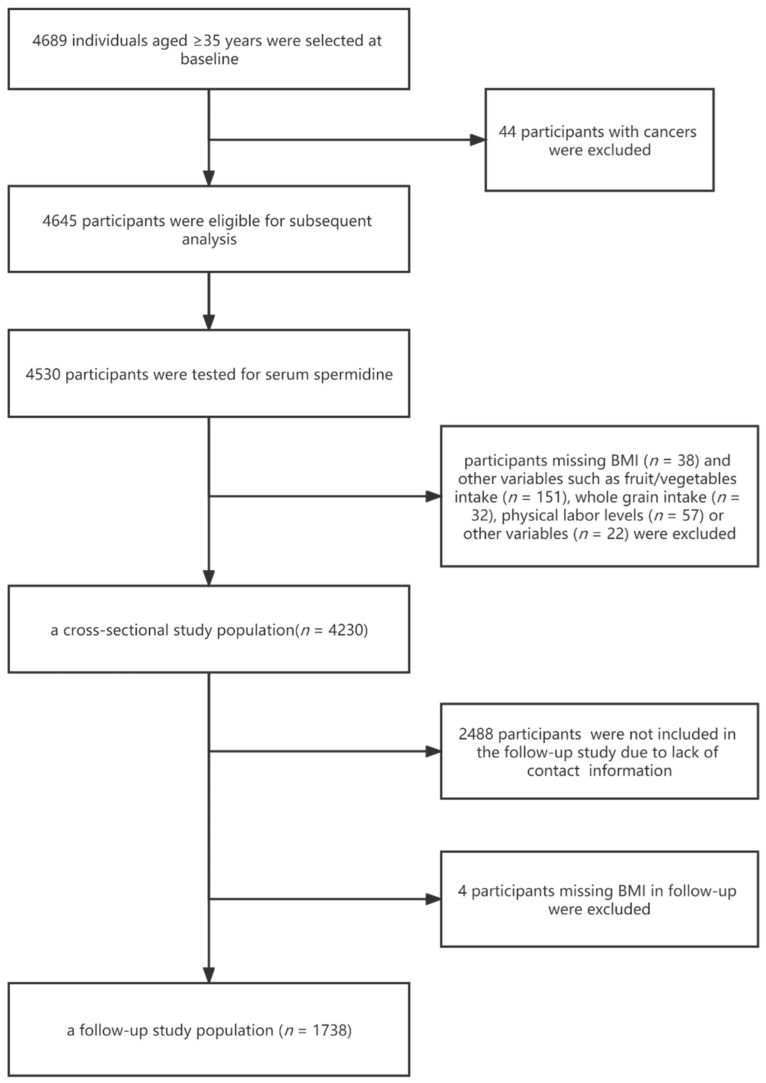
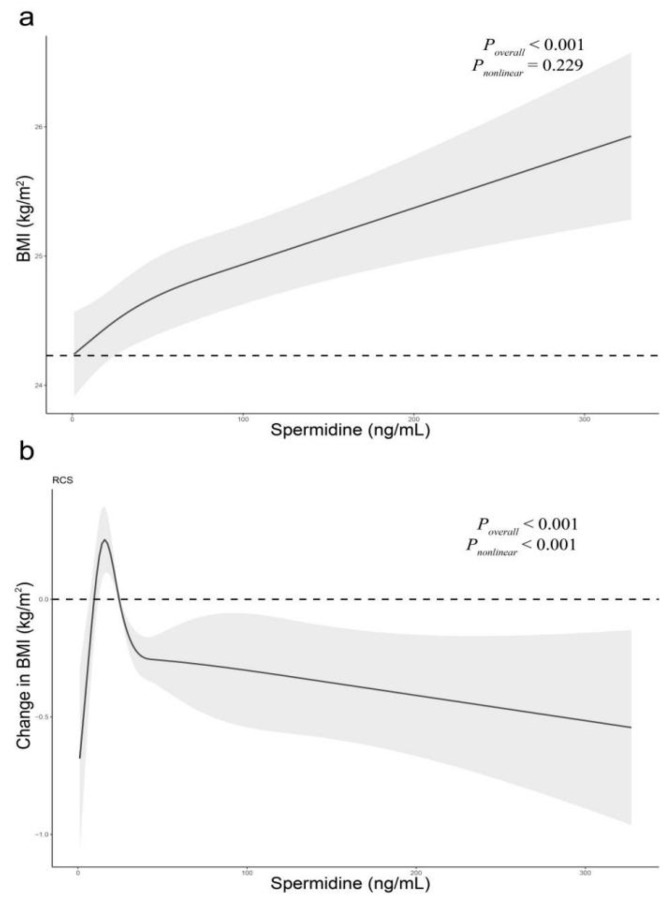
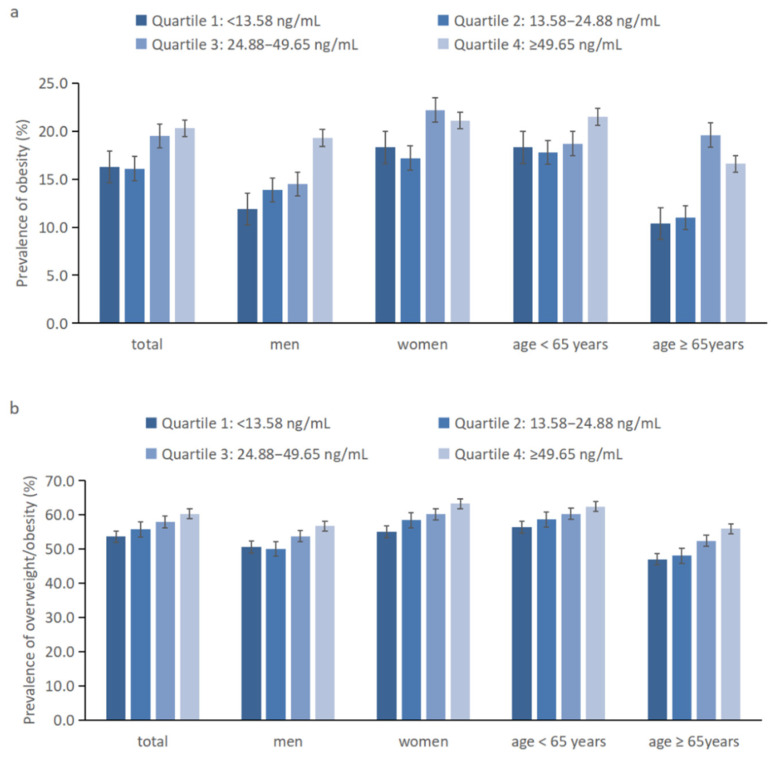
Background: Spermidine, a natural polyamine, appears to be a promising intervention for the treatment of obesity in animal studies, but epidemiological studies on the association between spermidine and obesity are inadequate. Methods: In the cross-sectional study, a total of 4230 eligible Chinese rural participants aged ≥ 35 years at baseline were recruited, of whom 1738 completed the two-year follow-up. Serum spermidines were measured using high-performance liquid chromatography with a fluorescence detector. Obesity and change in BMI were used as outcomes. Multivariable logistic regression analysis was applied to obtain the odds ratios (ORs) and 95% confidence intervals (CIs). Results: Participants who were obese had higher serum spermidine concentrations than those who were of normal weight (median (IQR), 27.2 ng/mL (14.8−53.4 ng/mL) vs. 23.8 ng/mL (12.8−46.6 ng/mL), p = 0.002). Compared with participants in the first quartile, those in the third quartile (OR 1.327, 95% CI 1.050 to 1.678) and the fourth quartile (OR 1.417, 95% CI 1.121 to 1.791) had a significantly increased risk of prevalent obesity after adjustment for confounding factors. In the follow-up study, participants in the third quartile (OR 0.712, 95% CI 0.535 to 0.946) and the fourth quartile (OR 0.493, 95% CI 0.370 to 0.657) had significantly lower risks of an increase in BMI after adjustment for confounding factors, with the lowest quartile as the reference. Meanwhile, we found a nonlinear relationship between spermidine and BMI in the follow-up study (p < 0.001). Conclusions: Serum spermidine was positively associated with increased odds of obesity in the cross-sectional study but reduced odds of an increase in BMI in the follow-up study among Chinese adults. Future studies are warranted to determine the exact mechanism underlying the association between spermidine and obesity and the scope for interventions.
spermidine 是一种天然多胺,在动物研究中似乎是治疗肥胖的有前途的干预措施,但关于 spermidine 与肥胖之间关联的流行病学研究还不够充分。
在这项横断面研究中,共招募了 4230 名符合条件的基线时年龄≥35 岁的中国农村参与者,其中 1738 名完成了为期两年的随访。使用高效液相色谱法-荧光检测器测定血清 spermidine 浓度。将肥胖和 BMI 变化作为结局。采用多变量 logistic 回归分析得出比值比(OR)及其 95%置信区间(CI)。
肥胖参与者的血清 spermidine 浓度高于体重正常者(中位数(IQR),27.2ng/ml(14.8-53.4ng/ml)比 23.8ng/ml(12.8-46.6ng/ml),p=0.002)。与第 1 四分位数的参与者相比,第 3 四分位数(OR 1.327,95%CI 1.050-1.678)和第 4 四分位数(OR 1.417,95%CI 1.121-1.791)在调整混杂因素后肥胖的发生风险显著增加。在随访研究中,与第 3 四分位数(OR 0.712,95%CI 0.535-0.946)和第 4 四分位数(OR 0.493,95%CI 0.370-0.657)相比,调整混杂因素后 BMI 增加的风险显著降低,以最低四分位数为参照。同时,我们在随访研究中发现 spermidine 与 BMI 之间存在非线性关系(p<0.001)。
在横断面研究中,血清 spermidine 与肥胖的几率增加呈正相关,但在随访研究中与 BMI 的增加几率呈负相关。需要进一步研究以确定 spermidine 与肥胖之间关联的确切机制和干预范围。