Wang Shuai, Qi Xin
Department of Physiology and Biophysics, Case Western Reserve University School of Medicine, Cleveland, OH, United States.
Front Pharmacol. 2022 Jun 24;13:916653. doi: 10.3389/fphar.2022.916653. eCollection 2022.
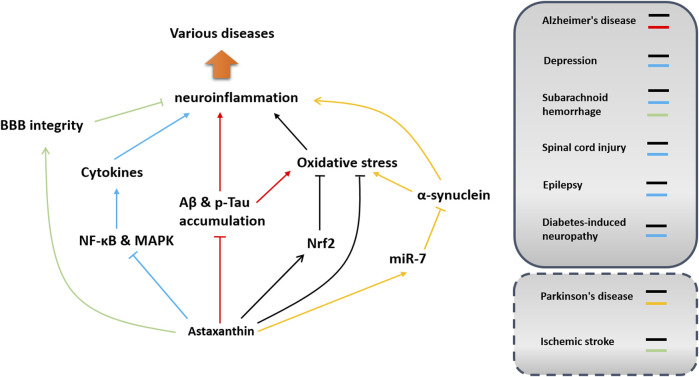
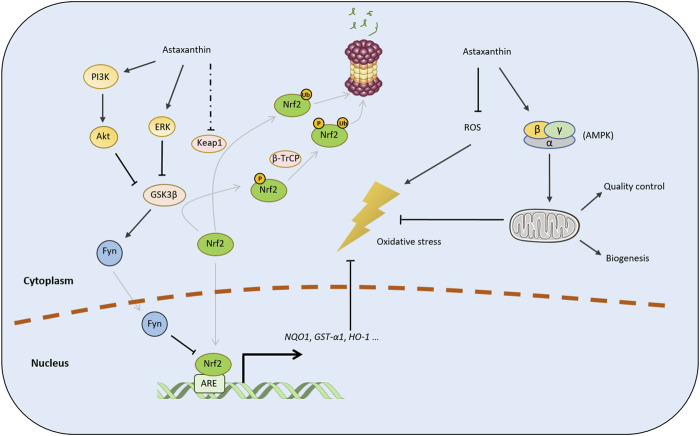
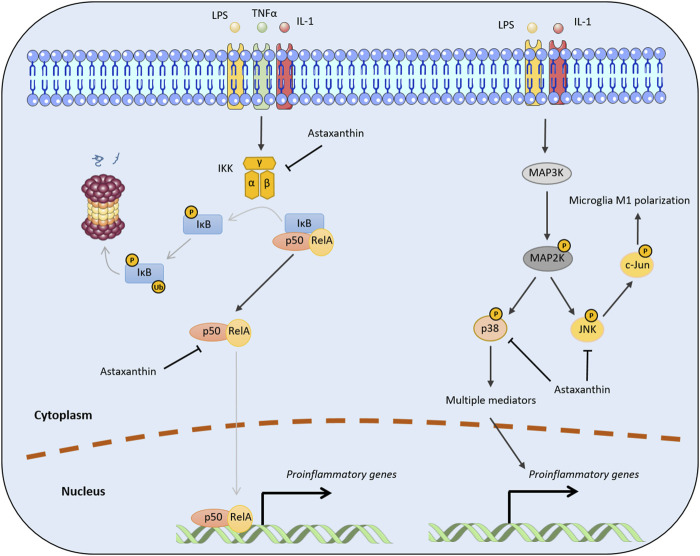
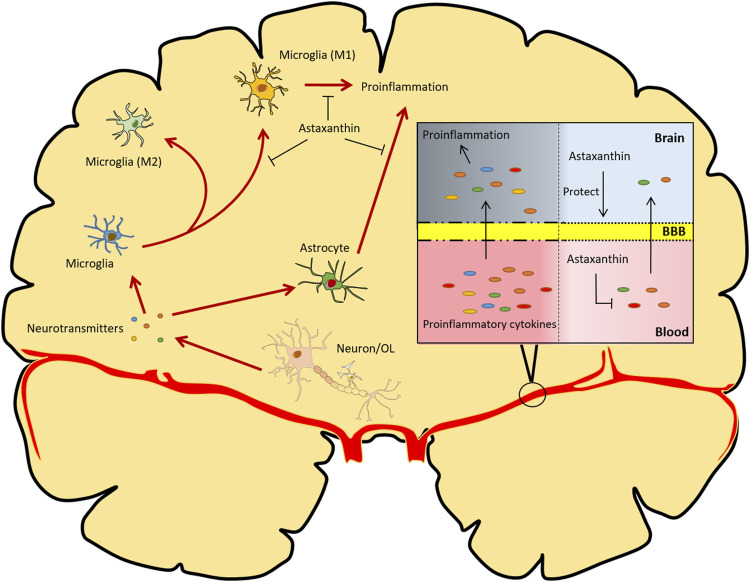
Neuroinflammation is a protective mechanism against insults from exogenous pathogens and endogenous cellular debris and is essential for reestablishing homeostasis in the brain. However, excessive prolonged neuroinflammation inevitably leads to lesions and disease. The use of natural compounds targeting pathways involved in neuroinflammation remains a promising strategy for treating different neurological and neurodegenerative diseases. Astaxanthin, a natural xanthophyll carotenoid, is a well known antioxidant. Mounting evidence has revealed that astaxanthin is neuroprotective and has therapeutic potential by inhibiting neuroinflammation, however, its functional roles and underlying mechanisms in modulating neuroinflammation have not been systematically summarized. Hence, this review summarizes recent progress in this field and provides an update on the medical value of astaxanthin. Astaxanthin modulates neuroinflammation by alleviating oxidative stress, reducing the production of neuroinflammatory factors, inhibiting peripheral inflammation and maintaining the integrity of the blood-brain barrier. Mechanistically, astaxanthin scavenges radicals, triggers the Nrf2-induced activation of the antioxidant system, and suppresses the activation of the NF-κB and mitogen-activated protein kinase pathways. With its good biosafety and high bioavailability, astaxanthin has strong potential for modulating neuroinflammation, although some outstanding issues still require further investigation.
神经炎症是一种针对外源性病原体和内源性细胞碎片的损伤的保护机制,对于在大脑中重新建立内环境稳态至关重要。然而,过度延长的神经炎症不可避免地会导致损伤和疾病。使用针对神经炎症相关途径的天然化合物仍然是治疗不同神经和神经退行性疾病的一种有前景的策略。虾青素是一种天然的叶黄素类胡萝卜素,是一种著名的抗氧化剂。越来越多的证据表明,虾青素具有神经保护作用,并且通过抑制神经炎症具有治疗潜力,然而,其在调节神经炎症中的功能作用和潜在机制尚未得到系统总结。因此,本综述总结了该领域的最新进展,并提供了虾青素医学价值的最新信息。虾青素通过减轻氧化应激、减少神经炎症因子的产生、抑制外周炎症和维持血脑屏障的完整性来调节神经炎症。从机制上讲,虾青素清除自由基,触发Nrf2诱导的抗氧化系统激活,并抑制NF-κB和丝裂原活化蛋白激酶途径的激活。尽管一些突出问题仍需要进一步研究,但虾青素具有良好的生物安全性和高生物利用度,在调节神经炎症方面具有强大的潜力。