Department of Interventional Ultrasound, Chinese PLA General Hospital, 28 Fuxing Road, Beijing, 100853, China.
Department of Hepatobiliary Surgery, Hunan Provincial People's Hospital, The First Affiliated Hospital of Hunan Normal University, Changsha, 410002, Hunan Province, China.
J Gastroenterol. 2022 Sep;57(9):684-694. doi: 10.1007/s00535-022-01895-3. Epub 2022 Jul 11.
Radiofrequency ablation (RFA) is considered as a convenient treatment with mild damage in treating recurrent hepatocellular carcinoma (RHCC). However, for patients with high risk of progression after RFA still needs new strategies to decrease the repeat recurrence.
A total of 460 patients with RHCC within Milan criteria in four institutions were enrolled. 174 pairs were enrolled after propensity score matching (PSM). Overall survival (OS) and tumor-free survival (TFS) were compared between the two groups. A quantitative score system was established to screen out the beneficial population from RFA-sorafenib treatment.
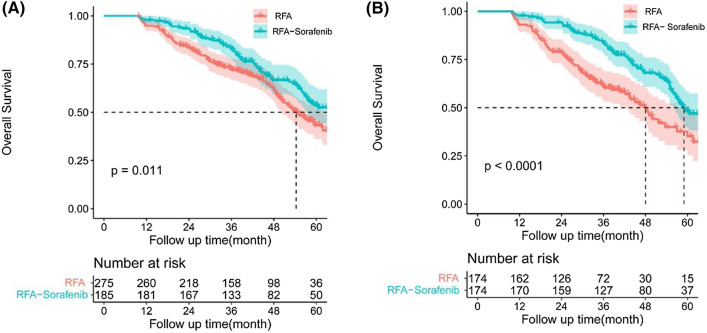
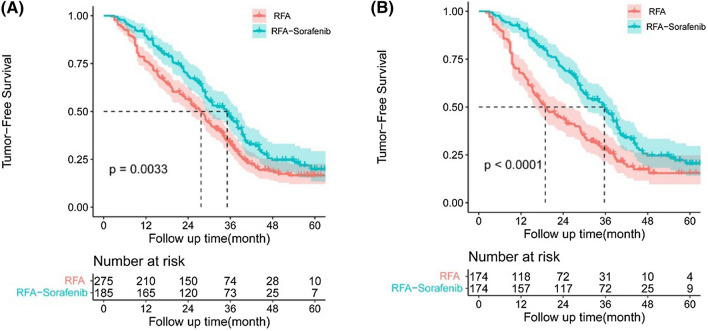
The 1-, 3-, and 5-year OS rates were 97.7%, 83.7%, 54.7% for RFA-sorafenib group, and 93.1%, 61.3%, 30.9% for RFA group after PSM, respectively. Compared with the RFA group, the RFA-sorafenib group had significantly better OS (P < 0.001). The 1-, 3-, and 5-year TFS rates were 90.8%, 49.0%, 20.4% for RFA-sorafenib group, and 67.8%, 28.0%, 14.5% for RFA group after PSM. The difference was observed significantly between RFA-sorafenib group and RFA group (P < 0.001). A quantitative risk score system was established to precisely screen out the beneficial population from RFA-sorafenib treatment.
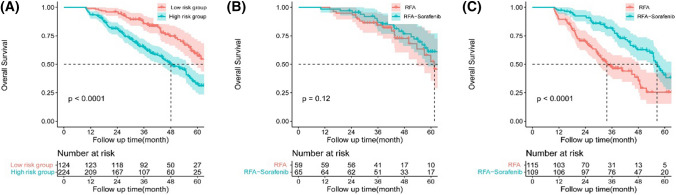
Adjuvant sorafenib after RFA was superior to RFA alone in improving survival outcomes in patients with recurrent HCC within Milan criteria after initial hepatectomy. Subgroup analyses concluded that patients with high risk score had significantly longer survival from sorafenib administration.
射频消融(RFA)被认为是一种治疗复发性肝细胞癌(RHCC)的便捷方法,损伤较小。然而,对于 RFA 后进展风险较高的患者,仍需要新的策略来降低复发率。
共纳入四家机构符合米兰标准的 460 例 RHCC 患者。经倾向评分匹配(PSM)后纳入 174 对患者。比较两组患者的总生存期(OS)和无瘤生存期(TFS)。建立定量评分系统,筛选出从 RFA-索拉非尼治疗中获益的人群。
PSM 后,RFA-索拉非尼组的 1、3、5 年 OS 率分别为 97.7%、83.7%、54.7%,RFA 组分别为 93.1%、61.3%、30.9%。与 RFA 组相比,RFA-索拉非尼组的 OS 明显更好(P<0.001)。PSM 后,RFA-索拉非尼组的 1、3、5 年 TFS 率分别为 90.8%、49.0%、20.4%,RFA 组分别为 67.8%、28.0%、14.5%。RFA-索拉非尼组与 RFA 组差异有统计学意义(P<0.001)。建立定量风险评分系统,可准确筛选出从 RFA-索拉非尼治疗中获益的人群。
在初始肝切除后符合米兰标准的复发性 HCC 患者中,RFA 后辅助索拉非尼治疗在改善生存结局方面优于 RFA 单药治疗。亚组分析得出,高风险评分患者从索拉非尼治疗中获益的生存时间明显延长。