Wei Fu-Qun, Huang Pei-Shu, Zhang Bing, Guo Rui, Yuan Yan, Chen Jin, Lin Zheng-Yu
Department of Interventional Radiology, First Affiliated Hospital of Fujian Medical University, Fuzhou, 350000, China.
Department of Interventional Radiology, National Regional Medical Center, Binhai Campus of the First Affiliated Hospital, Fujian Medical University, Fuzhou, China.
BMC Cancer. 2025 Jan 28;25(1):159. doi: 10.1186/s12885-025-13510-8.
The appropriateness of ablation for liver cancer patients meeting the Milan criteria remains controversial.
This study aims to evaluate the long-term outcomes of MR-guided thermal ablation for HCC patients meeting the Milan criteria and develop a nomogram for predicting survival rates.
A retrospective analysis was conducted from January 2009 to December 2021 at a single institution. Patients underwent MR-guided thermal ablation. Factors influencing progression-free survival (PFS) and overall survival (OS) were identified using univariate and multivariate Cox regression and stepwise regression. A nomogram was developed for survival prediction, followed by risk stratification and internal validation. Adverse events (AEs) were also analyzed.
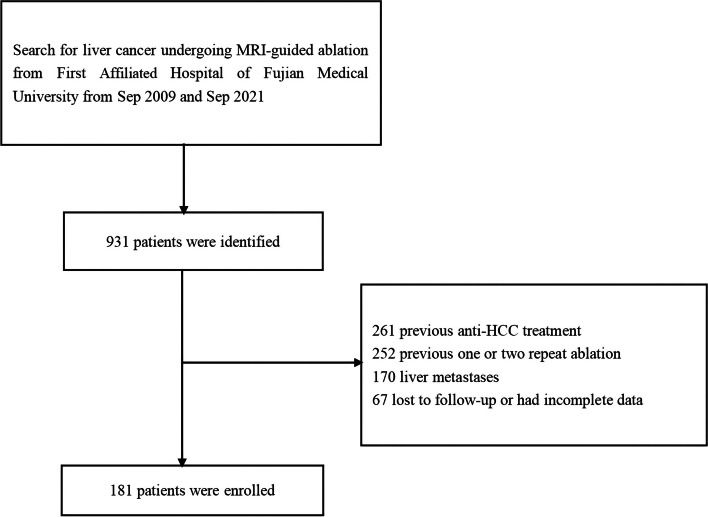
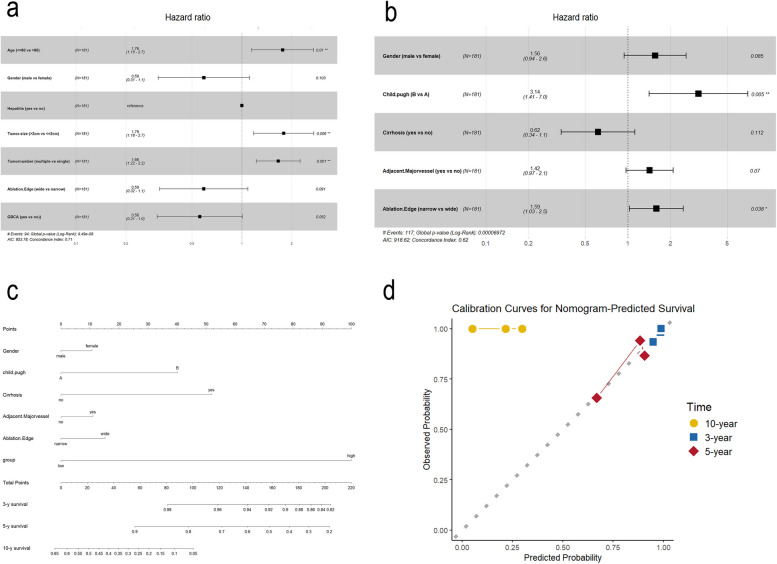
A total of 181 patients were included, with a mean follow-up of 73.8 ± 31.7 months. The cumulative local tumor progression rates at 1, 3, and 5 years were 0.80%, 1.27%, and 1.86%, respectively. The 1-, 3-, and 5-year PFS rates were 81.8%, 57.4%, and 38.1%, and OS rates were 98.3%, 87.8%, and 62.9%. Poorer outcomes were associated with age ≤ 60 years, tumor size > 2 cm, multiple tumors, cirrhosis, proximity to major vessels, and narrow ablation margins (P < 0.05). The nomogram accurately predicted 3- and 5-year survival, and internal validation confirmed the results. AEs occurred in 33.7% of patients, with pain being the most common.
MR-guided ablation is effective for HCC patients within the Milan criteria, especially for those with smaller tumors and better liver function. The nomogram and risk stratification model are valuable tools for predicting patient outcomes and guiding treatment.
对于符合米兰标准的肝癌患者,消融治疗的适用性仍存在争议。
本研究旨在评估磁共振引导下热消融治疗符合米兰标准的肝癌患者的长期疗效,并建立一个预测生存率的列线图。
对2009年1月至2021年12月在单一机构进行的一项回顾性分析。患者接受磁共振引导下热消融治疗。使用单因素和多因素Cox回归以及逐步回归确定影响无进展生存期(PFS)和总生存期(OS)的因素。建立用于生存预测的列线图,随后进行风险分层和内部验证。还分析了不良事件(AE)。
共纳入181例患者,平均随访73.8±31.7个月。1年、3年和5年的累积局部肿瘤进展率分别为0.80%、1.27%和1.86%。1年、3年和5年的PFS率分别为81.8%、57.4%和38.1%,OS率分别为98.3%、87.8%和62.9%。较差的预后与年龄≤60岁、肿瘤大小>2 cm、多发肿瘤、肝硬化、靠近大血管和消融边缘狭窄有关(P < 0.05)。列线图准确预测了3年和5年生存率,内部验证证实了结果。33.7%的患者发生了AE,疼痛是最常见的。
磁共振引导下消融治疗对符合米兰标准的肝癌患者有效,尤其是对于肿瘤较小且肝功能较好的患者。列线图和风险分层模型是预测患者预后和指导治疗的有价值工具。