Department of Respiratory and Critical Care Medicine, The Third Affiliated Hospital of Guangzhou Medical University, Guangzhou, China.
Department of Obstetrics and Gynecology, Center for Reproductive Medicine, Key Laboratory for Major Obstetric Diseases of Guangdong Province, The Third Affiliated Hospital of Guangzhou Medical University, Guangzhou, China.
Cell Transplant. 2022 Jan-Dec;31:9636897221106998. doi: 10.1177/09636897221106998.
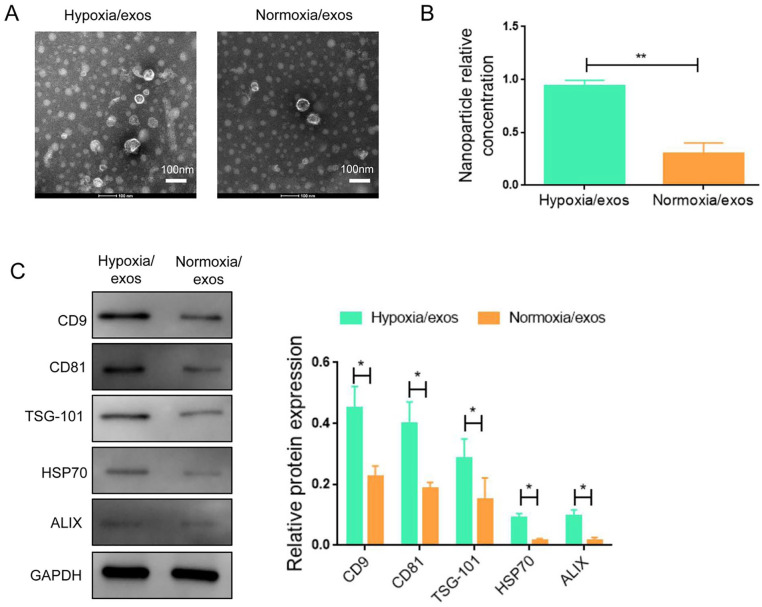
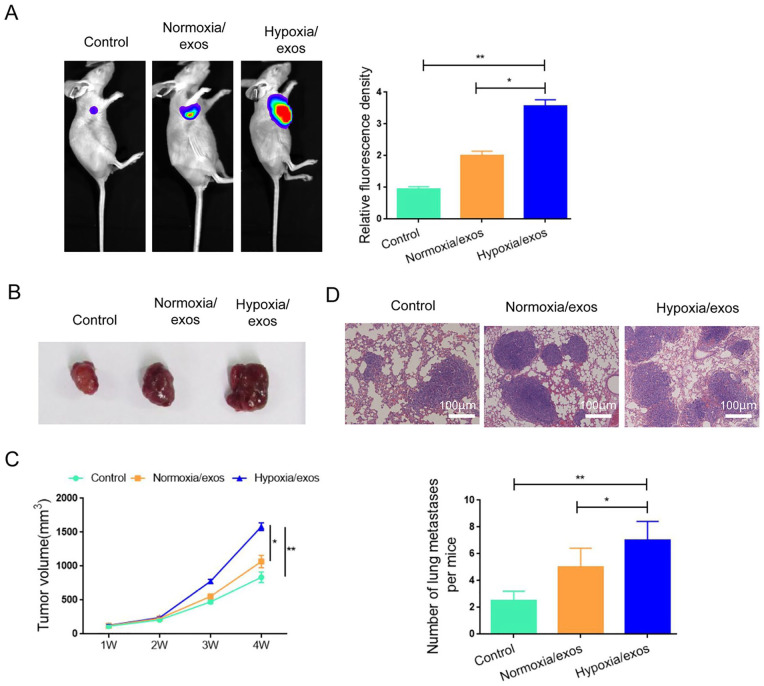
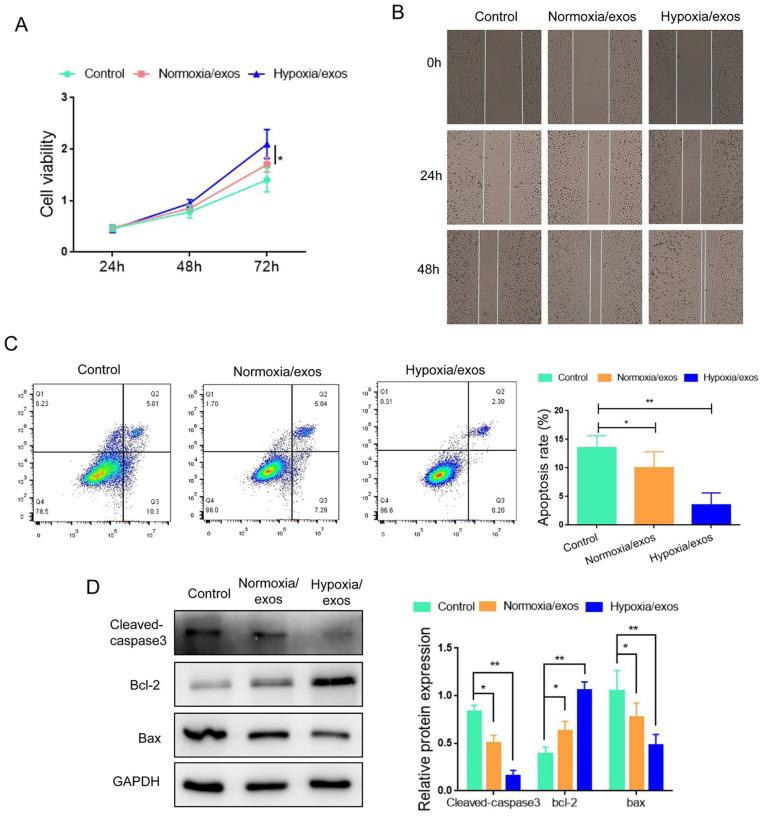
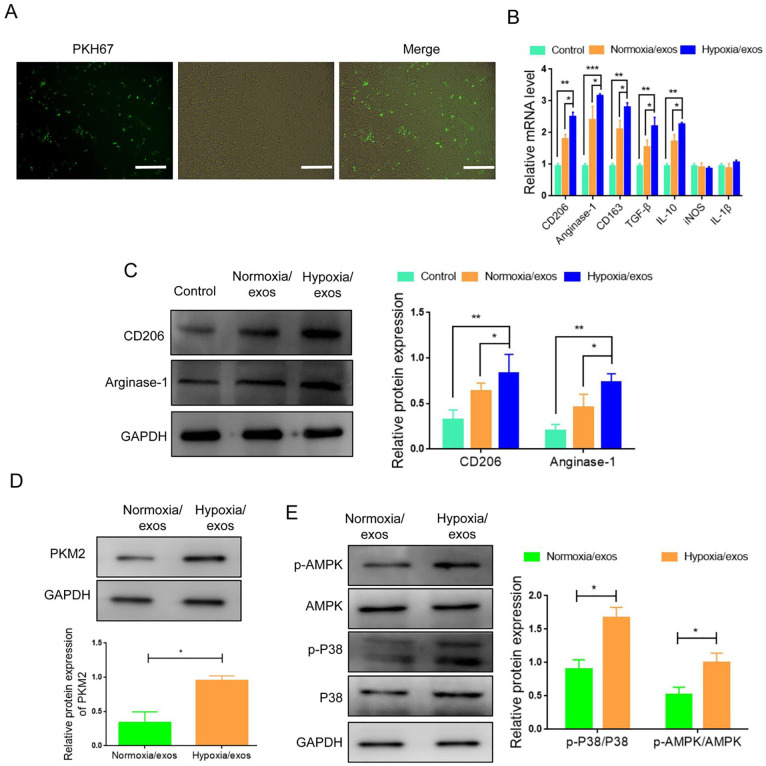
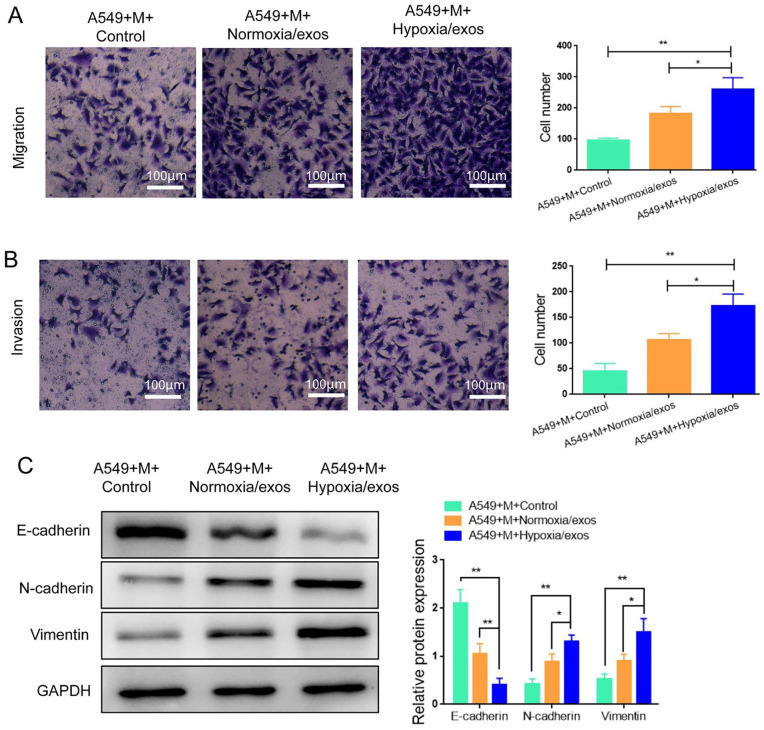
Hypoxia is a major regulator of tumor aggressiveness and metastasis in cancer progression. Exosomes (exos) play an important role in the communication between lung cancer and hypoxic microenvironment. However, the underlying mechanisms are largely undefined. Exos were isolated from A549 cells under hypoxia conditions. Transmission electron microscopy and nanoparticle tracking analysis were carried out to characterize exos. CCK-8 assay, flow cytometry, Western blot, wound healing, and transwell assays were performed to assess the proliferation, apoptosis, migration, and invasion of A549 cells, respectively. The M2 polarization of macrophages was evaluated by RT-qPCR and Western blot analysis. In vivo nude mice model was established to determine the regulatory effect of hypoxia/exos on the progression of lung cancer. Hypoxic A549 cell-derived exos (hypoxia/exos) promoted the proliferation and migration, and inhibited the apoptosis in A549 cells. The expression of PKM2 was significantly upregulated in hypoxia/exos. Hypoxic exosomal PKM2 induced M2 polarization of macrophages by activating AMPK pathway. Co-culture with hypoxia/exos-treated macrophages enhanced the migration, invasion, and epithelial-mesenchymal transition (EMT) in A549 cells. Moreover, treatment with hypoxia/exos facilitated the tumor growth and lung metastasis of A549 cells. Our findings reveal that hypoxic exosomal PKM2 induces M2 macrophage polarization via AMPK pathway, and thus exerts a simulative effect on the growth and metastasis of lung carcinoma.
缺氧是肿瘤侵袭和转移的主要调节因子,在癌症进展中起关键作用。外泌体(exos)在肺癌与缺氧微环境的交流中发挥着重要作用。然而,其潜在的机制在很大程度上尚未明确。本研究从缺氧条件下的 A549 细胞中分离出外泌体。通过透射电子显微镜和纳米颗粒跟踪分析对外泌体进行表征。通过 CCK-8 测定、流式细胞术、Western blot、划痕愈合和 Transwell 测定分别评估 A549 细胞的增殖、凋亡、迁移和侵袭。通过 RT-qPCR 和 Western blot 分析评估巨噬细胞的 M2 极化。建立体内裸鼠模型,以确定缺氧/外泌体对肺癌进展的调节作用。缺氧 A549 细胞来源的外泌体(hypoxia/exos)促进 A549 细胞的增殖和迁移,并抑制凋亡。缺氧/exos 中 PKM2 的表达显著上调。缺氧外泌体 PKM2 通过激活 AMPK 通路诱导巨噬细胞 M2 极化。与缺氧/exos 处理的巨噬细胞共培养增强了 A549 细胞的迁移、侵袭和上皮间质转化(EMT)。此外,缺氧/exos 的处理促进了 A549 细胞的肿瘤生长和肺转移。我们的研究结果表明,缺氧外泌体 PKM2 通过 AMPK 通路诱导 M2 巨噬细胞极化,从而对肺癌的生长和转移产生刺激作用。