Department of Gastroenterology, Peking University Third Hospital, Beijing, 100191, China.
State Key Laboratory of Microbial Resources, Institute of Microbiology, Chinese Academy of Sciences, Beijing, 100101, China.
Mol Nutr Food Res. 2022 Sep;66(18):e2200164. doi: 10.1002/mnfr.202200164. Epub 2022 Jul 21.
The gut microbiota plays a prominent role in gut-brain interactions and gut dysbiosis is involved in neuroinflammation. However, specific probiotics targeting neuroinflammation need to be explored. In this study, the antineuroinflammatory effect of the potential probiotic Roseburia hominis (R. hominis) and its underlying mechanisms is investigated.
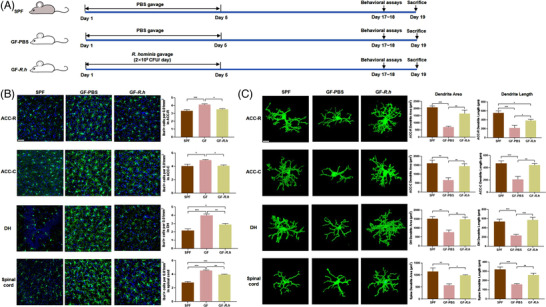
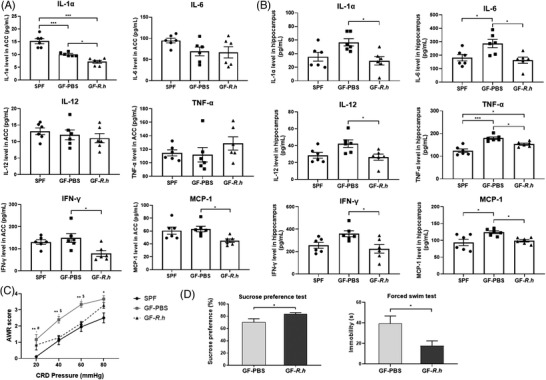
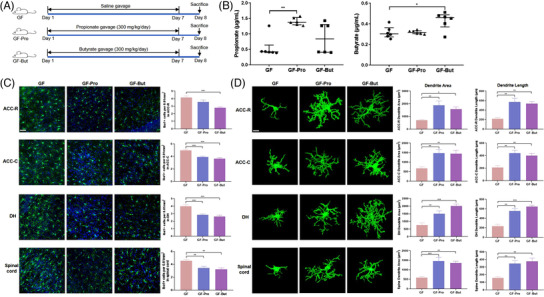
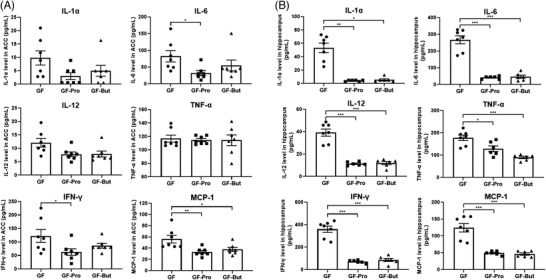
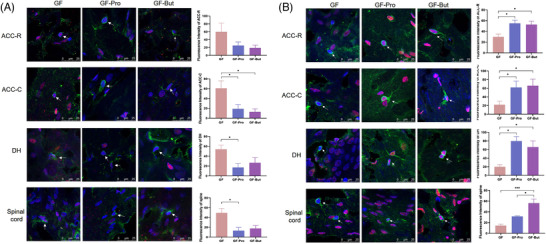
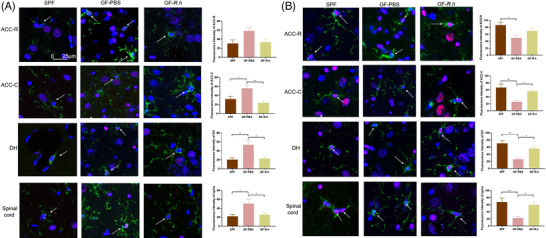
First, germ-free (GF) rats are orally treated with R. hominis. Microglial activation, proinflammatory cytokines, levels of short-chain fatty acids, depressive behaviors, and visceral sensitivity are assessed. Second, GF rats are treated with propionate or butyrate, and microglial activation, proinflammatory cytokines, histone deacetylase 1 (HDAC1), and histone H3 acetyl K9 (Ac-H3K9) are analyzed. The results show that R. hominis administration inhibits microglial activation, reduces the levels of IL-1α, INF-γ, and MCP-1 in the brain, and alleviates depressive behaviors and visceral hypersensitivity in GF rats. Moreover, the serum levels of propionate and butyrate are increased significantly in the R. hominis-treated group. Propionate or butyrate treatment reduces microglial activation, the levels of proinflammatory cytokines and HDAC1, and promotes the expression of Ac-H3K9 in the brain.
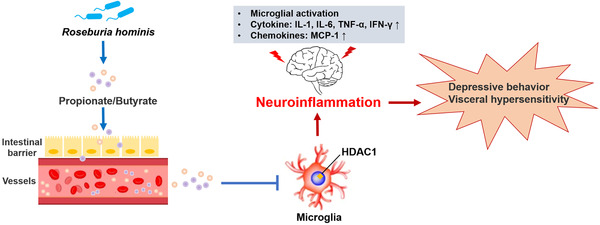
These findings suggest that R. hominis alleviates neuroinflammation by producing propionate and butyrate, which serve as HDAC inhibitors. This study provides a potential psychoprobiotic to reduce neuroinflammation.
肠道微生物群在肠道-大脑相互作用中起着突出的作用,肠道菌群失调与神经炎症有关。然而,需要探索针对神经炎症的特定益生菌。本研究探讨了潜在益生菌罗斯伯里亚·霍米尼斯(R. hominis)的抗神经炎症作用及其潜在机制。
首先,无菌(GF)大鼠经口给予 R. hominis。评估小胶质细胞激活、促炎细胞因子、短链脂肪酸水平、抑郁行为和内脏敏感性。其次,用丙酸盐或丁酸盐处理 GF 大鼠,分析小胶质细胞激活、促炎细胞因子、组蛋白去乙酰化酶 1(HDAC1)和组蛋白 H3 乙酰 K9(Ac-H3K9)。结果表明,R. hominis 给药抑制小胶质细胞激活,降低大脑中 IL-1α、INF-γ和 MCP-1 的水平,并缓解 GF 大鼠的抑郁行为和内脏敏感性。此外,R. hominis 治疗组血清中丙酸盐和丁酸盐水平显著升高。丙酸盐或丁酸盐治疗可减少小胶质细胞激活、促炎细胞因子和 HDAC1 的水平,并促进大脑中 Ac-H3K9 的表达。
这些发现表明,R. hominis 通过产生丙酸盐和丁酸盐来减轻神经炎症,丙酸盐和丁酸盐作为 HDAC 抑制剂。本研究为减少神经炎症提供了一种潜在的心理益生菌。