Hoier Birgitte, Olsen Line Nørregaard, Leinum Maria, Jørgensen Tue Smith, Carter Howard Henry, Hellsten Ylva, Bangsbo Jens
Department of Nutrition, Exercise and Sports, University of Copenhagen, Copenhagen, Denmark.
Herlev Hospital, Copenhagen, Denmark.
Front Aging. 2021 Apr 23;2:667519. doi: 10.3389/fragi.2021.667519. eCollection 2021.
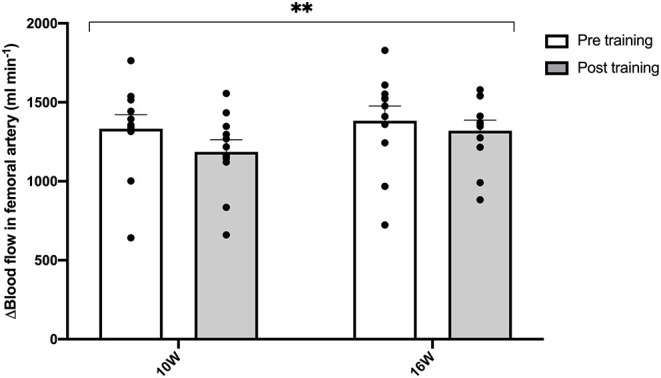
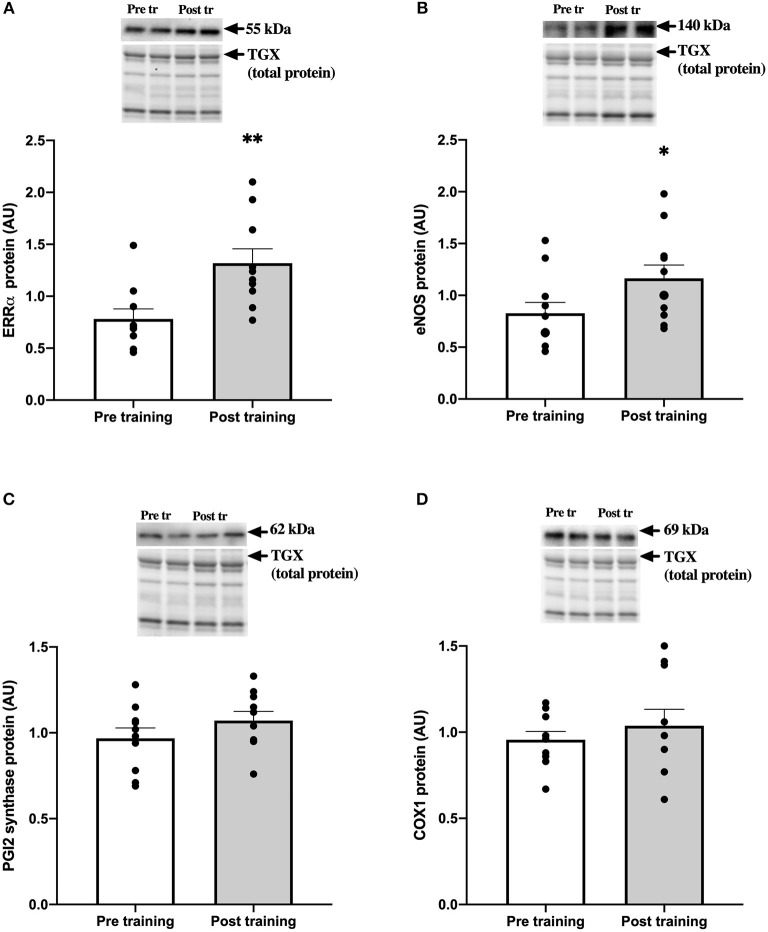
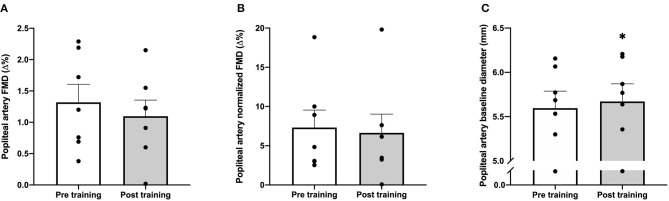
The aim of this study was to determine the effect of a period of aerobic high intensity training on central- and peripheral cardiovascular parameters in older post-menopausal women. Eleven healthy post-menopausal (>10 years after menopause) women (mean age: 64 years; BMI: 25.3 kg m) completed an 8-week period of supervised, high intensity cycle training, with sessions conducted three times per week. Before and after the training period maximal oxygen uptake, body composition, popliteal artery flow mediated dilation, exercise hyperemia, arterial blood pressure, and plasma lipids were assessed. In addition, levels of estrogen related receptor α (ERRα) and vasodilator enzymes were determined in muscle biopsy samples. Training induced an 18% increase ( < 0.001) in maximal oxygen uptake. Plasma High-density lipoprotein (HDL) was higher ( < 0.05) after than before the training period. Fat mass was reduced (4.9%; < 0.01), whereas lean body mass was unaltered. Mean arterial blood pressure was unchanged (91 vs. 88 mmHg; = 0.058) with training. Training did not induce a change in popliteal flow mediated dilation. Exercise hyperemia at submaximal exercise was lower ( < 0.01; 11 and 4.6% at 10 and 16 W, respectively) after compared to before training. Muscle ERRα (1.7-fold; < 0.01) and eNOS (1.4-fold; < 0.05) were higher after the training intervention. The current study demonstrates that, in older post-menopausal women, a period of aerobic high intensity training effectively increases maximal oxygen uptake and improves the cardiovascular health profile, without a parallel improvement in conduit artery function.
本研究的目的是确定一段有氧高强度训练对绝经后老年女性的中心和外周心血管参数的影响。11名健康的绝经后(绝经超过10年)女性(平均年龄:64岁;体重指数:25.3 kg/m²)完成了为期8周的有监督的高强度自行车训练,每周进行三次训练。在训练期前后评估了最大摄氧量、身体成分、腘动脉血流介导的扩张、运动性充血、动脉血压和血脂。此外,还测定了肌肉活检样本中雌激素相关受体α(ERRα)和血管舒张酶的水平。训练使最大摄氧量增加了18%(P<0.001)。训练期后血浆高密度脂蛋白(HDL)高于训练前(P<0.05)。脂肪量减少(4.9%;P<0.01),而瘦体重未改变。训练后平均动脉血压无变化(91 vs. 88 mmHg;P = 0.058)。训练未引起腘动脉血流介导的扩张变化。与训练前相比,次最大运动时的运动性充血在训练后降低(P<0.01;在10 W和16 W时分别为11%和4.6%)。训练干预后肌肉ERRα(约1.7倍;P<0.01)和内皮型一氧化氮合酶(eNOS,约1.4倍;P<0.05)升高。本研究表明,在绝经后老年女性中,一段有氧高强度训练能有效增加最大摄氧量并改善心血管健康状况,但对 conduit 动脉功能无相应改善。