. Divisão de Cirurgia Torácica, Departamento de Cardiopneumologia, Hospital das Clinicas, Faculdade de Medicina, Universidade de São Paulo, São Paulo (SP) Brasil.
J Bras Pneumol. 2022 Jul 8;48(4):e20210464. doi: 10.36416/1806-3756/e20210464. eCollection 2022.
To compare 90-day morbidity in patients undergoing lung lobectomy performed by either robotic-assisted thoracic surgery (RATS) or video-assisted thoracic surgery (VATS). Intraoperative complications, drainage time, length of hospital stay, postoperative pain, postoperative quality of life, and readmissions within 90 days were also compared.
This was a two-arm randomized clinical trial including patients with lung lesions (primary lung cancer or lung metastasis) who were candidates for lung lobectomy. Patients with comorbidities that precluded surgical treatment were excluded. All patients followed the same postoperative protocol.
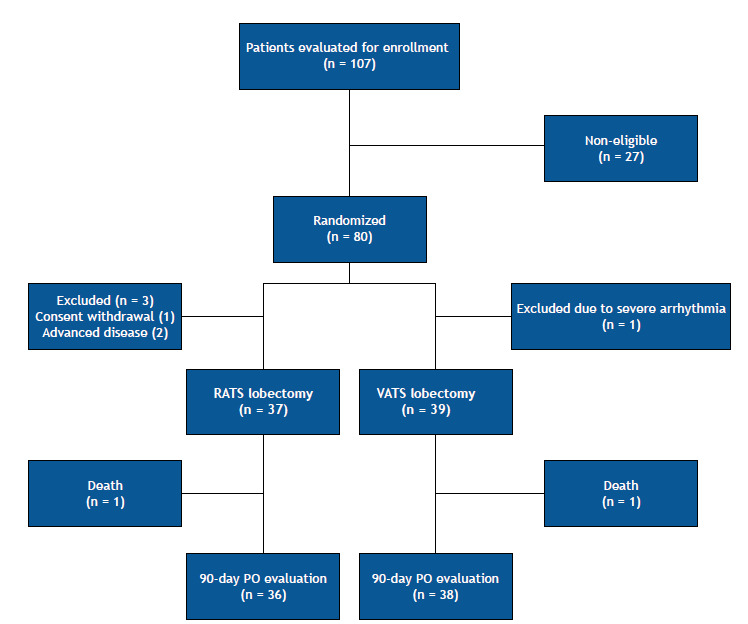
The overall sample comprised 76 patients (39 in the VATS group and 37 in the RATS group). The two groups were similar regarding gender, age, BMI, FEV1 in % of predicted, and comorbidities. Postoperative complications within 90 days tended to be more common in the VATS group than in the RATS group, but the difference was not significant (p = 0.12). However, when only major complications were analyzed, this tendency disappeared (p = 0.58). Regarding postoperative outcomes, the VATS group had a significantly higher number of readmissions within 90 days than did the RATS group (p = 0.029). No significant differences were found regarding intraoperative complications, drainage time, length of hospital stay, postoperative pain, and postoperative quality of life.
RATS and VATS lobectomy had similar 90-day outcomes. However, RATS lobectomy was associated with a significant reduction in the 90-day hospital readmission rate. Larger studies are necessary to confirm such a finding.(ClinicalTrials.gov identifier: NCT02292914 [http://www.clinicaltrials.gov/]).
比较机器人辅助胸腔镜手术(RATS)与电视辅助胸腔镜手术(VATS)行肺叶切除术患者的 90 天发病率。还比较了术中并发症、引流时间、住院时间、术后疼痛、术后生活质量以及 90 天内再入院率。
这是一项双臂随机临床试验,纳入了适合行肺叶切除术的肺部病变(原发性肺癌或肺转移瘤)患者。排除了有手术治疗禁忌证的合并症患者。所有患者均遵循相同的术后方案。
总体样本包括 76 例患者(VATS 组 39 例,RATS 组 37 例)。两组在性别、年龄、BMI、预计 FEV1%和合并症方面相似。VATS 组患者术后 90 天内并发症发生率高于 RATS 组,但差异无统计学意义(p=0.12)。然而,当仅分析主要并发症时,这一趋势消失(p=0.58)。关于术后结果,VATS 组患者术后 90 天内再入院率显著高于 RATS 组(p=0.029)。两组在术中并发症、引流时间、住院时间、术后疼痛和术后生活质量方面无显著差异。
RATS 和 VATS 肺叶切除术的 90 天结局相似。然而,RATS 肺叶切除术与 90 天内住院再入院率显著降低相关。需要更大规模的研究来证实这一发现。(ClinicalTrials.gov 标识符:NCT02292914 [http://www.clinicaltrials.gov/])。