Universidade Federal de São Paulo, São Paulo, SP, Brazil.
Faculdade de Ciências Médicas, Santa Casa de São Paulo, São Paulo, SP, Brazil.
Rev Paul Pediatr. 2022 Jul 6;41:e2021272. doi: 10.1590/1984-0462/2023/41/2021272. eCollection 2022.
To estimate the temporal trend of the incidence rates of accidents with venomous animals in children and adolescents in Brazil.
An ecological time-series study was carried out between 2007 and 2019. Data were obtained from the Brazilian Information System on Diseases of Compulsory Declaration (Sistema de Informação de Agravos de Notificação - SINAN). The time series of incidence rates of accidents with venomous animals were stratified by age group (children aged 0 to 9 years and adolescents aged 10 to 19 years), Brazilian macro-regions (North, Northeast, Midwest, Southeast, and South), and type of accident (snake, scorpion, spider, and caterpillar). For trend analysis, the Prais-Winsten model and the Annual Percent Change (APC) were used.
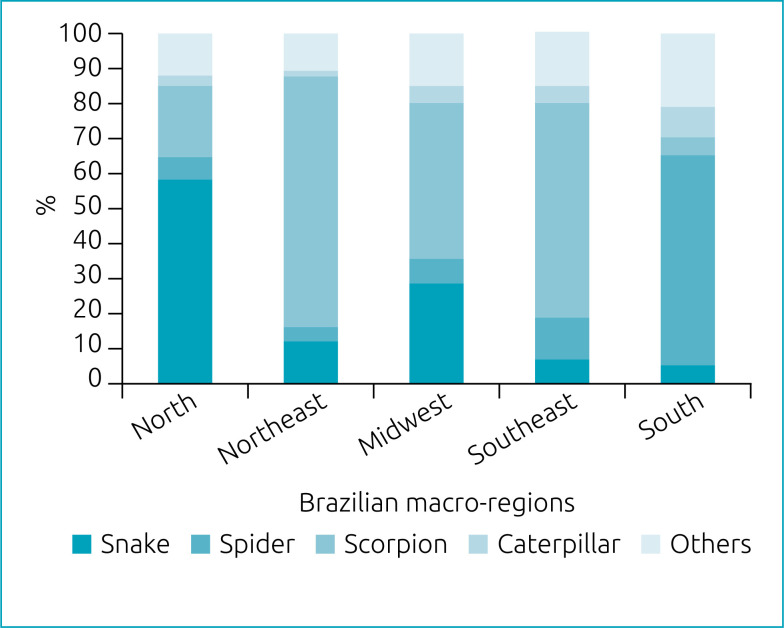
The time series of the incidence rate of accidents with venomous animals in children and adolescents from the North, Northeast, Midwest, and Southeast macro-regions and in children from the South region showed an upward trend. The average annual incidence rates were higher in the age group of 10 to 19 years, except for the South macro-region. Accidents with scorpions, snakes, and spiders, in this order, were the most frequent; the trends in the time series stratified by type of animal varied according to the geographic macro-region.
There was an upward trend in the incidence rate of accidents with venomous animals in children and adolescents in Brazil, except for adolescents in the South macro-region of the country.
估计巴西儿童和青少年被有毒动物咬伤事故发生率的时间趋势。
本生态时间序列研究于 2007 年至 2019 年进行。数据来自巴西强制报告疾病信息系统(Sistema de Informação de Agravos de Notificação - SINAN)。按年龄组(0 至 9 岁儿童和 10 至 19 岁青少年)、巴西宏观区域(北部、东北部、中西部、东南部和南部)和事故类型(蛇、蝎子、蜘蛛和毛毛虫)对有毒动物咬伤事故发生率的时间序列进行分层。采用 Prais-Winsten 模型和年变化百分比(APC)进行趋势分析。
来自北部、东北部、中西部和东南部宏观区域以及南部地区的儿童和青少年被有毒动物咬伤事故发生率的时间序列呈上升趋势。除南部地区外,10 至 19 岁年龄组的平均年发生率较高。蝎子、蛇和蜘蛛引起的事故最为频繁;按动物类型分层的时间序列趋势因地理宏观区域而异。
巴西儿童和青少年被有毒动物咬伤事故发生率呈上升趋势,但该国南部地区的青少年除外。