Márquez Katherine, Márquez Nicole, Ávila Felipe, Cruz Nadia, Burgos-Edwards Alberto, Pardo Ximena, Carrasco Basilio
Centro de Estudios en Alimentos Procesados (CEAP), CONICYT-Regional, Gore Maule R0912001, Talca, Chile.
Escuela de Nutrición y Dietética, Facultad de Ciencias de la Salud, Universidad de Talca, Talca, Chile.
Front Nutr. 2022 Jun 23;9:895070. doi: 10.3389/fnut.2022.895070. eCollection 2022.
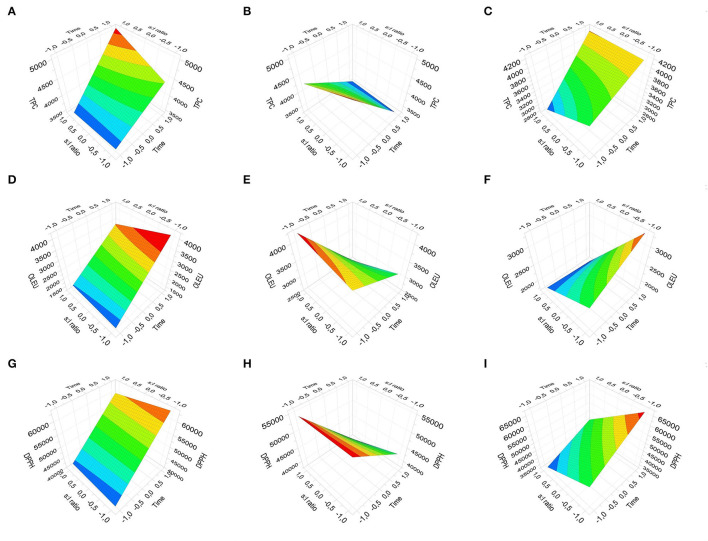
Olive oil consumption has increased in the last two decades and consequently, its wastes have increased, which generates a tremendous environmental impact. Among the by-products are the olive mill leaves, which are easier and inexpensive to treat than other olive by-products. However, little research has been done on their chemical composition and potential bioactivity. Hence, in this study, olive mill leaves were used to obtain Oleuropein-Enriched Extracts (OLEU-EE) using Conventional Extraction, Ultrasound-Assisted Extraction, and Homogenization-Assisted Extraction. These three techniques were evaluated using a Factorial Design to determine the parameters to obtain an OLEU-EE with high contents of Total Phenolic Compounds (TPC), Antioxidant Activity (AA), and Oleuropein concentration (OLEU). From the results, the Homogenizer-Assisted Extraction (HAE) technique was selected at 18,000 rpm, solid:liquid ratio 1:10, and 30 s of homogenization with 70% ethanol, due to its high TPC (5,196 mg GA/100 g), AA (57,867 μmol of TE/100 g), and OLEU (4,345 mg of OLEU/100 g). In addition, the antiglycating effect of OLEU-EE on the levels of (1) fluorescent Advanced Glycation End Products (AGEs) were IC of 0.1899 and 0.1697 mg/mL for λ 325/λ 440 and λ 389/λ 443, respectively; (2) protein oxidative damage markers such as dityrosine (DiTyr), N-formylkynurenine (N-formyl Kyn), and kynurenine (Kyn) were IC of 0.1852, 0.2044, and 0.1720 mg/mL, respectively. In conclusion, OLEU-EE from olive mill leaves has different capacities to inhibit AGEs evidenced by the IC of fluorescent AGEs and protein oxidation products, together with the scavenging free radical evidenced by the concentration of Trolox Equivalent. Therefore, OLEU-EE could be potential functional ingredients that prevent oxidative damage caused by free radicals and AGEs accumulation.
在过去二十年中,橄榄油的消费量有所增加,因此其废弃物也随之增加,这对环境产生了巨大影响。其中,橄榄渣叶是副产品之一,相较于其他橄榄副产品,其处理起来更为简便且成本低廉。然而,针对其化学成分和潜在生物活性的研究却很少。因此,在本研究中,采用传统提取法、超声辅助提取法和均质辅助提取法,利用橄榄渣叶来获取富含橄榄苦苷的提取物(OLEU-EE)。运用析因设计对这三种技术进行评估,以确定获得总酚化合物(TPC)、抗氧化活性(AA)和橄榄苦苷浓度(OLEU)含量高的OLEU-EE的参数。结果表明,选择均质辅助提取(HAE)技术,转速为18,000转/分钟,固液比为1:10,用70%乙醇均质30秒,因为其TPC含量高(5,196毫克没食子酸/100克)、AA含量高(57,867微摩尔TE/100克)以及OLEU含量高(4,345毫克OLEU/100克)。此外,OLEU-EE对(1)荧光晚期糖基化终产物(AGEs)水平的抗糖化作用,对于λ 325/λ 440和λ 389/λ 443,IC分别为0.1899和0.1697毫克/毫升;(2)蛋白质氧化损伤标志物,如二酪氨酸(DiTyr)、N-甲酰犬尿氨酸(N-甲酰犬尿)和犬尿氨酸(Kyn),IC分别为0.1852、0.2044和0.1720毫克/毫升。总之,橄榄渣叶中的OLEU-EE具有不同的抑制AGEs的能力,这通过荧光AGEs和蛋白质氧化产物的IC得以证明,同时其清除自由基的能力也通过Trolox当量浓度得以体现。因此,OLEU-EE可能是预防自由基和AGEs积累所导致的氧化损伤的潜在功能成分。