Hills Kate E, Kostarelos Kostas, Wykes Robert C
Nanomedicine Lab, Faculty of Biology, Medicine and Health, University of Manchester, Manchester, United Kingdom.
Catalan Institute for Nanoscience and Nanotechnology (ICN2), Edifici ICN2, Campus UAB, Barcelona, Spain.
Front Mol Neurosci. 2022 Jun 27;15:903115. doi: 10.3389/fnmol.2022.903115. eCollection 2022.
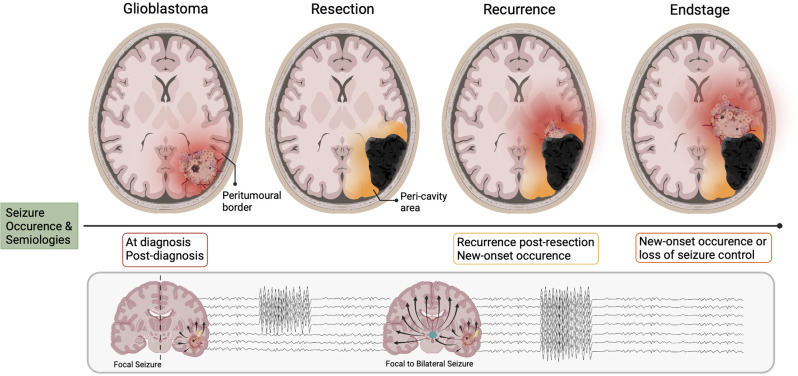
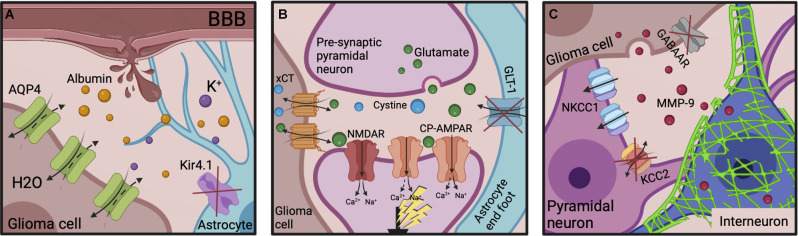
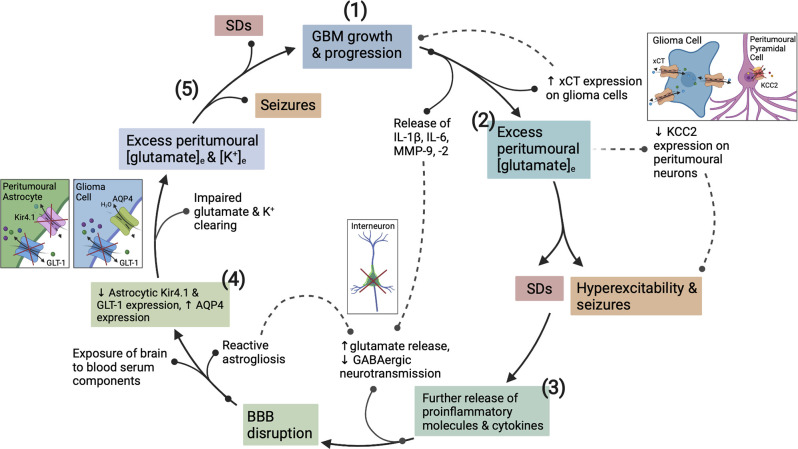
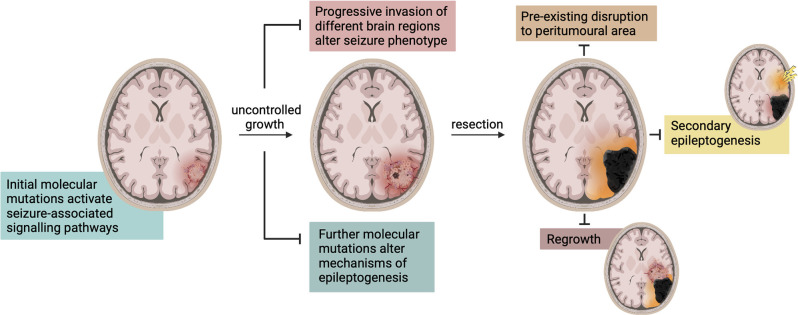
Glioblastoma (GBM) is the most common and advanced form of primary malignant tumor occurring in the adult central nervous system, and it is frequently associated with epilepsy, a debilitating comorbidity. Seizures are observed both pre- and post-surgical resection, indicating that several pathophysiological mechanisms are shared but also prompting questions about how the process of epileptogenesis evolves throughout GBM progression. Molecular mutations commonly seen in primary GBM, i.e., in and p53, and their associated downstream effects are known to influence seizure likelihood. Similarly, various intratumoral mechanisms, such as GBM-induced blood-brain barrier breakdown and glioma-immune cell interactions within the tumor microenvironment are also cited as contributing to network hyperexcitability. Substantial alterations to peri-tumoral glutamate and chloride transporter expressions, as well as widespread dysregulation of GABAergic signaling are known to confer increased epileptogenicity and excitotoxicity. The abnormal characteristics of GBM alter neuronal network function to result in metabolically vulnerable and hyperexcitable peri-tumoral tissue, properties the tumor then exploits to favor its own growth even post-resection. It is evident that there is a complex, dynamic interplay between GBM and epilepsy that promotes the progression of both pathologies. This interaction is only more complicated by the concomitant presence of spreading depolarization (SD). The spontaneous, high-frequency nature of GBM-associated epileptiform activity and SD-associated direct current (DC) shifts require technologies capable of recording brain signals over a wide bandwidth, presenting major challenges for comprehensive electrophysiological investigations. This review will initially provide a detailed examination of the underlying mechanisms that promote network hyperexcitability in GBM. We will then discuss how an investigation of these pathologies from a network level, and utilization of novel electrophysiological tools, will yield a more-effective, clinically-relevant understanding of GBM-related epileptogenesis. Further to this, we will evaluate the clinical relevance of current preclinical research and consider how future therapeutic advancements may impact the bidirectional relationship between GBM, SDs, and seizures.
胶质母细胞瘤(GBM)是成人中枢神经系统中最常见且最严重的原发性恶性肿瘤形式,并且它常与癫痫相关,癫痫是一种使人衰弱的合并症。在手术切除前后均观察到癫痫发作,这表明几种病理生理机制是共有的,但也引发了关于癫痫发生过程如何在GBM进展过程中演变的问题。已知原发性GBM中常见的分子突变,即 和p53,及其相关的下游效应会影响癫痫发作的可能性。同样,各种肿瘤内机制,如GBM诱导的血脑屏障破坏以及肿瘤微环境内的胶质瘤 - 免疫细胞相互作用,也被认为是导致网络兴奋性过高的原因。已知肿瘤周围谷氨酸和氯离子转运体表达的大量改变以及GABA能信号的广泛失调会导致癫痫发生性和兴奋性毒性增加。GBM的异常特征改变了神经元网络功能,导致肿瘤周围组织代谢脆弱且兴奋性过高,肿瘤利用这些特性即使在切除后也有利于自身生长。很明显,GBM和癫痫之间存在复杂、动态的相互作用,促进了这两种病理状态的进展。这种相互作用因同时存在扩散性去极化(SD)而更加复杂。与GBM相关的癫痫样活动的自发、高频性质以及与SD相关的直流(DC)偏移需要能够在宽频带上记录脑信号的技术,这给全面的电生理研究带来了重大挑战。本综述最初将详细探讨促进GBM中网络兴奋性过高的潜在机制。然后我们将讨论从网络层面研究这些病理状态以及利用新型电生理工具如何能更有效地、与临床相关地理解GBM相关的癫痫发生。除此之外,我们将评估当前临床前研究的临床相关性,并考虑未来治疗进展可能如何影响GBM、SD和癫痫之间的双向关系。