De Ridder Dirk, Vanneste Sven, Song Jae-Jin, Adhia Divya
Section of Neurosurgery, Department of Surgical Sciences, Dunedin School of Medicine, University of Otago, Dunedin, New Zealand.
Global Brain Health Institute, Trinity College Dublin, Dublin, Ireland.
Clin Exp Otorhinolaryngol. 2022 Aug;15(3):205-212. doi: 10.21053/ceo.2022.00815. Epub 2022 Jul 11.
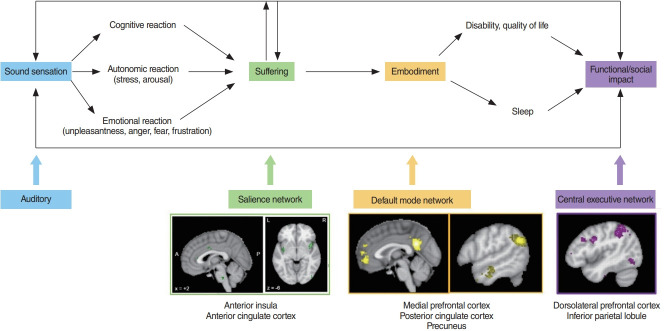
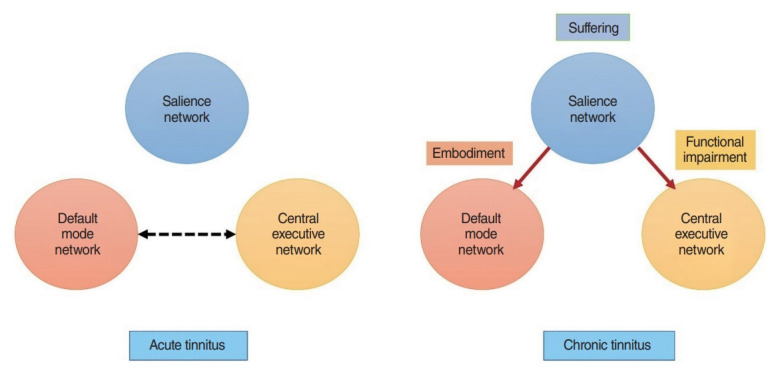
Tinnitus is defined as the conscious awareness of a sound without an identifiable external sound source, and tinnitus disorder as tinnitus with associated suffering. Chronic tinnitus has been anatomically and phenomenologically separated into three pathways: a lateral "sound" pathway, a medial "suffering" pathway, and a descending noise-canceling pathway. Here, the triple network model is proposed as a unifying framework common to neuropsychiatric disorders. It proposes that abnormal interactions among three cardinal networks-the self-representational default mode network, the behavioral relevance-encoding salience network and the goal-oriented central executive network-underlie brain disorders. Tinnitus commonly leads to negative cognitive, emotional, and autonomic responses, phenomenologically expressed as tinnitus-related suffering, processed by the medial pathway. This anatomically overlaps with the salience network, encoding the behavioral relevance of the sound stimulus. Chronic tinnitus can also become associated with the self-representing default mode network and becomes an intrinsic part of the self-percept. This is likely an energy-saving evolutionary adaptation, by detaching tinnitus from sympathetic energy-consuming activity. Eventually, this can lead to functional disability by interfering with the central executive network. In conclusion, these three pathways can be extended to a triple network model explaining all tinnitus-associated comorbidities. This model paves the way for the development of individualized treatment modalities.
耳鸣被定义为在没有可识别的外部声源的情况下对声音的自觉意识,耳鸣障碍则是指伴有相关痛苦的耳鸣。慢性耳鸣在解剖学和现象学上已被分为三条通路:一条外侧的“声音”通路、一条内侧的“痛苦”通路和一条下行的噪声消除通路。在此,三重网络模型被提出作为神经精神疾病共有的统一框架。它提出,三个主要网络——自我表征默认模式网络、行为相关性编码突显网络和目标导向中央执行网络之间的异常相互作用是脑部疾病的基础。耳鸣通常会导致负面的认知、情绪和自主反应,在现象学上表现为与耳鸣相关的痛苦,由内侧通路处理。这在解剖学上与突显网络重叠,突显网络对声音刺激的行为相关性进行编码。慢性耳鸣也可能与自我表征默认模式网络相关联,并成为自我感知的一个内在部分。这可能是一种节能的进化适应,通过将耳鸣与消耗交感神经能量的活动分离。最终,这可能会通过干扰中央执行网络而导致功能障碍。总之,这三条通路可以扩展为一个三重网络模型,用以解释所有与耳鸣相关的合并症。该模型为个性化治疗方式的发展铺平了道路。