Neff P, Simões J, Psatha S, Nyamaa A, Boecking B, Rausch L, Dettling-Papargyris J, Funk C, Brueggemann P, Mazurek B
Department of Psychiatry and Psychotherapy, University of Regensburg, Regensburg, Germany.
University Research Priority Program 'Dynamics of Healthy Aging', University of Zürich, Zürich, Switzerland.
Sci Rep. 2021 Jan 26;11(1):2243. doi: 10.1038/s41598-021-81728-0.
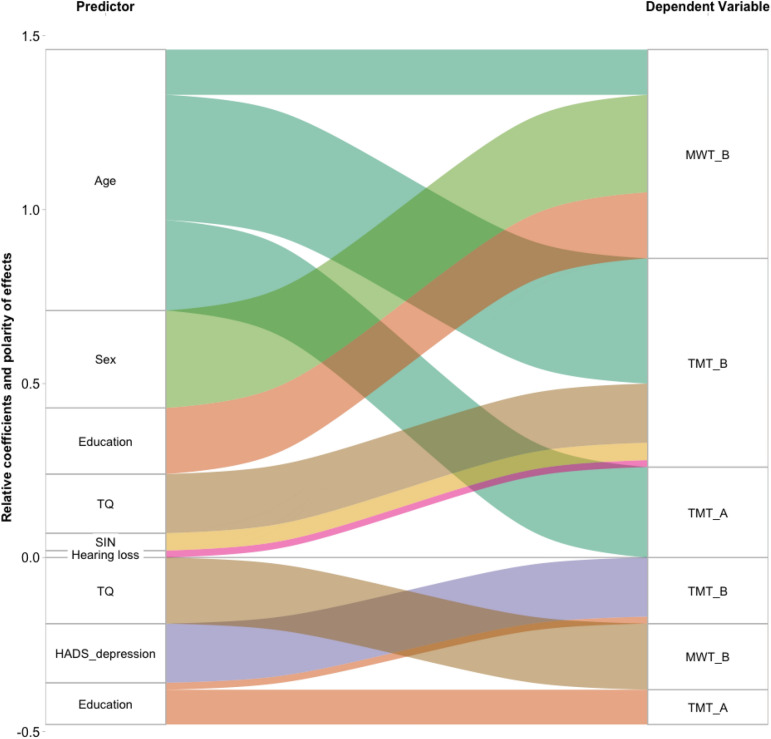
Tinnitus is the chronic perception of a phantom sound with different levels of related distress. Past research has elucidated interactions of tinnitus distress with audiological, affective and further clinical variables. The influence of tinnitus distress on cognition is underinvestigated. Our study aims at investigating specific influences of tinnitus distress and further associated predictors on cognition in a cohort of n = 146 out-ward clinical tinnitus patients. Age, educational level, hearing loss, Tinnitus Questionnaire (TQ) score, tinnitus duration, speech in noise (SIN), stress, anxiety and depression, and psychological well-being were included as predictors of a machine learning regression approach (elastic net) in three models with scores of a multiple choice vocabulary test (MWT-B), or two trail-making tests (TMT-A and TMT-B), as dependent variables. TQ scores predicted lower MWT-B scores and higher TMT-B test completion time. Stress, emotional, and psychological variables were not found to be relevant predictors in all models with the exception of small positive influences of SIN and depression on TMT-B. Effect sizes were small to medium for all models and predictors. Results are indicative of specific influence of tinnitus distress on cognitive performance, especially on general or crystallized intelligence and executive functions. More research is needed at the delicate intersection of tinnitus distress and cognitive skills needed in daily functioning.
耳鸣是对幻听的慢性感知,伴有不同程度的相关痛苦。过去的研究已经阐明了耳鸣痛苦与听力学、情感及其他临床变量之间的相互作用。耳鸣痛苦对认知的影响研究不足。我们的研究旨在调查耳鸣痛苦及其他相关预测因素对一组n = 146名门诊临床耳鸣患者认知的具体影响。年龄、教育水平、听力损失、耳鸣问卷(TQ)得分、耳鸣持续时间、噪声中的言语(SIN)、压力、焦虑和抑郁以及心理健康被纳入机器学习回归方法(弹性网络)的预测因素,在三个模型中,以多项选择词汇测试(MWT-B)得分或两个连线测验(TMT-A和TMT-B)作为因变量。TQ得分预测MWT-B得分较低且TMT-B测试完成时间较长。除了SIN和抑郁对TMT-B有小的正向影响外,压力、情绪和心理变量在所有模型中均未被发现是相关预测因素。所有模型和预测因素的效应大小为小到中等。结果表明耳鸣痛苦对认知表现有特定影响,尤其是对一般或晶体智力以及执行功能。在耳鸣痛苦与日常功能所需认知技能的微妙交叉点上,还需要更多研究。