Kozawa Takahiro, Kitabayashi Fumiya, Fukuyama Kayo, Naito Makio
Joining and Welding Research Institute, Osaka University, 11-1 Mihogaoka, Ibaraki, Osaka, 567-0047, Japan.
Sci Rep. 2022 Jul 14;12(1):11992. doi: 10.1038/s41598-022-16383-0.
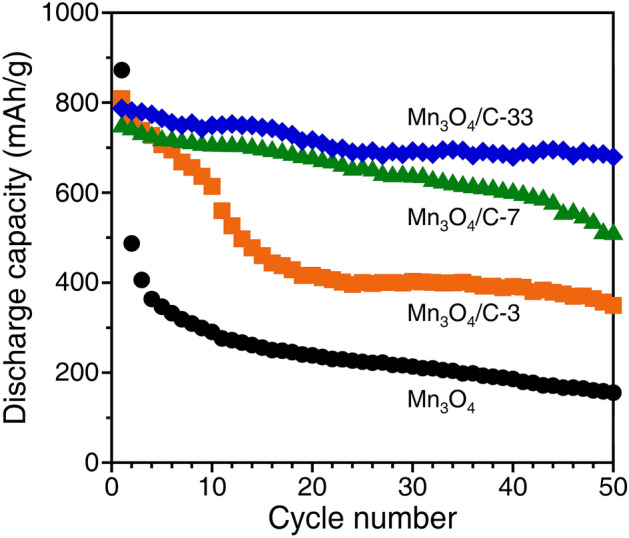
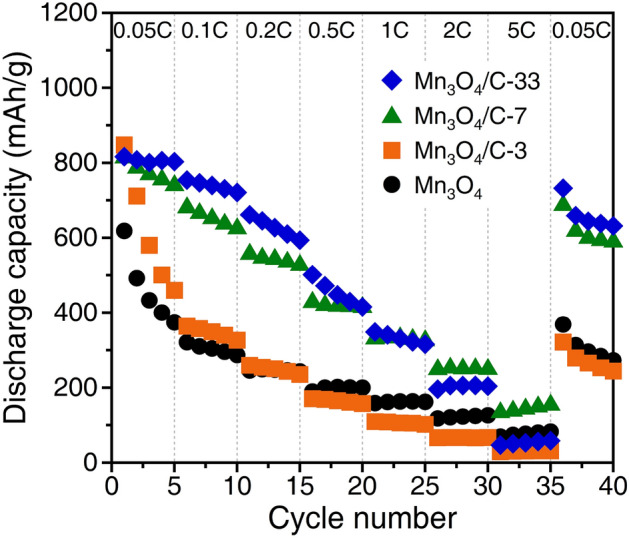
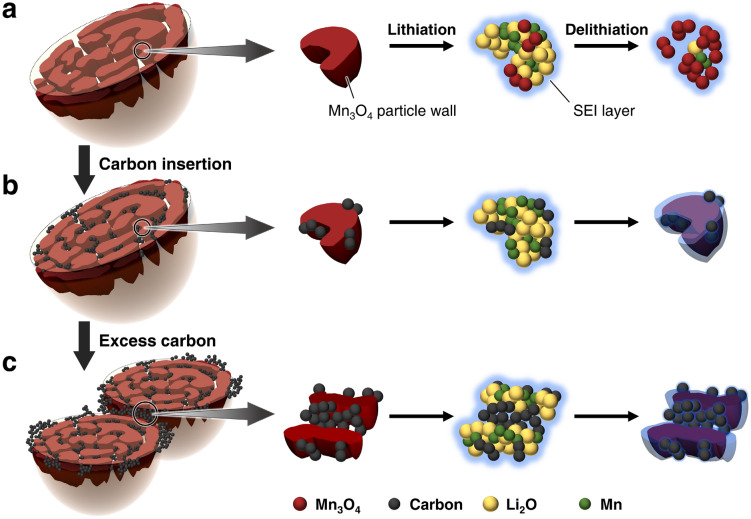
Manganese oxide (MnO) has garnered substantial attention as a low-cost, environment-friendly anode material. It undergoes a conversion reaction involving the formation of LiO and metallic Mn to provide high-energy Li-ion batteries. However, its low electrical conductivity and significant volume change reduce its capacity during the initial lithiation/delithiation, hindering its practical application. To improve the cycle performance, we propose a new composite structure wherein we entrap carbon nanoparticles in macroporous MnO microspheres with a unique maze-like porous interior. We fabricate the MnO/C composites using a scalable two-step process involving the thermal decomposition of MnCO in water vapor and mixing in a carbon-dispersed solution. The fabricated MnO/C composites with varying carbon contents exhibit a high maximum discharge capacity retention of 86% after 50 cycles, compared to the 18% given by bare MnO. The entrapped carbon nanoparticles improve the cycle performance both electrochemically and physically. The microstructure of the composite particles and the fabrication process developed in this study will help improve the performance of other conversion-type anode materials that suffer from cycle degradation, including inexpensive transition metal oxides and sulfides.
氧化锰(MnO)作为一种低成本、环境友好型阳极材料已引起广泛关注。它经历一个涉及形成LiO和金属Mn的转化反应,以提供高能量锂离子电池。然而,其低电导率和显著的体积变化会降低其在首次锂化/脱锂过程中的容量,阻碍其实际应用。为了提高循环性能,我们提出了一种新的复合结构,即将碳纳米颗粒包裹在具有独特迷宫状内部多孔结构的大孔MnO微球中。我们采用一种可扩展的两步法制备MnO/C复合材料,该方法包括在水蒸气中热分解MnCO并在碳分散溶液中混合。与裸MnO给出的18%相比,制备的具有不同碳含量的MnO/C复合材料在50次循环后表现出高达86%的高最大放电容量保持率。包裹的碳纳米颗粒在电化学和物理方面都改善了循环性能。本研究中开发的复合颗粒微观结构和制备工艺将有助于提高其他遭受循环降解的转化型阳极材料的性能,包括廉价的过渡金属氧化物和硫化物。