Motloch Lukas J, Jirak Peter, Gareeva Diana, Davtyan Paruir, Gumerov Ruslan, Lakman Irina, Tataurov Aleksandr, Zulkarneev Rustem, Kabirov Ildar, Cai Benzhi, Valeev Bairas, Pavlov Valentin, Kopp Kristen, Hoppe Uta C, Lichtenauer Michael, Fiedler Lukas, Pistulli Rudin, Zagidullin Naufal
University Clinic for Internal Medicine II, Paracelsus Medical University, Salzburg, Austria.
Cardiovascular Disease in COVID-19, International Research Network, Ufa, Russia.
Front Med (Lausanne). 2022 Jun 28;9:906665. doi: 10.3389/fmed.2022.906665. eCollection 2022.
While COVID-19 affects the cardiovascular system, the potential clinical impact of cardiovascular biomarkers on predicting outcomes in COVID-19 patients is still unknown. Therefore, to investigate this issue we analyzed the prognostic potential of cardiac biomarkers on in-hospital and long-term post-discharge mortality of patients with COVID-19 pneumonia.
Serum soluble ST2, VCAM-1, and hs-TnI were evaluated upon admission in 280 consecutive patients hospitalized with COVID-19-associated pneumonia in a single, tertiary care center. Patient clinical and laboratory characteristics and the concentration of biomarkers were correlated with in-hospital [Hospital stay: 11 days (10; 14)] and post-discharge all-cause mortality at 1 year follow-up [FU: 354 days (342; 361)].
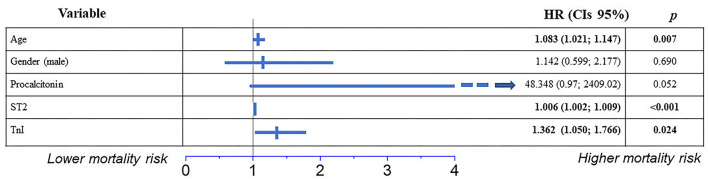
11 patients died while hospitalized for COVID-19 (3.9%), and 11 patients died during the 1-year post-discharge follow-up period ( = 11, 4.1%). Using multivariate analysis, VCAM-1 was shown to predict mortality during the hospital period (HR 1.081, CI 95% 1.035;1.129, = 0.017), but not ST2 or hs-TnI. In contrast, during one-year FU post hospital discharge, ST2 (HR 1.006, 95% CI 1.002;1.009, < 0.001) and hs-TnI (HR 1.362, 95% CI 1.050;1.766, = 0.024) predicted mortality, although not VCAM-1.
In patients hospitalized with Covid-19 pneumonia, elevated levels of VCAM-1 at admission were associated with in-hospital mortality, while ST2 and hs-TnI might predict post-discharge mortality in long term follow-up.
虽然新型冠状病毒肺炎(COVID-19)会影响心血管系统,但心血管生物标志物对预测COVID-19患者预后的潜在临床影响仍不明确。因此,为研究此问题,我们分析了心脏生物标志物对COVID-19肺炎患者住院期间及出院后长期死亡率的预后潜力。
在一家三级医疗中心,对280例因COVID-19相关性肺炎连续住院的患者入院时评估血清可溶性ST2、血管细胞黏附分子-1(VCAM-1)和高敏肌钙蛋白I(hs-TnI)。患者的临床和实验室特征以及生物标志物浓度与住院期间[住院时间:11天(10;14)]和出院后1年随访期[随访:354天(342;361)]的全因死亡率相关。
11例患者在因COVID-19住院期间死亡(3.9%),11例患者在出院后1年随访期内死亡(n = 11,4.1%)。采用多因素分析,结果显示VCAM-1可预测住院期间的死亡率(风险比1.081,95%置信区间1.035;1.129,P = 0.017),但ST2或hs-TnI不能。相反,在出院后1年随访期间,ST2(风险比1.006,95%置信区间1.002;1.009,P < 0.001)和hs-TnI(风险比1.362,95%置信区间1.050;1.766,P = 0.024)可预测死亡率,而VCAM-1不能。
在因COVID-19肺炎住院的患者中,入院时VCAM-1水平升高与住院期间死亡率相关,而ST2和hs-TnI可能在长期随访中预测出院后死亡率。