School of Biological and Behavioural Sciences, Queen Mary University of London, London, UK.
Center for Mind/Brain Sciences, University of Trento, Rovereto, Italy.
Sci Rep. 2022 Jul 15;12(1):12086. doi: 10.1038/s41598-022-14963-8.
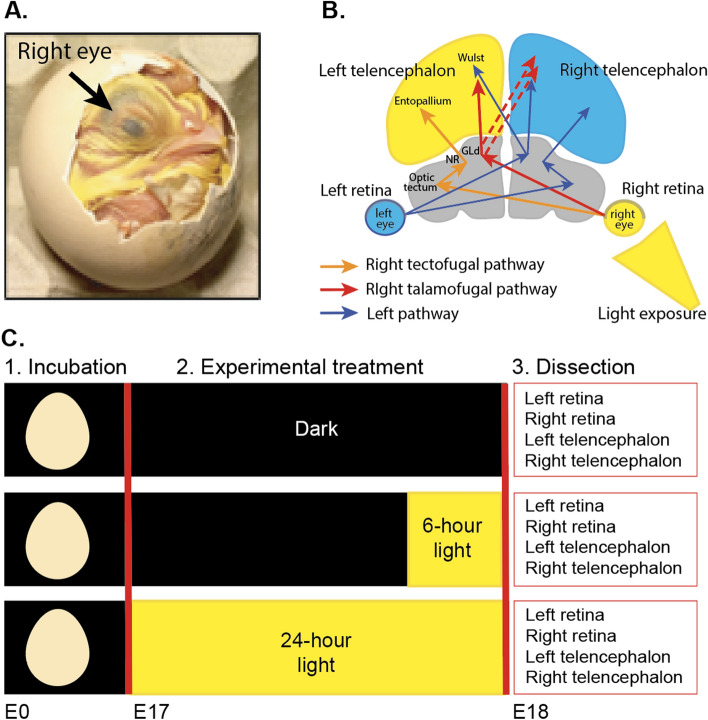
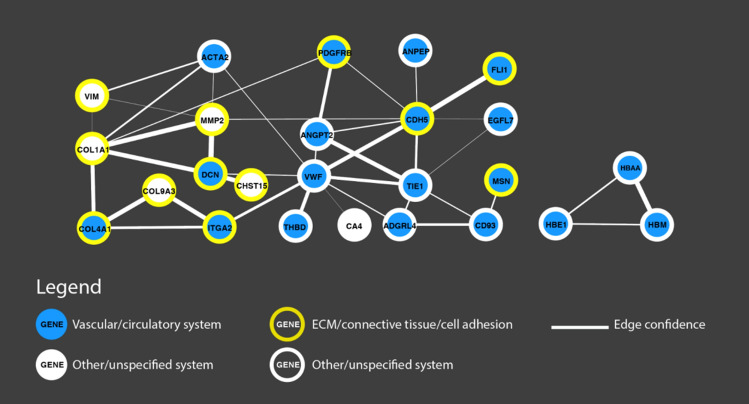
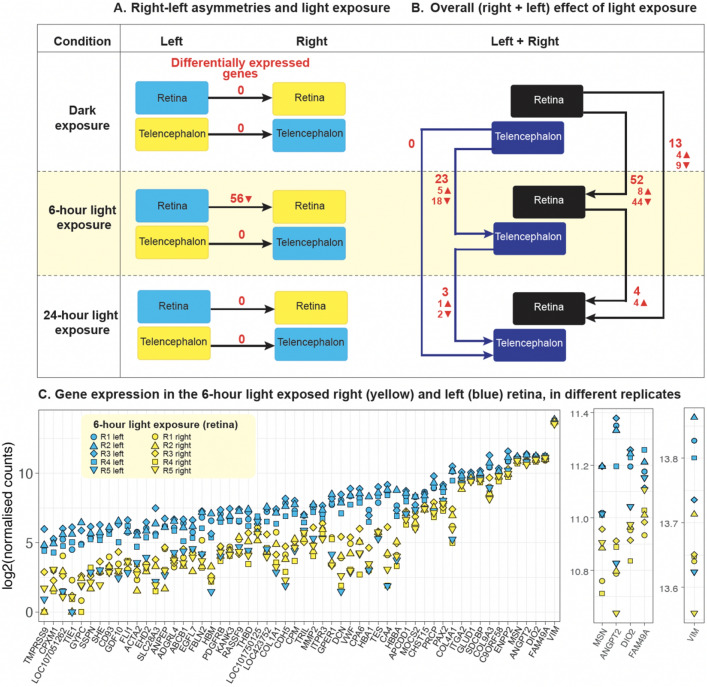
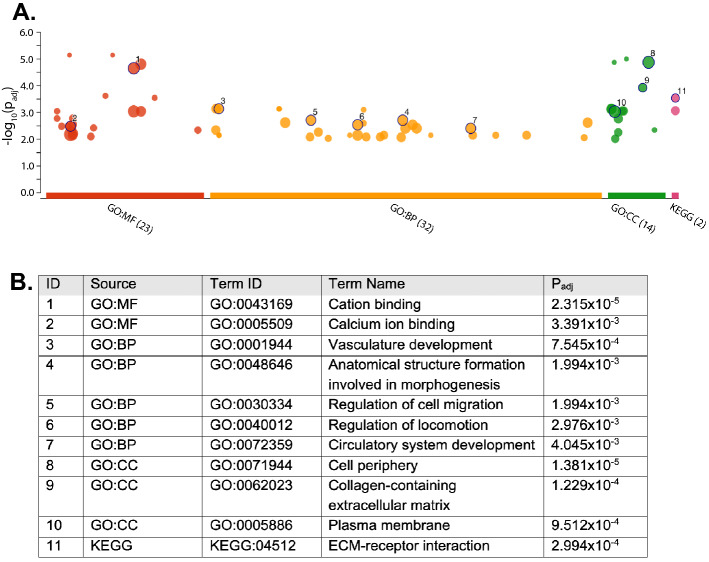
Left-right asymmetries in the nervous system (lateralisation) influence a broad range of behaviours, from social responses to navigation and language. The role and pathways of endogenous and environmental mechanisms in the ontogeny of lateralisation remains to be established. The domestic chick is a model of both endogenous and experience-induced lateralisation driven by light exposure. Following the endogenous rightward rotation of the embryo, the asymmetrical position in the egg results in a greater exposure of the right eye to environmental light. To identify the genetic pathways activated by asymmetric light stimulation, and their time course, we exposed embryos to different light regimes: darkness, 6 h of light and 24 h of light. We used RNA-seq to compare gene expression in the right and left retinas and telencephalon. We detected differential gene expression in right vs left retina after 6 h of light exposure. This difference was absent in the darkness condition and had already disappeared by 24 h of light exposure, suggesting that light-induced activation is a self-terminating phenomenon. This transient effect of light exposure was associated with a downregulation of the sensitive-period mediator gene DIO2 (iodothyronine deiodinase 2) in the right retina. No differences between genes expressed in the right vs. left telencephalon were detected. Gene networks associated with lateralisation were connected to vascularisation, cell motility, and the extracellular matrix. Interestingly, we know that the extracellular matrix-including the differentially expressed PDGFRB gene-is involved in morphogenesis, sensitive periods, and in the endogenous chiral mechanism of primary cilia, that drives lateralisation. Our data show a similarity between endogenous and experience-driven lateralisation, identifying functional gene networks that affect lateralisation in a specific time window.
神经系统的左右不对称(偏侧化)影响着广泛的行为,从社交反应到导航和语言。内源性和环境机制在偏侧化的发生中的作用和途径仍有待确定。家鸡是一个由光照驱动的内源性和经验诱导的偏侧化的模型。在胚胎的内源性向右旋转之后,鸡蛋中的不对称位置导致右眼更多地暴露于环境光中。为了确定受不对称光照刺激激活的遗传途径及其时间过程,我们将胚胎暴露于不同的光照条件下:黑暗、6 小时光照和 24 小时光照。我们使用 RNA-seq 比较了右眼和左眼视网膜和端脑的基因表达。我们在 6 小时光照暴露后检测到右眼与左眼视网膜之间的差异基因表达。在黑暗条件下这种差异不存在,并且在 24 小时光照暴露后已经消失,这表明光诱导的激活是一种自我终止的现象。这种光暴露的短暂效应与右眼视网膜中敏感期调节剂基因 DIO2(甲状腺素脱碘酶 2)的下调有关。在右与左端脑中表达的基因之间没有差异。与偏侧化相关的基因网络与血管生成、细胞运动和细胞外基质有关。有趣的是,我们知道细胞外基质-包括差异表达的 PDGFRB 基因-参与形态发生、敏感期以及驱动偏侧化的初级纤毛的内源性手性机制。我们的数据显示内源性和经验驱动的偏侧化之间存在相似性,确定了影响特定时间窗口偏侧化的功能基因网络。