Ali Zafar Syed, Aslam Muhammad, Albaqami Mohammed, Ashraf Awais, Hassan Arbaz, Iqbal Junaid, Maqbool Amir, Naeem Muhammad, Al-Yahyai Rashid, Tan Kee Zuan Ali
Department of Plant Breeding and Genetics, University of Agriculture, Faisalabad, Pakistan.
Department of Biology, Faculty of Applied Science, Umm Al-Qura University, Makkah 21955, Saudi Arabia.
Saudi J Biol Sci. 2022 May;29(5):3300-3307. doi: 10.1016/j.sjbs.2022.02.008. Epub 2022 Feb 10.
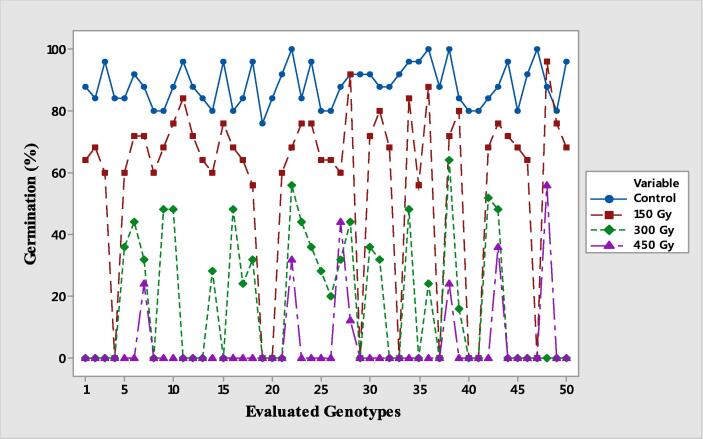
The present study assessed the effectiveness of gamma radiation in inducing favorable genetic variability in tomato ( L.). An experiment was conducted in a randomized complete block design to produce M generation. Significant differences were observed among the genotypes as well as between the treatments at individual plant level based on observed traits (seed germination percentage, seedling survival, plant height, number of flower clusters plant, number of flowers and fruits plant). All observed characters in the mutagenized population were adversely affected with increasing radiation dose. Results identified 450 Gy as the most damaging radiation dose followed by 300 Gy and 150 Gy. Moreover, 300 Gy treatment was identified as lethal dose (LD) as it caused a 50% germination inhibition in almost all the evaluated genotypes. The 150 Gy treatment showed the least damaging impact and induced maximum genetic variability in almost all the genotypes under study. Character association studies were also conducted which could be utilized in the selection of desirable mutants. Correlation studies revealed an altered association among the observed parameters from positive to negative direction in 300 Gy and 450 Gy treatments as compared to control. These deviations in correlation coefficients proved that mutagenesis can break the linkage among specific loci. Furthermore, path coefficient analysis identified the growth attributes with an effective direct and indirect contribution in yield.
本研究评估了伽马辐射在诱导番茄(L.)产生有利遗传变异方面的有效性。采用随机完全区组设计进行实验以产生M1代。基于观察到的性状(种子发芽率、幼苗存活率、株高、每株花簇数、每株花和果实数),在个体植株水平上,基因型之间以及处理之间均观察到显著差异。诱变群体中所有观察到的性状均随着辐射剂量的增加而受到不利影响。结果确定450 Gy为最具破坏性的辐射剂量,其次是300 Gy和150 Gy。此外,300 Gy处理被确定为致死剂量(LD),因为它几乎在所有评估的基因型中都导致了50% 的发芽抑制。150 Gy处理显示出最小的破坏影响,并在几乎所有研究的基因型中诱导了最大的遗传变异。还进行了性状关联研究,可用于选择理想的突变体。相关性研究表明,与对照相比,在300 Gy和450 Gy处理中,观察到的参数之间的关联从正向变为负向。这些相关系数的偏差证明诱变可以打破特定基因座之间的连锁。此外,通径系数分析确定了对产量有有效直接和间接贡献的生长属性。