Reddinger J Lucas, Levine David, Charness Gary
Department of Economics, University of California, Santa Barbara, 93106, United States.
Menard Family Initiative, College of Business Administration, University of Wisconsin-La Crosse, 54601, United States.
Prev Med Rep. 2022 Oct;29:101903. doi: 10.1016/j.pmedr.2022.101903. Epub 2022 Jul 11.
Widespread vaccination is certainly a critical element in successfully fighting the COVID-19 pandemic. We apply theories of social identity to design targeted messaging to reduce vaccine hesitancy among groups with low vaccine uptake, such as African Americans and political conservatives.
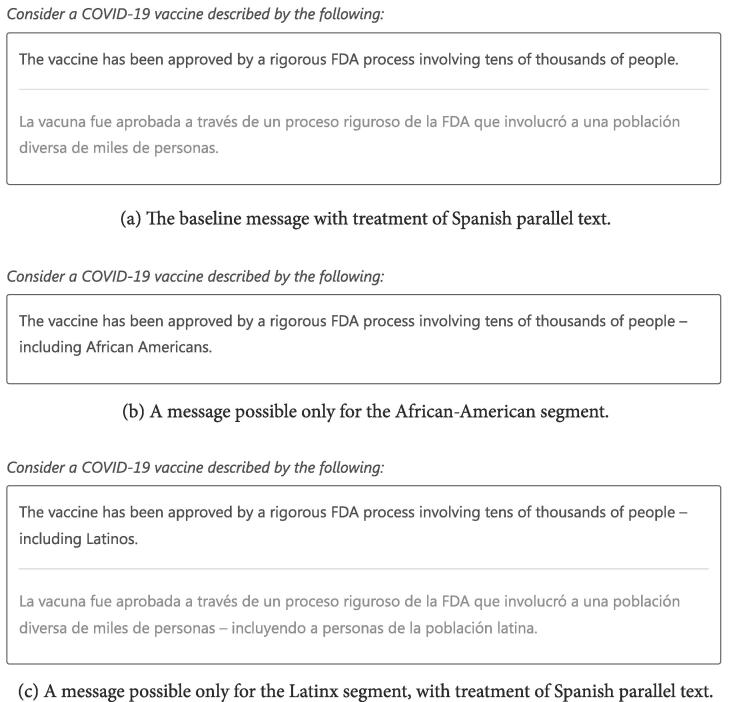
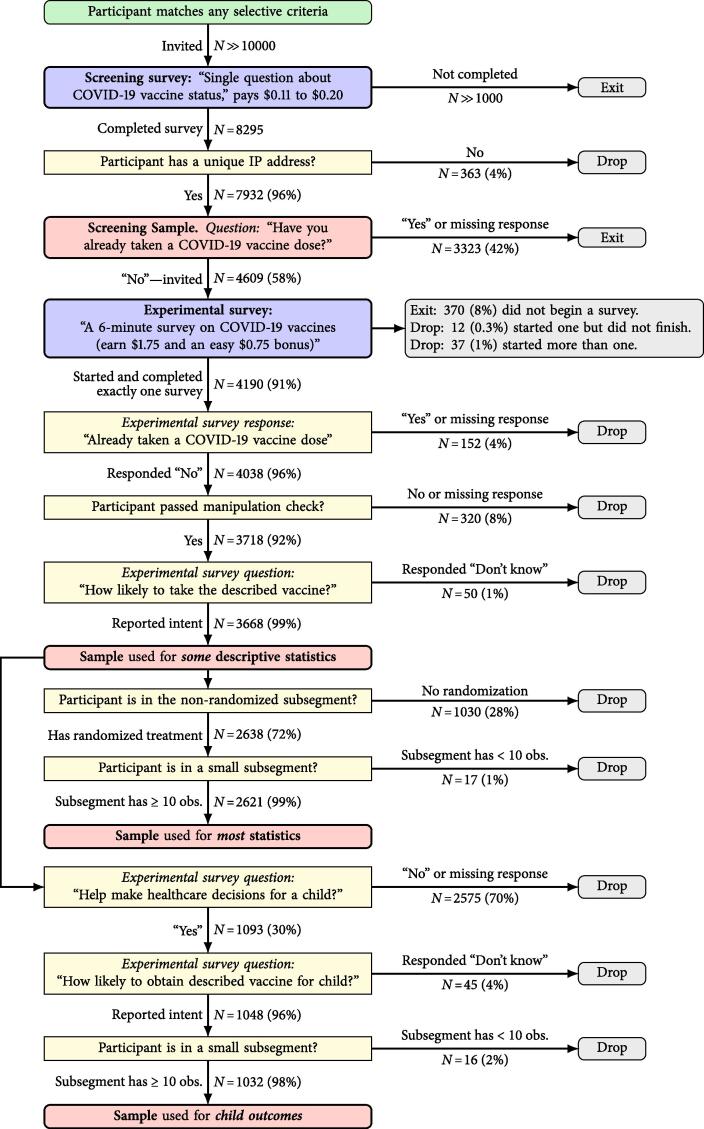
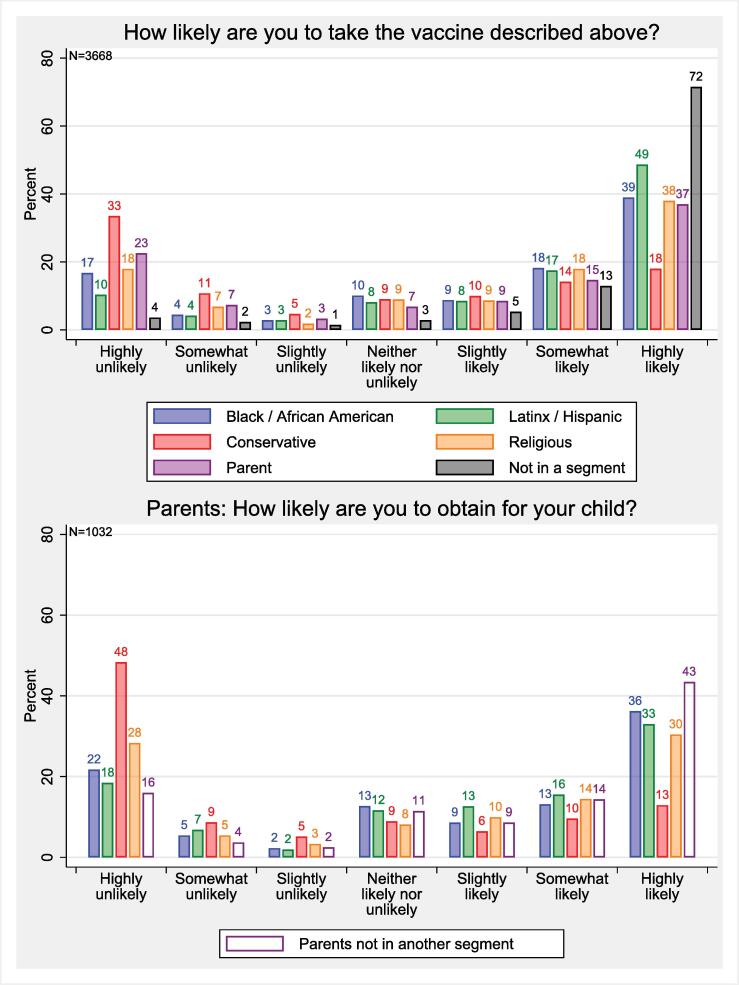
We conducted an online experiment from April 7 to 27, 2021, that oversampled Black, Latinx, conservative, and religious U.S. residents. We first solicited the vaccination status of over 10,000 individuals. Of the 4,609 individuals who reported being unvaccinated, 4,190 enrolled in our covariate-adaptive randomized trial. We provided participants messages that presented the health risks of COVID-19 to oneself and others; they also received messages about the benefits of a COVID-19 vaccine and an endorsement by a celebrity. Messages were randomly tailored to each participant's identities-Black, Latinx, conservative, religious, or being a parent. Respondents reported their intent to obtain the vaccine for oneself and, if a parent, for one's child.
We report results for the 2,621 unvaccinated respondents who passed an incentivized manipulation check. We find no support for the hypothesis that customized messages or endorsers reduce vaccine hesitancy among our segments. A analysis finds evidence that a vaccine endorsement from Dr. Fauci reduces stated intent to vaccinate among conservatives.
We find no evidence that tailoring public-health communication regarding COVID-19 vaccination for broad demographic groups would increase its effectiveness. We recommend further research on communicators and endorsers, as well as incentives.
广泛接种疫苗无疑是成功抗击新冠疫情的关键因素。我们运用社会认同理论来设计有针对性的信息,以减少疫苗接种率较低群体(如非裔美国人和政治保守派)中的疫苗犹豫情绪。
我们于2021年4月7日至27日进行了一项在线实验,对美国黑人、拉丁裔、保守派和宗教居民进行了过度抽样。我们首先询问了10000多名个体的疫苗接种状况。在报告未接种疫苗的4609名个体中,有4190人参加了我们的协变量适应性随机试验。我们向参与者提供了展示新冠病毒对自身和他人健康风险的信息;他们还收到了关于新冠疫苗益处以及名人背书的信息。信息根据每位参与者的身份(黑人、拉丁裔、保守派、宗教人士或身为父母)进行随机定制。受访者报告了自己接种疫苗的意愿,如果是父母,则报告为孩子接种疫苗的意愿。
我们报告了通过激励性操纵检验的2621名未接种疫苗受访者的结果。我们没有找到证据支持定制信息或背书者能减少我们所研究群体中的疫苗犹豫情绪这一假设。一项分析发现,有证据表明福奇博士的疫苗背书会降低保守派接种疫苗的既定意愿。
我们没有发现证据表明针对广泛人口群体定制关于新冠疫苗接种的公共卫生宣传会提高其有效性。我们建议对传播者和背书者以及激励措施进行进一步研究。