Cao Xingqi, Ma Chao, Zheng Zhoutao, He Liu, Hao Meng, Chen Xi, Crimmins Eileen M, Gill Thomas M, Levine Morgan E, Liu Zuyun
School of Public Health and the Second Affiliated Hospital, Zhejiang University School of Medicine, The Key Laboratory of Intelligent Preventive Medicine of Zhejiang Province, Hangzhou 310058, Zhejiang, China.
School of Economics and Management, Southeast University, Nanjing 211189, Jiangsu, China.
EClinicalMedicine. 2022 Jul 10;51:101548. doi: 10.1016/j.eclinm.2022.101548. eCollection 2022 Sep.
Accelerated aging leads to increasing burdens of chronic diseases in late life, posing a huge challenge to the society. With two well-developed aging measures (i.e., physiological dysregulation [PD] and frailty index [FI]), this study aimed to evaluate the relative contributions of life course circumstances (e.g., childhood and adulthood socioeconomic status) to variance in aging.
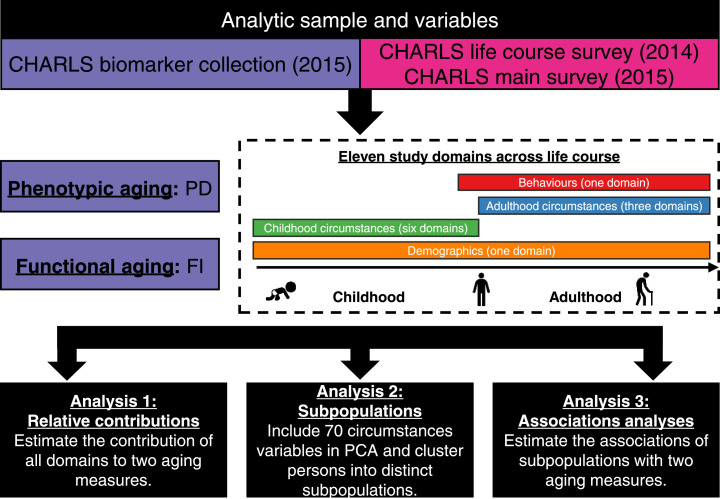
We assembled data for 6224 middle-aged and older adults in China from the 2014 life course survey (June to December 2014), the 2015 biomarker collection (July 2015 to January 2016), and the 2015 main survey (July 2015 to January 2016) of the China Health and Retirement Longitudinal Study. Two aging measures (PD and FI) were calculated, with a higher value indicating more accelerated aging. Life course circumstances included childhood (i.e., socioeconomic status, war, health, trauma, relationship, and parents' health) and adulthood circumstances (i.e., socioeconomic status, adversity, and social support), demographics, and behaviours. The Shapley value decomposition, hierarchical clustering, and general linear regression models were performed.
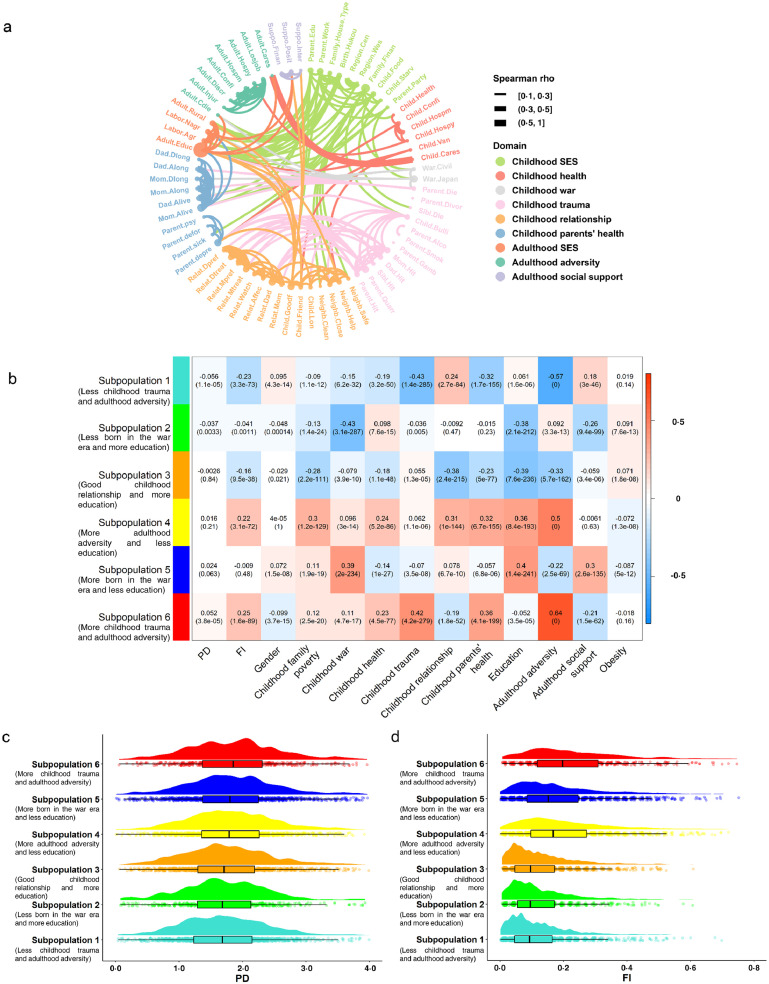
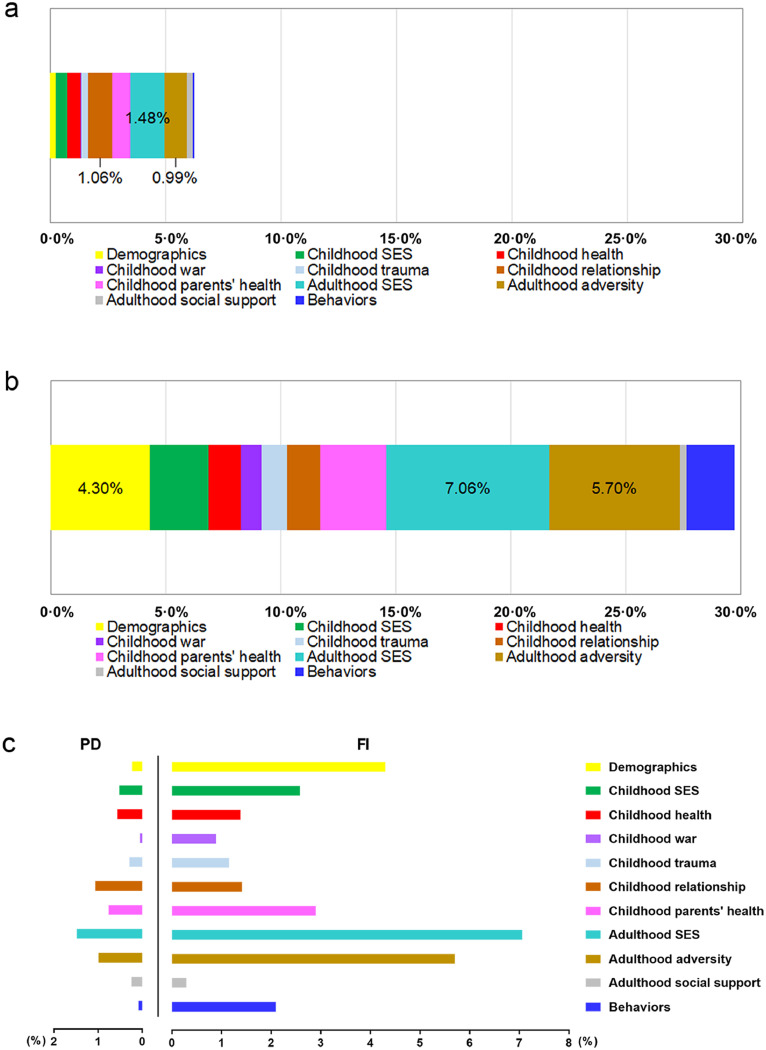
The Shapley value decomposition revealed that all included life course circumstances accounted for about 6·3% and 29·7% of variance in PD and FI, respectively. We identified six subpopulations who shared similar patterns in terms of childhood and adulthood circumstances. The most disadvantaged subpopulation (i.e., subpopulation 6 [more childhood trauma and adulthood adversity]) consistently exhibited accelerated aging indicated by the two aging measures. Relative to the most advantaged subpopulation (i.e., subpopulation 1 [less childhood trauma and adulthood adversity]), PD and FI in the most disadvantaged subpopulation were increased by an average of 0·14 (i.e., coefficient, by one-standard deviation, 95% confidence interval [CI] 0·06-0·21; < 0·0001) and 0·10 (by one-point, 95% CI 0·09-0·11; < 0·0001), respectively.
Our findings highlight the different contributions of life course circumstances to phenotypic and functional aging. Special attention should be given to promoting health for the disadvantaged subpopulation and narrowing their health gap with advantaged counterparts.
National Natural Science Foundation of China, Milstein Medical Asian American Partnership Foundation, Natural Science Foundation of Zhejiang Province, Fundamental Research Funds for the Central Universities, National Institute on Aging, National Centre for Advancing Translational Sciences, and Yale Alzheimer's Disease Research Centre.
加速衰老导致晚年慢性病负担不断增加,给社会带来了巨大挑战。本研究采用两种成熟的衰老测量方法(即生理失调[PD]和衰弱指数[FI]),旨在评估生命历程因素(如儿童期和成年期社会经济地位)对衰老差异的相对贡献。
我们收集了来自中国健康与养老追踪调查2014年生命历程调查(2014年6月至12月)、2015年生物标志物采集(2015年7月至2016年1月)以及2015年主要调查(2015年7月至2016年1月)的6224名中老年成年人的数据。计算了两种衰老测量指标(PD和FI),值越高表明衰老加速越明显。生命历程因素包括儿童期(即社会经济地位、战争、健康、创伤、人际关系和父母健康)和成年期情况(即社会经济地位、逆境和社会支持)、人口统计学特征和行为。进行了夏普里值分解、层次聚类和一般线性回归模型分析。
夏普里值分解显示,所有纳入的生命历程因素分别占PD和FI差异的约6.3%和29.7%。我们识别出六个在儿童期和成年期情况方面具有相似模式的亚群体。最弱势的亚群体(即亚群体6[更多儿童期创伤和成年期逆境])在两种衰老测量指标下均持续表现出加速衰老。相对于最优势的亚群体(即亚群体1[较少儿童期创伤和成年期逆境]),最弱势亚群体的PD和FI平均分别增加了0.14(即系数,标准差为1,95%置信区间[CI]0.06 - 0.21;<0.0001)和0.10(1分,95%CI 0.09 - 0.11;<0.0001)。
我们的研究结果突出了生命历程因素对表型衰老和功能衰老的不同贡献。应特别关注促进弱势亚群体的健康,并缩小他们与优势亚群体之间的健康差距。
中国国家自然科学基金、米尔斯坦医学亚裔美国人合作基金会、浙江省自然科学基金、中央高校基本科研业务费、美国国立衰老研究所、美国国立转化医学推进中心和耶鲁阿尔茨海默病研究中心。