Seidel Thorsten
Dynamic Cell Imaging, Faculty of Biology, Bielefeld University, Bielefeld, Germany.
Front Plant Sci. 2022 Jun 30;13:931777. doi: 10.3389/fpls.2022.931777. eCollection 2022.
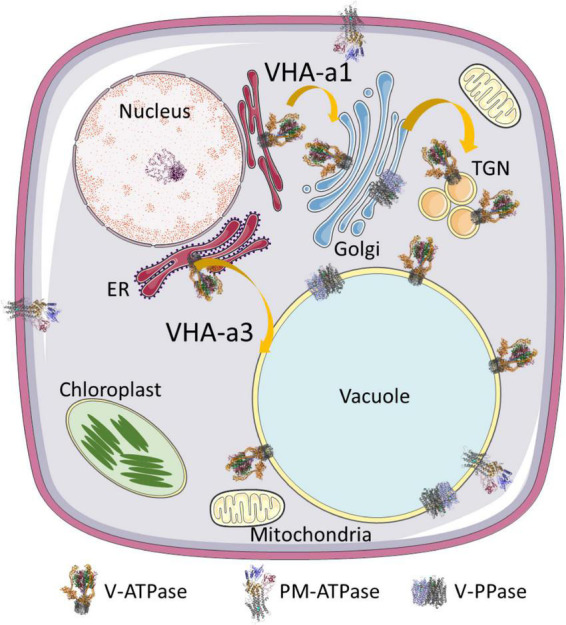
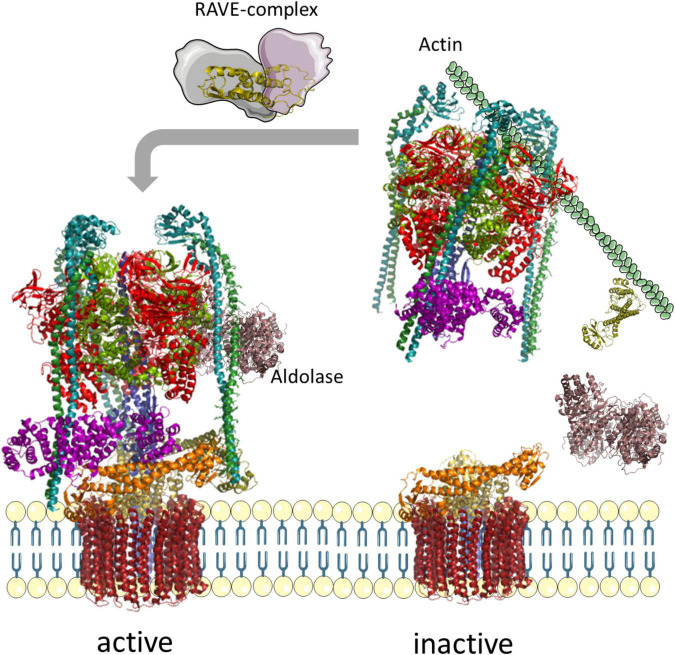
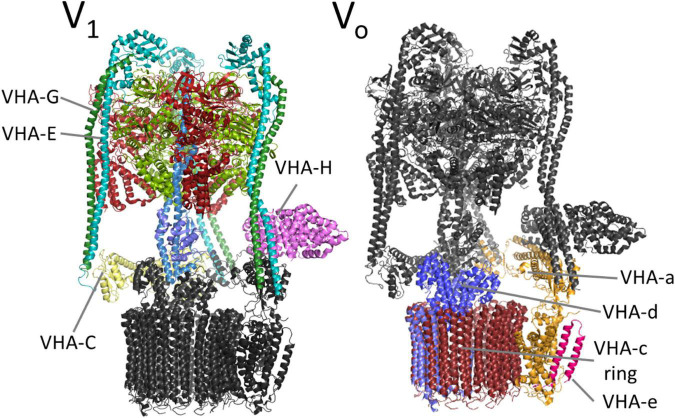
V-ATPase is the dominant proton pump in plant cells. It contributes to cytosolic pH homeostasis and energizes transport processes across endomembranes of the secretory pathway. Its localization in the trans Golgi network/early endosomes is essential for vesicle transport, for instance for the delivery of cell wall components. Furthermore, it is crucial for response to abiotic and biotic stresses. The V-ATPase's rather complex structure and multiple subunit isoforms enable high structural flexibility with respect to requirements for different organs, developmental stages, and organelles. This complexity further demands a sophisticated assembly machinery and transport routes in cells, a process that is still not fully understood. Regulation of V-ATPase is a target of phosphorylation and redox-modifications but also involves interactions with regulatory proteins like 14-3-3 proteins and the lipid environment. Regulation by reversible assembly, as reported for yeast and the mammalian enzyme, has not be proven in plants but seems to be absent in autotrophic cells. Addressing the regulation of V-ATPase is a promising approach to adjust its activity for improved stress resistance or higher crop yield.
V-ATP酶是植物细胞中主要的质子泵。它有助于维持胞质pH稳态,并为分泌途径内膜系统的转运过程提供能量。其在反式高尔基体网络/早期内体中的定位对于囊泡运输至关重要,例如对于细胞壁成分的递送。此外,它对于植物对非生物和生物胁迫的响应也至关重要。V-ATP酶相当复杂的结构和多个亚基异构体使得其在不同器官、发育阶段和细胞器的需求方面具有高度的结构灵活性。这种复杂性进一步要求细胞中有精密的组装机制和运输途径,而这一过程仍未完全被理解。V-ATP酶的调节是磷酸化和氧化还原修饰的靶点,但也涉及与14-3-3蛋白等调节蛋白以及脂质环境的相互作用。如在酵母和哺乳动物酶中报道的通过可逆组装进行调节,在植物中尚未得到证实,但在自养细胞中似乎不存在。研究V-ATP酶的调节是一种有前景的方法,可通过调节其活性来提高植物的抗逆性或作物产量。