
老年营养风险指数与癌胚抗原联合预测结直肠癌患者的生存情况
Combination of Geriatric Nutritional Risk Index and Carcinoembryonic Antigen to Predict the Survival of Patients With Colorectal Cancer.
作者信息
Xie Hailun, Wei Lishuang, Yuan Guanghui, Liu Mingxiang, Liang Yanren, Gao Shunhui, Wang Qiwen, Lin Xin, Tang Shuangyi, Gan Jialiang
机构信息
Department of Colorectal and Anal Surgery, The First Affiliated Hospital, Guangxi Medical University, Nanning, China.
Guangxi Key Laboratory of Enhanced Recovery After Surgery for Gastrointestinal Cancer, Nanning, China.
出版信息
Front Nutr. 2022 Jun 30;9:902080. doi: 10.3389/fnut.2022.902080. eCollection 2022.
BACKGROUND
This study explored the value of the combination of Geriatric Nutritional Risk Index (GNRI) and carcinoembryonic antigen (CEA) for the prognosis assessment of CRC patients.
METHODS
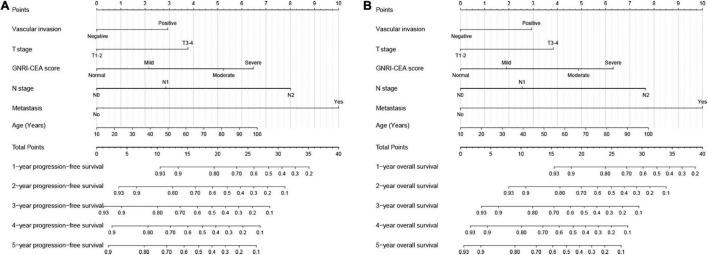
This study retrospectively enrolled 1,014 CRC patients who underwent surgery between 2012 and 2014. Kaplan-Meier and log-rank tests were used to compare survival differences. Cox proportional hazards regression analysis was used to assess risk factors associated with progression-free survival (PFS) and overall survival (OS). Nomograms were constructed to predict the prognosis of CRC patients. Randomized internal validation was used to confirm the predictive accuracy of the prognostic nomograms.
RESULTS
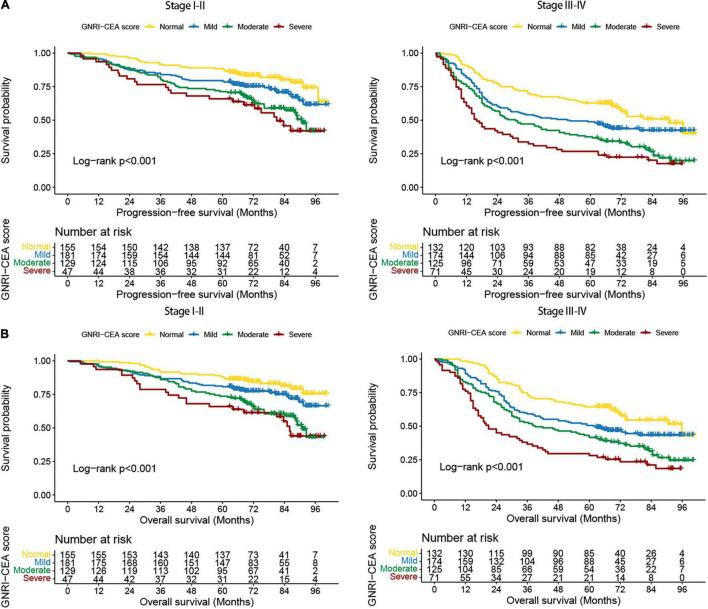
The GNRI-CEA score was established by combining GNRI and CEA. Compared with patients with normal GNRI-CEA scores, patients with mild/moderate/severe GNRI-CEA scores had significantly lower survival (PFS, 68.99% vs. 57.75% vs. 41.34% vs. 31.36%, < 0.001; OS, 68.99% vs. 57.75% vs. 41.34% vs. 31.36%, < 0.001). The GNRI-CEA score is an independent factor predicting the prognosis of CRC patients. The risk of death was twofold higher in patients with low GNRI and high CEA than in those with both normal GNRI and CEA [PFS, hazard ratio (HR), 2.339; 95% confidence interval (CI), 1.656-3.303; < 0.001; OS, HR, 2.340; 95% CI, 1.645-3.329; < 0.001]. Prognostic nomograms had good resolution and accuracy in predicting 1-5 year PFS and OS. Randomized internal validation showed that the nomograms were reliable.
CONCLUSION
The combination of GNRI and CEA can effectively stratify the prognosis of CRC patients. The nomogram established based on the two indices can provide a personalized reference for prognostic assessment and clinical decision-making for CRC patients.
背景
本研究探讨老年营养风险指数(GNRI)与癌胚抗原(CEA)联合应用于结直肠癌(CRC)患者预后评估的价值。
方法
本研究回顾性纳入了2012年至2014年间接受手术的1014例CRC患者。采用Kaplan-Meier法和对数秩检验比较生存差异。采用Cox比例风险回归分析评估无进展生存期(PFS)和总生存期(OS)的相关危险因素。构建列线图以预测CRC患者的预后。采用随机内部验证来确认预后列线图的预测准确性。
结果
通过联合GNRI和CEA建立了GNRI-CEA评分。与GNRI-CEA评分正常的患者相比,轻度/中度/重度GNRI-CEA评分的患者生存率显著降低(PFS:68.99%对57.75%对41.34%对31.36%,P<0.001;OS:68.99%对57.75%对41.34%对31.36%,P<0.001)。GNRI-CEA评分是预测CRC患者预后的独立因素。GNRI低且CEA高的患者死亡风险是GNRI和CEA均正常患者的两倍[PFS,风险比(HR),2.339;95%置信区间(CI),1.656 - 3.303;P<0.001;OS,HR,2.340;95%CI,1.645 - 3.329;P<0.001]。预后列线图在预测1 - 5年PFS和OS方面具有良好的分辨力和准确性。随机内部验证表明列线图可靠。
结论
GNRI与CEA联合可有效对CRC患者的预后进行分层。基于这两个指标建立的列线图可为CRC患者的预后评估和临床决策提供个性化参考。


 Zotero 插件