Zhang Shuning, Paul Soumyajeet, Kundu Parag
Laboratory for Microbiota-Host Interactions, The Center for Microbes, Development and Health, Institut Pasteur of Shanghai, Chinese Academy of Sciences, Shanghai, China.
University of Chinese Academy of Sciences, Beijing, China.
Front Cell Dev Biol. 2022 Jul 1;10:874940. doi: 10.3389/fcell.2022.874940. eCollection 2022.
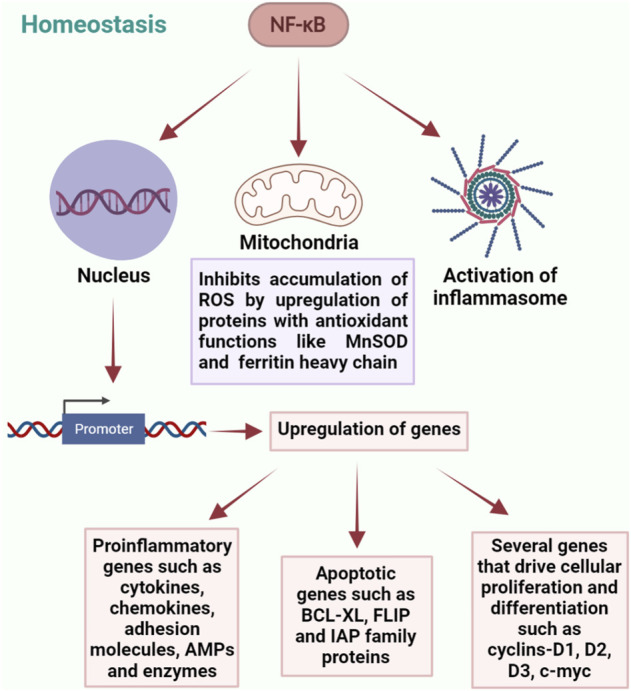
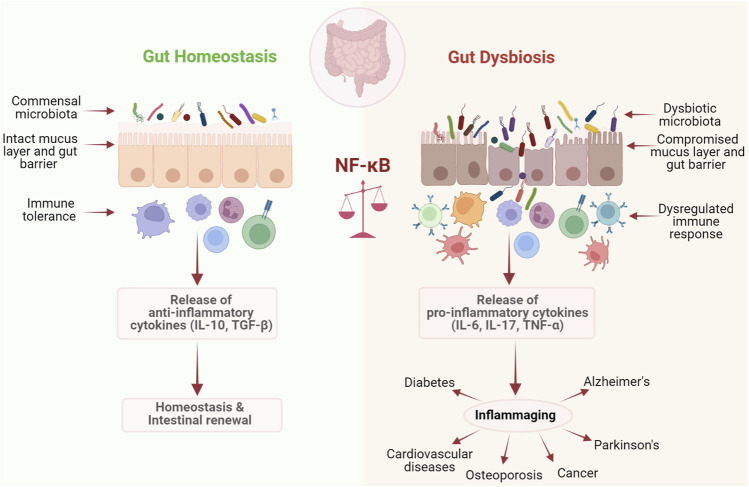
Human beings and their indigenous microbial communities have coexisted for centuries, which led to the development of co-evolutionary mechanisms of communication and cooperation. Such communication machineries are governed by sophisticated multi-step feedback loops, which typically begin with the recognition of microbes by pattern recognition receptors (PRRs), followed by a host transcriptional response leading to the release of effector molecules. Our gastrointestinal tract being the main platform for this interaction, a variety of host intestinal cells tightly regulate these loops to establish tolerance towards the microbial communities of the gut and maintain homeostasis. The transcription factor, nuclear factor kappa B (NF-κB) is an integral component of such a communication apparatus, which plays a critical role in determining the state of homeostasis or inflammation associated with dysbiosis in the host. Here we outline the crucial role of NF-κB in host response to microbial cues in the context of ageing and associated diseases.
人类与其原生微生物群落已经共存了几个世纪,这导致了共同进化的交流与合作机制的发展。这种交流机制由复杂的多步反馈回路控制,这些回路通常始于模式识别受体(PRR)对微生物的识别,随后是宿主转录反应,导致效应分子的释放。我们的胃肠道是这种相互作用的主要平台,多种宿主肠道细胞严格调节这些回路,以建立对肠道微生物群落的耐受性并维持体内平衡。转录因子核因子κB(NF-κB)是这种交流机制的一个组成部分,它在确定与宿主生态失调相关的体内平衡或炎症状态方面起着关键作用。在这里,我们概述了NF-κB在衰老及相关疾病背景下宿主对微生物信号反应中的关键作用。