Kassaw Chalachew, Sisay Daniel, Awulachew Ephrem, Endashaw Hareru Habtamu
Department of Psychiatry, College of Health and Medical Science, Dilla University, Dilla, Ethiopia.
School of Public Health, College of Medicine and Health Science, Dilla University, Dilla, Ethiopia.
AIDS Res Treat. 2022 Jul 8;2022:3246249. doi: 10.1155/2022/3246249. eCollection 2022.
The psychological experience of being rejected, blamed, and ashamed in relation to a recognized medical disease is known as perceived stigma. It has a close connection to psychological health and therapy afterward. To the best of our knowledge, there has not been any national systematic review and meta-analysis research on this topic. Therefore, we conducted this analysis to thoroughly evaluate the pooled prevalence of perceived stigma among HIV/AIDS patients in Ethiopia who are receiving antiretroviral therapy and its relationship to gender differences and disclosure status.
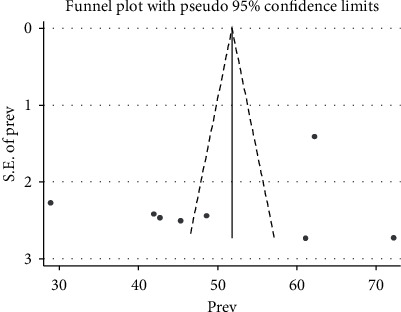
We investigated the eight databases for quantitative Ethiopian studies published in English from 2008 to 2021 that looked at the relationship between felt stigma, gender, and disclosure status. To meet the statistical requirements of a systematic review and meta-analysis analysis, the random effect model for pooled prevalence of perceived stigma, log odds ratio for associated variables, -squared statistics for heterogeneity, and Egger's test for publication bias were implemented. The Joanna Briggs Institute Meta-Analysis of Statistics Assessment and Review Instrument's standard data extraction method was performed to collect the necessary data, and STATA-14 statistical software was used for analysis.
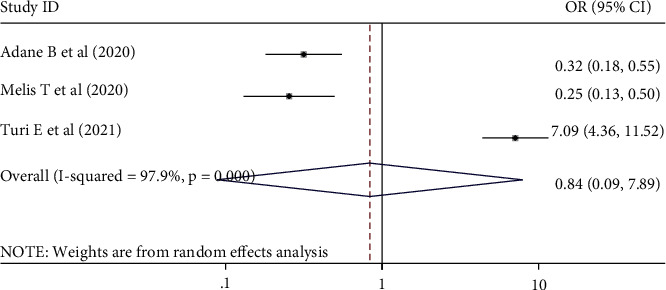
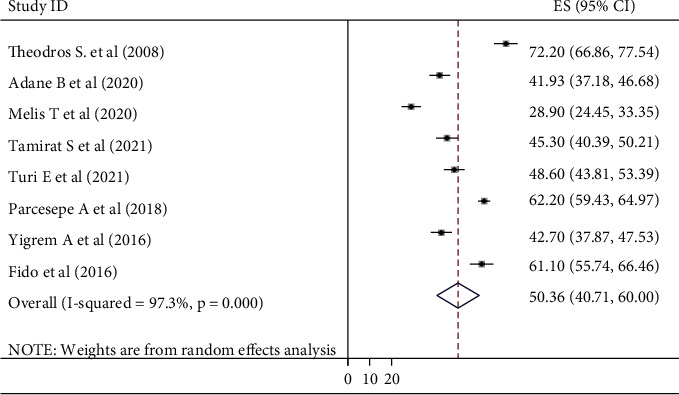
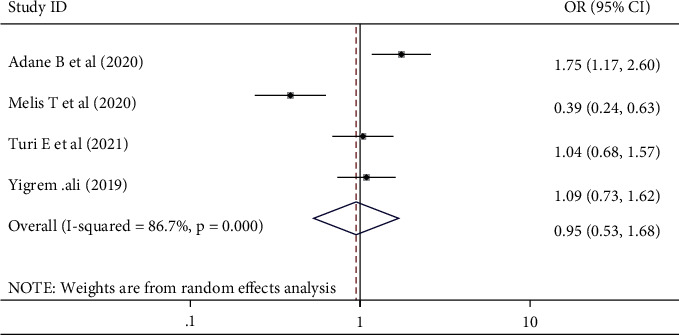
A total of 8 cross-sectional Ethiopian studies with 3,857 participants were integrated into this systematic review and meta-analysis study. The pooled prevalence of perceived stigma among people living with HIV/AIDS and attending antiretroviral therapy in Ethiopia was OR = 50.36% (95% CI: (40.71, 60.00), = 97.3%, =0.000 ). The pooled odds ratio of being male was 0.95 (95% CI: 0.53, 1.68, = 86.7%, =0.000) and disclosure status was 0.84 (95% CI: 0.09, 7.89, = 97.9%, =0.000).
In this study, half of the participants encountered stigma. There was no statistically significant correlation between gender difference, disclosure status, and the perception of stigma. To address the mental and psychological issues of people living with HIV/AIDS, it is necessary to look into other factors that influence perceived stigma. It is recommended to screen for and treat perceived stigma with prompt examination and follow-up.
与公认的医学疾病相关的被拒绝、被指责和感到羞耻的心理体验被称为感知耻辱感。它与心理健康及后续治疗密切相关。据我们所知,尚未有关于该主题的全国性系统综述和荟萃分析研究。因此,我们进行了此项分析,以全面评估埃塞俄比亚接受抗逆转录病毒治疗的艾滋病毒/艾滋病患者中感知耻辱感的合并患病率及其与性别差异和披露状况的关系。
我们检索了2008年至2021年期间以英文发表的关于埃塞俄比亚定量研究的八个数据库,这些研究探讨了感知耻辱感、性别和披露状况之间的关系。为满足系统综述和荟萃分析的统计要求,实施了感知耻辱感合并患病率的随机效应模型、相关变量的对数比值比、异质性的I²统计量以及发表偏倚的Egger检验。采用乔安娜·布里格斯研究所统计评估和综述工具的标准数据提取方法收集必要数据,并使用STATA - 14统计软件进行分析。
共有8项埃塞俄比亚横断面研究、3857名参与者纳入了本系统综述和荟萃分析研究。埃塞俄比亚接受抗逆转录病毒治疗的艾滋病毒/艾滋病患者中感知耻辱感的合并患病率为OR = 50.36%(95%CI:(40.71, 60.00),I² = 97.3%,P = 0.000)。男性的合并比值比为0.95(95%CI:0.53, 1.68,I² = 86.7%,P = 0.000),披露状况的合并比值比为0.84(95%CI:0.09, 7.89,I² = 97.9%,P = 0.000)。
在本研究中,一半的参与者遭遇了耻辱感。性别差异、披露状况与耻辱感认知之间无统计学显著相关性。为解决艾滋病毒/艾滋病患者的心理和精神问题,有必要探究影响感知耻辱感的其他因素。建议通过及时检查和随访来筛查和治疗感知耻辱感。