Yolande Voumbo Matoumona Mavoungou, Benjamin Longo-Mbenza, Héritier Mawalala Malengele, Nkodila Aliocha, Christophe Mambueni Thamba, Claude Mobousse Jean, Levy Mankoussou
Faculté des Sciences de la Santé, Université Marien Ngouabi, Brazzaville, République du Congo.
Université de Kinshasa, Faculté de Médecine, Kinshasa, République Démocratique du Congo.
Pan Afr Med J. 2022 Apr 12;41:297. doi: 10.11604/pamj.2022.41.297.32641. eCollection 2022.
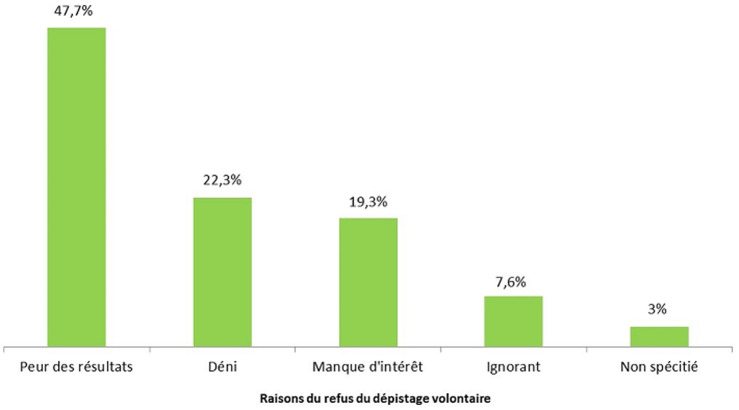
The COVID-19 pandemic affects populations worldwide without distinction. Large-scale RT-PCR testing was proposed to the populations to promote early diagnosis and management. The absence of publications related to COVID-19/Congo testing justified this study. The purpose of this study was to identify factors associated with the acceptability of the screening test for COVID-19. We conducted an analytical cross-sectional study in subjects over 18 years of age living in Brazzaville from August 18 to 24, 2020. Data were collected using a self-administered questionnaire. The variables considered included: socio-demographic characteristics, sources of information, knowledge and perception of the disease, acceptance or refusal of voluntary testing for COVID-19. In total, 328 (62.5%) respondents accepted voluntary screening for COVID-19, the average age was 35.9 years. Men predominated in both groups. Subjects who were more accepting of voluntary screening for COVID-19 were those aged 30-50 years; those with a higher level of education and followers of Muslim religion. Lack of perception of disease severity was associated with the refusal of voluntary screening. The level of knowledge of symptoms, the source of information about COVID-19 were not related to the acceptance or refusal of voluntary screening. The main source of information about COVID-19 was the Radio-TV. Fear for test results was the main reason for refusing voluntary screening. Acceptability of the voluntary screening for COVID-19 was related to individual factors, knowledge of symptoms and source of information. Awareness of COVID-19 should be improved.
新冠疫情对全球各地的人群均有影响,毫无差别。已向民众提议开展大规模逆转录聚合酶链反应(RT-PCR)检测,以促进早期诊断和管理。缺乏与新冠病毒/刚果病毒检测相关的出版物使得本研究具有合理性。本研究的目的是确定与新冠病毒筛查检测可接受性相关的因素。我们于2020年8月18日至24日在布拉柴维尔对18岁以上的受试者进行了一项分析性横断面研究。数据通过自行填写的问卷收集。所考虑的变量包括:社会人口学特征、信息来源、对疾病的认知和看法、对新冠病毒自愿检测的接受或拒绝情况。总共有328名(62.5%)受访者接受了新冠病毒自愿筛查,平均年龄为35.9岁。两组中男性均占多数。更愿意接受新冠病毒自愿筛查的受试者为年龄在30至50岁之间的人;教育程度较高且为穆斯林宗教信徒的人。对疾病严重性缺乏认知与拒绝自愿筛查有关。症状知晓程度、关于新冠病毒的信息来源与自愿筛查的接受或拒绝无关。关于新冠病毒的主要信息来源是广播电视。对检测结果的恐惧是拒绝自愿筛查的主要原因。新冠病毒自愿筛查的可接受性与个体因素、症状知晓情况和信息来源有关。应提高对新冠病毒的认知。