Department of Health, Medicine and Caring Sciences, Linköping University, Linköping, Sweden.
Department of Behavioral Sciences and Learning, Linköping University, Linköping, Sweden.
Front Public Health. 2023 Aug 3;11:988882. doi: 10.3389/fpubh.2023.988882. eCollection 2023.
Denmark and Sweden initially adopted different responses to the COVID-19 pandemic although the two countries share many characteristics. Denmark responded swiftly with many mandatory restrictions. In contrast, Sweden relied on voluntary restrictions and a more "relaxed" response during the first wave of the pandemic. However, increased rates of COVID-19 cases led to a new approach that involved many more mandatory restrictions, thus making Sweden's response similar to Denmark's in the second wave of the pandemic.
The aim was to investigate and compare the extent to which the populations in Denmark and Sweden considered the COVID-19 restrictions to be acceptable during the first two waves of the pandemic. The study also aimed to identify the characteristics of those who were least accepting of the restrictions in the two countries.
Cross-sectional surveys were conducted in Denmark and Sweden in 2021. The study population was sampled from nationally representative web panels in the two countries, consisting of 2,619 individuals from Denmark and 2,633 from Sweden. The questionnaire captured key socio-demographic characteristics. Acceptability was operationalized based on a theoretical framework consisting of seven constructs and one overarching construct.
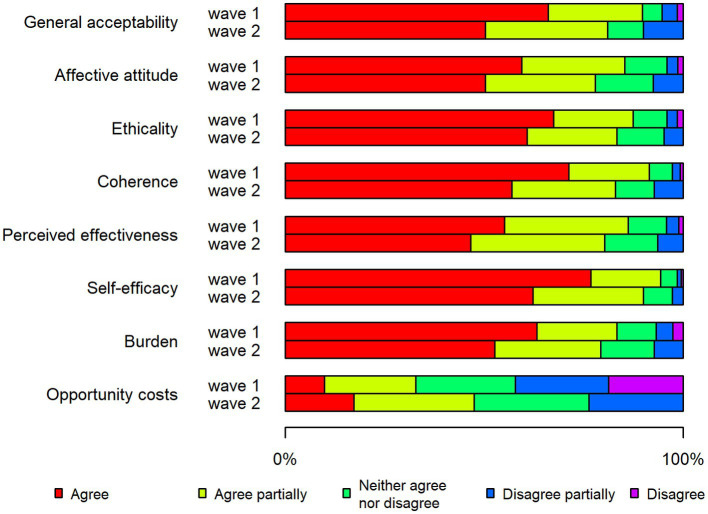
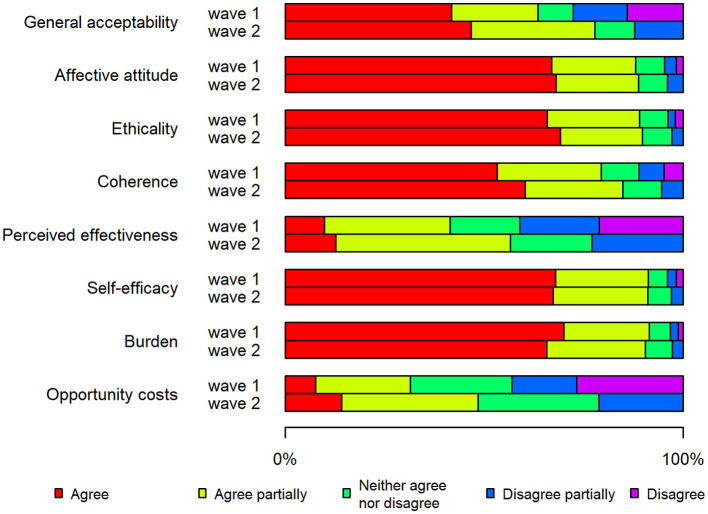
The respondents' age and gender patterns were similar in the two countries. The proportion of respondents in Denmark who agreed with the statements ("agree" alternative) that captured various acceptability constructs was generally higher for the first wave than the second wave of the pandemic. The opposite pattern was seen for Sweden. In Denmark, 66% in the first wave and 50% in the second wave were accepting of the restrictions. The corresponding figures for Sweden was 42% (first wave) and 47% (second wave). Low acceptance of the restrictions, defined as the 25% with the lowest total score on the seven acceptability statements, was associated with younger age, male gender and lower education levels.
Respondents in Sweden were more accepting of the restrictions in the second wave, when the country used many mandatory restrictions. In contrast, respondents in Denmark were more accepting of the restrictions in the first wave than in the second wave, implying an increased weariness to comply with the restrictions over time. There were considerable socio-demographic differences between those who expressed low acceptance of the restrictions and the others in both countries, suggesting the importance of tailoring communication about the pandemic to different segments of the population.
丹麦和瑞典在应对 COVID-19 大流行时最初采取了不同的措施,尽管这两个国家有许多共同特点。丹麦迅速采取了许多强制性限制措施。相比之下,瑞典在大流行的第一波期间依赖自愿限制和更“宽松”的措施。然而,COVID-19 病例的增加导致了一种新的方法,即采取了更多的强制性限制措施,从而使瑞典在大流行的第二波中的应对措施与丹麦类似。
旨在调查和比较丹麦和瑞典的人群在大流行的前两波期间对 COVID-19 限制措施的接受程度。本研究还旨在确定两国中最不接受这些限制措施的人群的特征。
2021 年在丹麦和瑞典进行了横断面调查。研究人群从两国的全国代表性网络面板中抽取,包括来自丹麦的 2619 人和来自瑞典的 2633 人。问卷捕获了关键的社会人口统计学特征。可接受性是根据一个包含七个结构和一个总体结构的理论框架来操作的。
两国受访者的年龄和性别模式相似。丹麦受访者对各种可接受性结构的陈述(“同意”选项)的同意比例,第一波大流行时普遍高于第二波。瑞典的情况则相反。在丹麦,第一波中有 66%的人同意限制措施,第二波中有 50%的人同意。瑞典的相应数字为 42%(第一波)和 47%(第二波)。对限制措施的低接受度,定义为七个可接受性陈述的最低总得分的 25%,与年龄较小、男性性别和较低的教育水平有关。
瑞典的受访者在第二波中更能接受限制措施,因为该国采用了许多强制性限制措施。相比之下,丹麦的受访者在第一波中比第二波更能接受限制措施,这表明随着时间的推移,人们越来越不愿意遵守这些限制措施。在两国中,对限制措施表达低接受度的人与其他人之间存在相当大的社会人口统计学差异,这表明需要针对不同的人群对大流行相关信息进行定制。