Shriners Hospitals for Children, Salt Lake City, Utah, United States of America.
Department of Orthopedic Surgery, University of Utah, Salt Lake City, Utah, United States of America.
PLoS One. 2022 Jul 18;17(7):e0270121. doi: 10.1371/journal.pone.0270121. eCollection 2022.
Cerebral palsy (CP) is a complex neuromuscular condition that may negatively influence gross motor function. Children diagnosed with CP often exhibit spasticity, weakness, reduced motor control, contracture, and bony malalignment. Despite many previous association studies, the causal impact of these impairments on motor function is unknown.
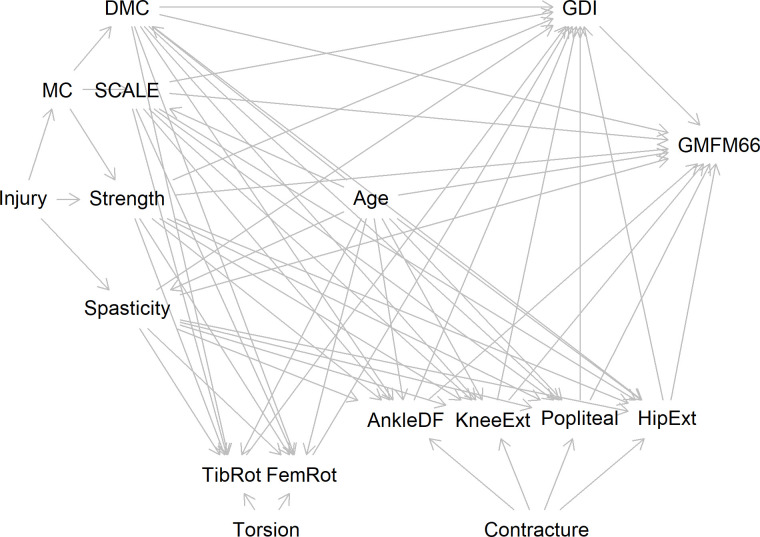
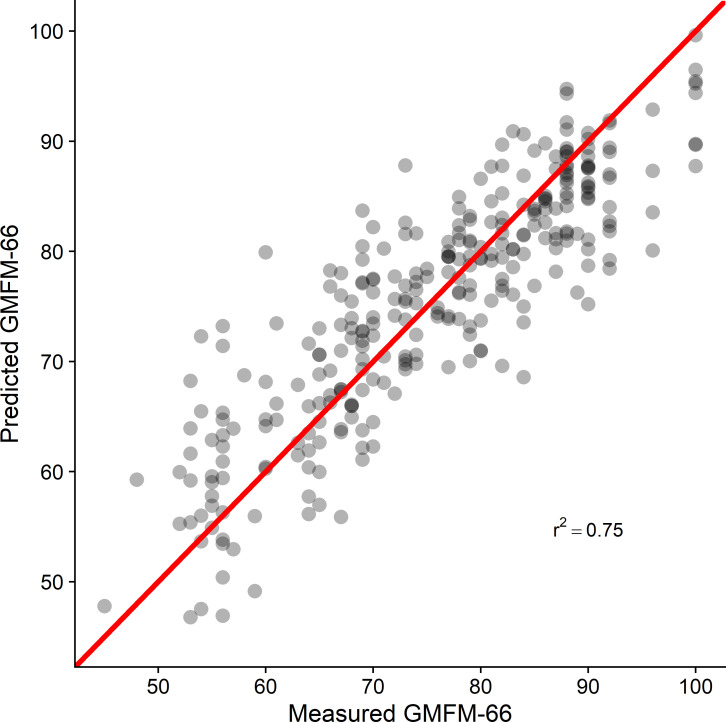
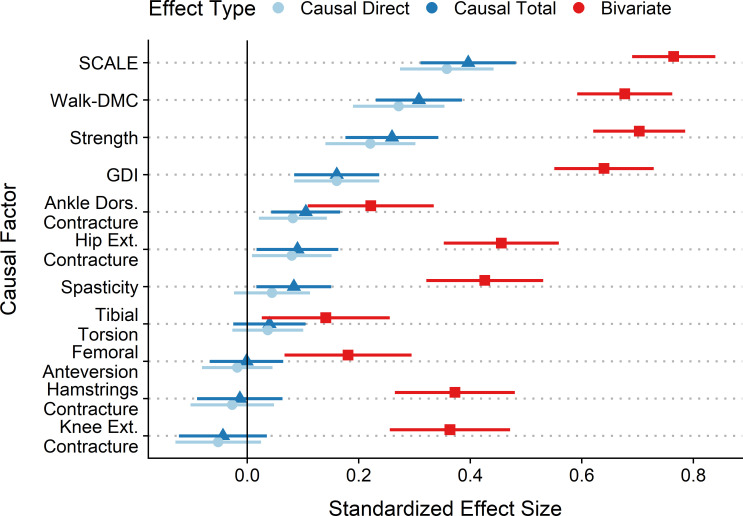
In this study, we proposed a causal model which estimated the effects of common impairments on motor function in children with spastic CP as measured by the 66-item Gross Motor Function Measure (GMFM-66). We estimated both direct and total effect sizes of all included variables using linear regression based on covariate adjustment sets implied by the minimally sufficient adjustment sets. In addition, we estimated bivariate effect sizes of all measures for comparison.
We retrospectively evaluated 300 consecutive subjects with spastic cerebral palsy who underwent routine clinical gait analysis. Model data included standard information collected during this analysis.
The largest causal effect sizes, as measured by standardized regression coefficients, were found for selective voluntary motor control and dynamic motor control, followed by strength, then gait deviations. In contrast, common treatment targets, such as spasticity and orthopedic deformity, had relatively small effects. Effect sizes estimated from bivariate models, which cannot appropriately adjust for other causal factors, substantially overestimated the total effect of spasticity, strength, and orthopedic deformity.
Understanding the effects of impairments on gross motor function will allow clinicians to direct treatments at those impairments with the greatest potential to influence gross motor function and provide realistic expectations of the anticipated changes.
脑瘫(CP)是一种复杂的神经肌肉疾病,可能会对粗大运动功能产生负面影响。被诊断患有脑瘫的儿童通常表现出痉挛、无力、运动控制能力降低、挛缩和骨骼对线不良。尽管有许多先前的关联研究,但这些损伤对运动功能的因果影响尚不清楚。
在这项研究中,我们提出了一个因果模型,该模型估计了常见损伤对痉挛性脑瘫儿童运动功能的影响,运动功能通过 66 项粗大运动功能测量(GMFM-66)进行测量。我们使用基于最小充分调整集隐含的协变量调整集的线性回归来估计所有包含变量的直接和总效应大小。此外,我们还估计了所有测量的双变量效应大小以供比较。
我们回顾性评估了 300 名连续接受常规临床步态分析的痉挛性脑瘫患者。模型数据包括在该分析中收集的标准信息。
以标准化回归系数衡量,选择性自愿运动控制和动态运动控制的因果效应最大,其次是力量,然后是步态偏差。相比之下,常见的治疗目标,如痉挛和骨科畸形,其影响相对较小。从不能适当调整其他因果因素的双变量模型估计的效应大小,大大高估了痉挛、力量和骨科畸形的总效应。
了解损伤对粗大运动功能的影响将使临床医生能够针对那些最有可能影响粗大运动功能的损伤进行治疗,并对预期的变化提供现实的期望。