Department of Nursing, Physiotherapy and Medicine, University of Almería, Road Sacramento s/n, 04120 Almería, Spain.
Department of Health Sciences, University of Jaen, Campus las Lagunillas, 23071 Jaén, Spain.
Sensors (Basel). 2022 Dec 16;22(24):9910. doi: 10.3390/s22249910.
Motor, gait and balance disorders reduce functional capabilities for activities of daily living in children with cerebral palsy (CP). Robot-assisted gait therapy (RAGT) is being used to complement conventional therapy (CT) or treadmill therapy (TT) in CP rehabilitation. The aim of this systematic review is to assess the effect of RAGT on gait, balance and functional independence in CP children, in comparison to CT or TT.
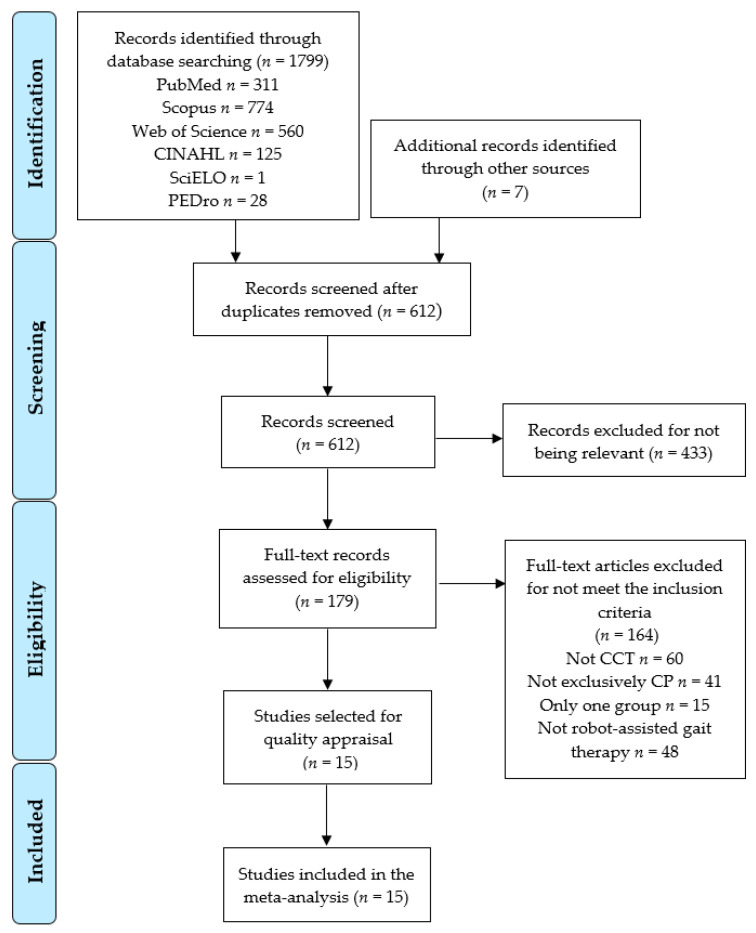
We have conducted a systematic review with meta-analysis. A search in PubMed Medline, Web of Science, Scopus, CINAHL, PEDro and SciELO has been conducted for articles published until October 2022. Controlled clinical trials (CCT), in which RAGT was compared to TT or CT and assessed gait speed, step and stride length, width step, walking distance, cadence, standing ability, walking, running and jumping ability, gross motor function and functional independence in children with CP, have been included. Methodological quality was assessed with the PEDro scale and the pooled effect was calculated with Cohen's Standardized Mean Difference (SMD) and its 95% Confidence Interval (95% CI).
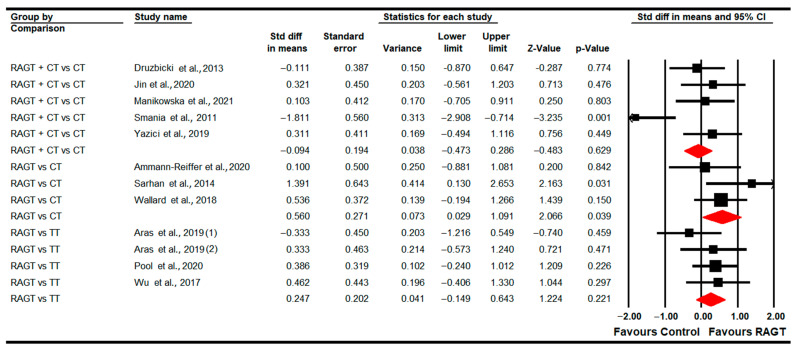
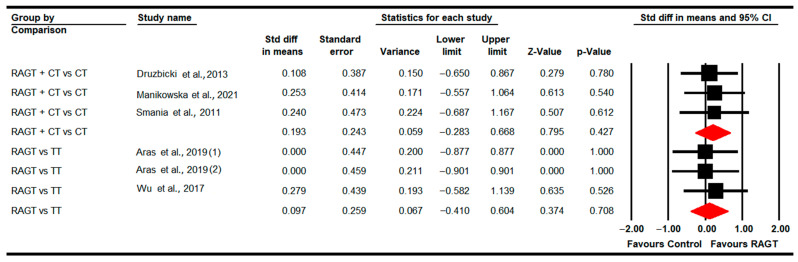
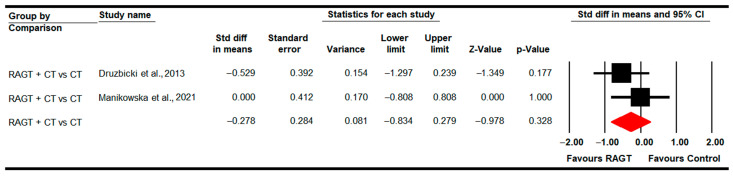
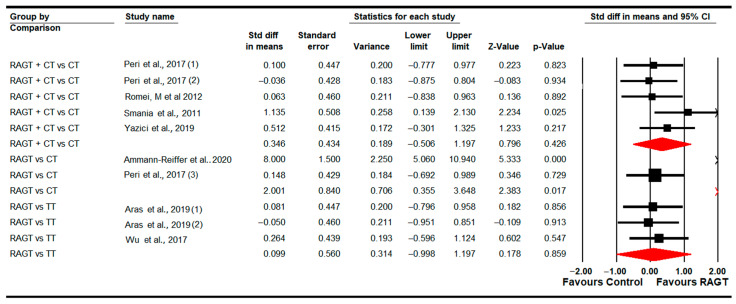
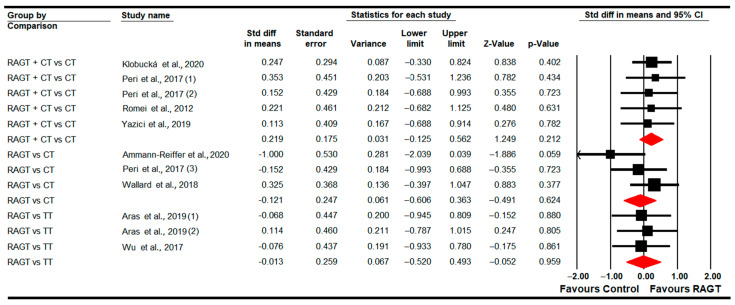
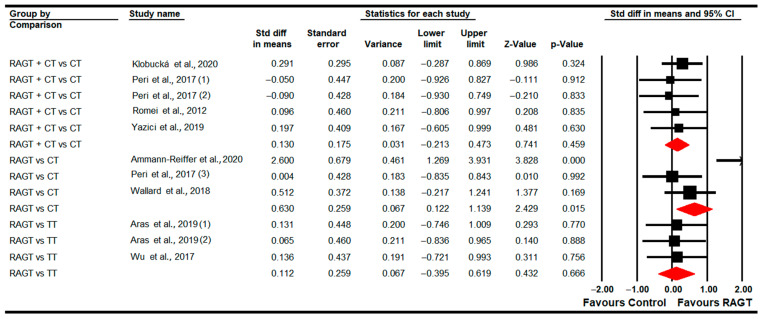
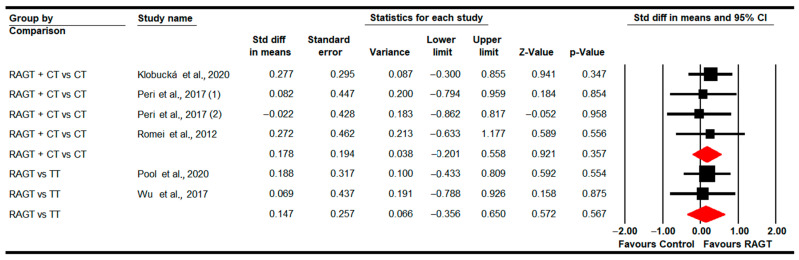
A total of 15 CCTs have been included, providing data from 413 participants, with an averaged methodological quality of 5.73 ± 1.1 points in PEDro. The main findings of this review are that RAGT shows better results than CT in the post-intervention assessment for gait speed (SMD 0.56; 95% CI 0.03 to 1.1), walking distance (SMD 2; 95% CI 0.36 to 3.65) and walking, running and jumping ability (SMD 0.63; 95% CI 0.12 to 1.14).
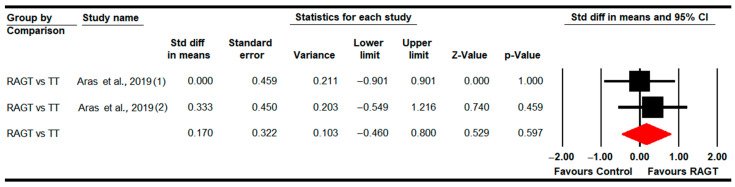
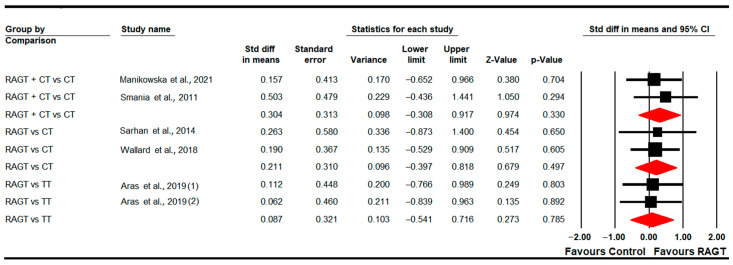
This study shows that the effect of RAGT is superior to CT on gait speed, walking distance and walking, running and jumping ability in post-intervention, although no differences were found between RAGT and TT or CT for the remaining variables.
运动、步态和平衡障碍降低了脑瘫(CP)儿童日常生活活动的功能能力。机器人辅助步态治疗(RAGT)被用于补充 CP 康复中的常规治疗(CT)或跑步机治疗(TT)。本系统评价的目的是评估 RAGT 对 CP 儿童步态、平衡和功能独立性的影响,与 CT 或 TT 相比。
我们进行了系统评价和荟萃分析。在 PubMed Medline、Web of Science、Scopus、CINAHL、PEDro 和 SciELO 中进行了检索,检索截至 2022 年 10 月的文章。纳入了将 RAGT 与 TT 或 CT 进行比较并评估 CP 儿童步态速度、步幅和跨步长度、步宽、步行距离、步频、站立能力、行走、跑步和跳跃能力、粗大运动功能和功能独立性的对照临床试验(CCT)。使用 PEDro 量表评估方法学质量,并使用 Cohen's 标准化均数差(SMD)及其 95%置信区间(95%CI)计算汇总效应。
共纳入 15 项 CCT,提供了 413 名参与者的数据,PEDro 平均方法学质量为 5.73±1.1 分。本综述的主要发现是,RAGT 在干预后评估中在步态速度(SMD 0.56;95%CI 0.03 至 1.1)、步行距离(SMD 2;95%CI 0.36 至 3.65)和行走、跑步和跳跃能力(SMD 0.63;95%CI 0.12 至 1.14)方面的效果优于 CT。
本研究表明,在干预后,RAGT 的效果优于 CT,在步态速度、步行距离和行走、跑步和跳跃能力方面,但在其余变量方面,RAGT 与 TT 或 CT 之间没有差异。