Departments of Neurology, Hospital Clinico San Carlos, San Carlos Research Health Institute (IdISSC), Universidad Complutense, Madrid, Spain.
Department of Computer Architecture and Communications, Centro Universitario de Mérida, Universidad de Extremadura, Mérida, Spain.
Med Biol Eng Comput. 2022 Sep;60(9):2737-2756. doi: 10.1007/s11517-022-02630-z. Epub 2022 Jul 19.
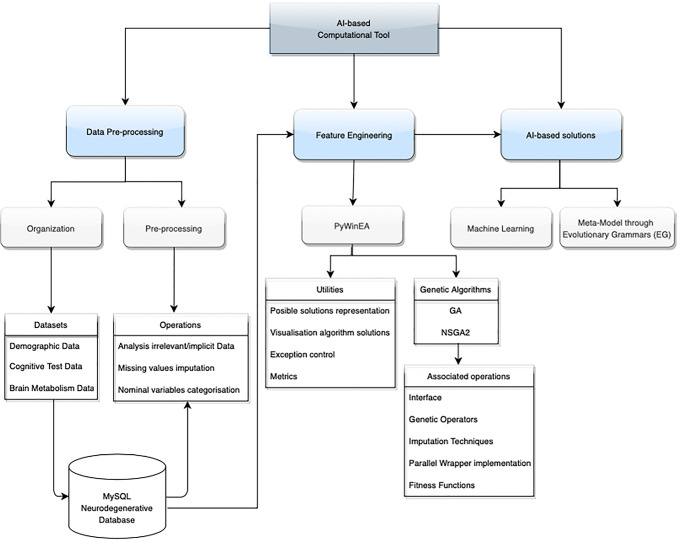
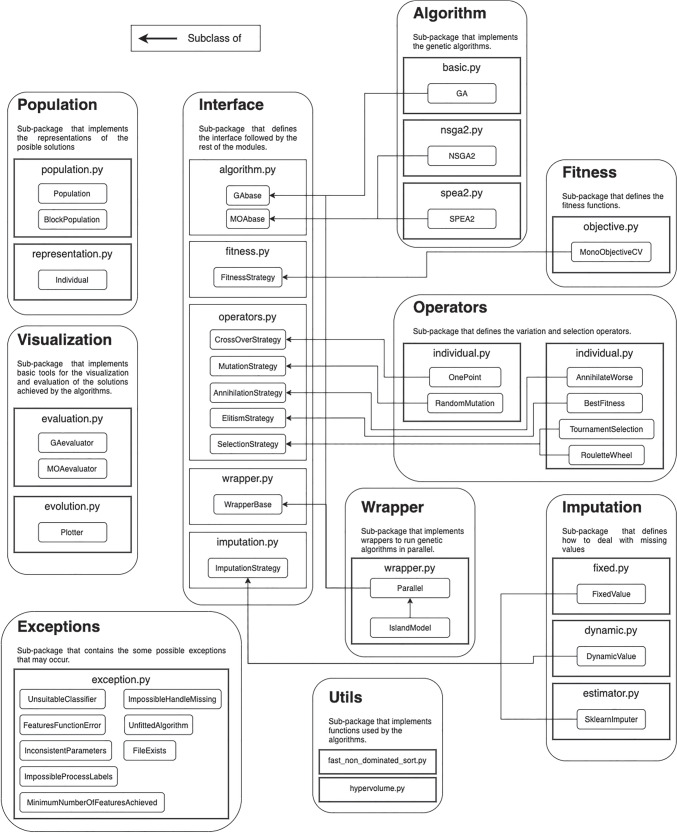
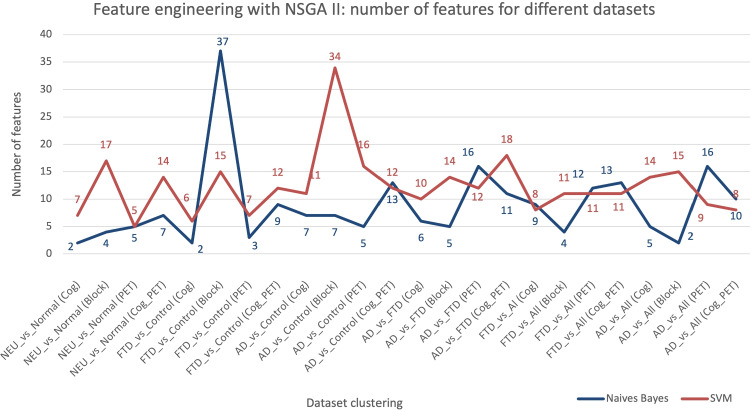
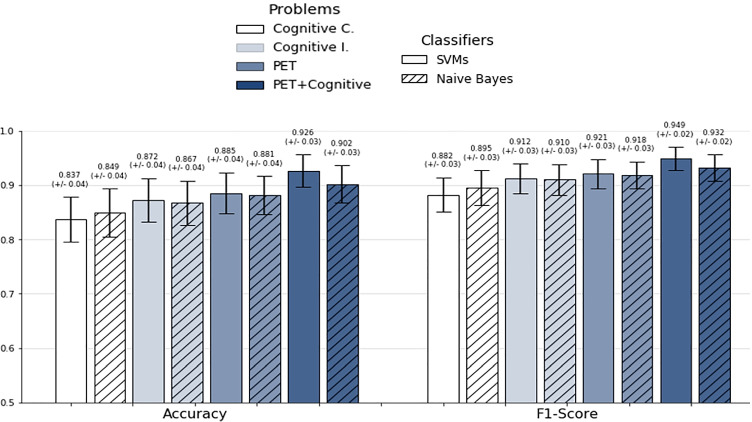
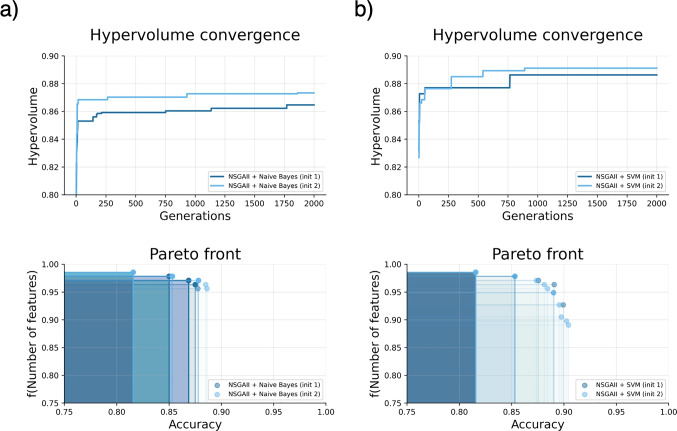
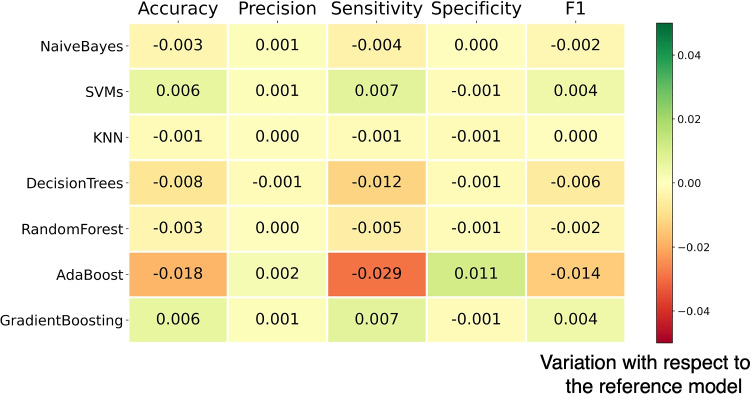
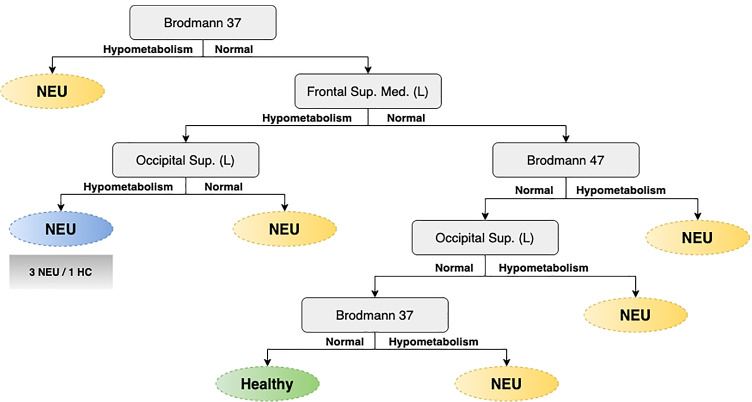
Artificial Intelligence aids early diagnosis and development of new treatments, which is key to slow down the progress of the diseases, which to date have no cure. The patients' evaluation is carried out through diagnostic techniques such as clinical assessments neuroimaging techniques, which provide high-dimensionality data. In this work, a computational tool is presented that deals with the data provided by the clinical diagnostic techniques. This is a Python-based framework implemented with a modular design and fully extendable. It integrates (i) data processing and management of missing values and outliers; (ii) implementation of an evolutionary feature engineering approach, developed as a Python package, called PyWinEA using Mono-objective and Multi-objetive Genetic Algorithms (NSGAII); (iii) a module for designing predictive models based on a wide range of machine learning algorithms; (iv) a multiclass decision stage based on evolutionary grammars and Bayesian networks. Developed under the eXplainable Artificial Intelligence and open science perspective, this framework provides promising advances and opens the door to the understanding of neurodegenerative diseases from a data-centric point of view. In this work, we have successfully evaluated the potential of the framework for early and automated diagnosis with neuroimages and neurocognitive assessments from patients with Alzheimer's disease (AD) and frontotemporal dementia (FTD).
人工智能辅助早期诊断和新疗法的开发,这是减缓目前尚无治愈方法的疾病进展的关键。通过临床评估神经影像学等诊断技术对患者进行评估,这些技术提供了高维度的数据。在这项工作中,提出了一种计算工具,用于处理临床诊断技术提供的数据。这是一个基于 Python 的框架,采用模块化设计,完全可扩展。它集成了:(i) 数据处理和缺失值和异常值的管理;(ii) 进化特征工程方法的实现,该方法作为一个名为 PyWinEA 的 Python 包开发,使用单目标和多目标遗传算法 (NSGAII);(iii) 基于广泛的机器学习算法的预测模型设计模块;(iv) 基于进化语法和贝叶斯网络的多类决策阶段。该框架在可解释人工智能和开放科学的视角下开发,为神经退行性疾病的研究提供了有前景的进展,并为从数据中心的角度理解神经退行性疾病开辟了道路。在这项工作中,我们成功评估了该框架在使用神经影像学和神经认知评估对阿尔茨海默病 (AD) 和额颞叶痴呆 (FTD) 患者进行早期和自动诊断的潜力。