Division of Pulmonary, Critical Care and Sleep Medicine, Department of Medicine, University of Washington, Seattle, Washington, United States of America.
Division of Dermatology, Department of Medicine, University of Washington, Seattle, Washington, United States of America.
PLoS Med. 2022 Jul 19;19(7):e1004035. doi: 10.1371/journal.pmed.1004035. eCollection 2022 Jul.
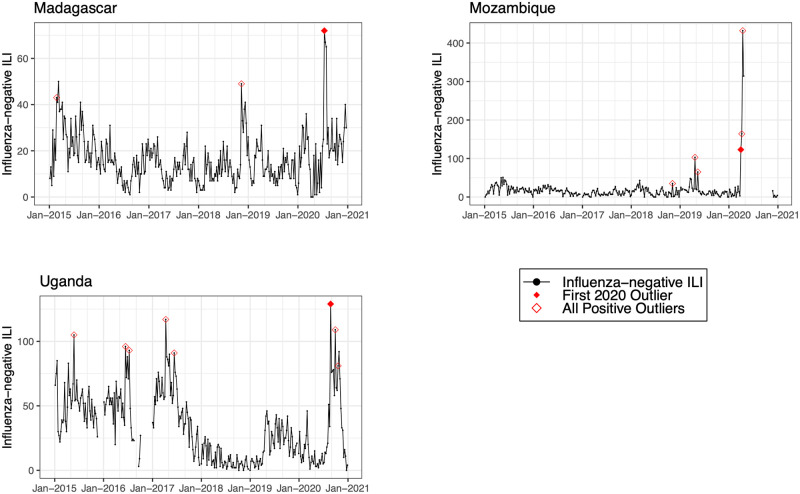
Surveillance systems are important in detecting changes in disease patterns and can act as early warning systems for emerging disease outbreaks. We hypothesized that analysis of data from existing global influenza surveillance networks early in the COVID-19 pandemic could identify outliers in influenza-negative influenza-like illness (ILI). We used data-driven methods to detect outliers in ILI that preceded the first reported peaks of COVID-19.
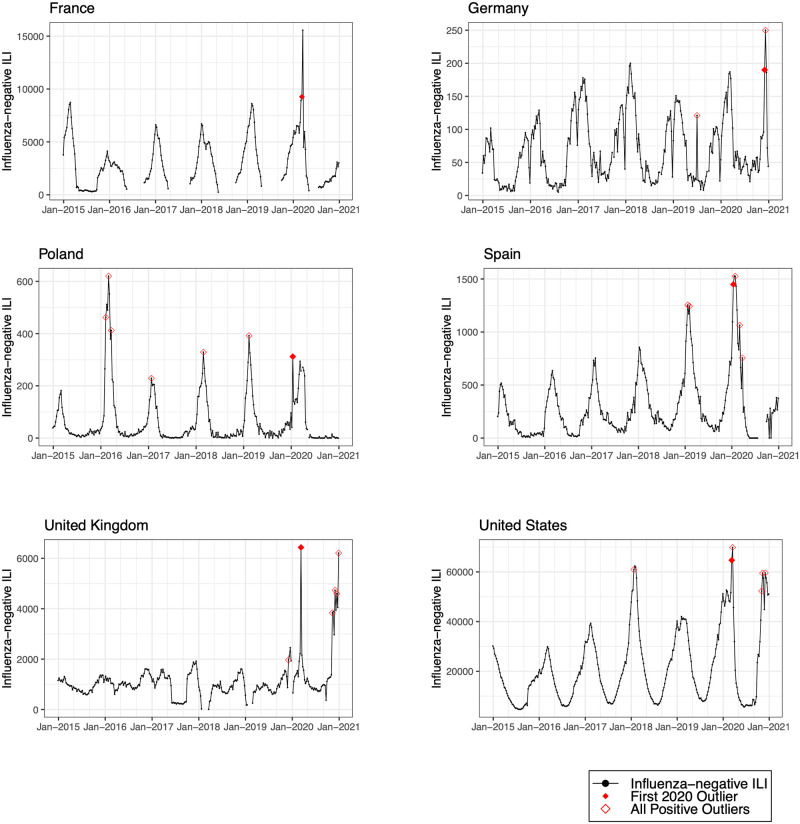
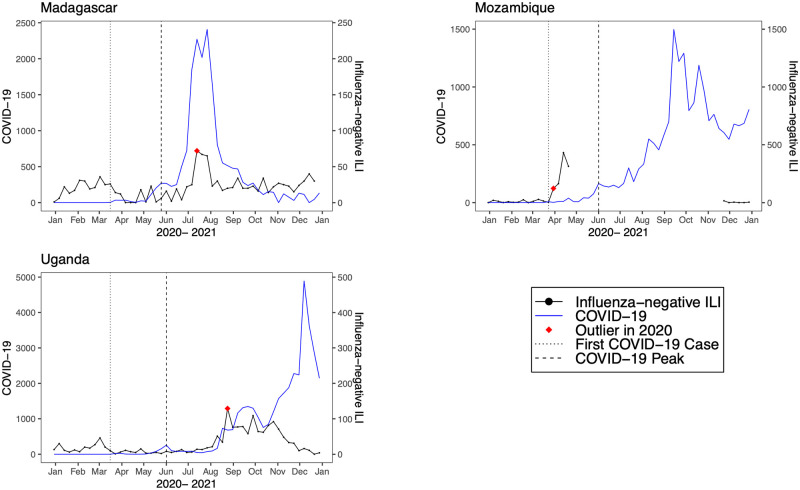
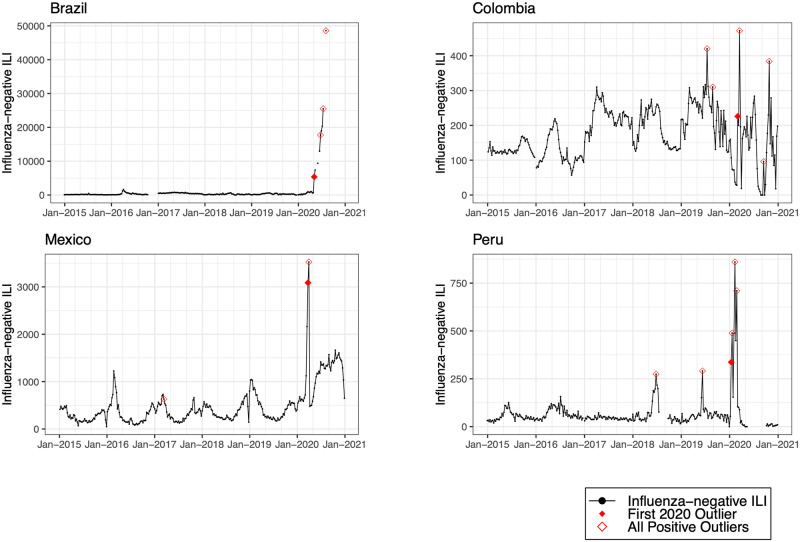
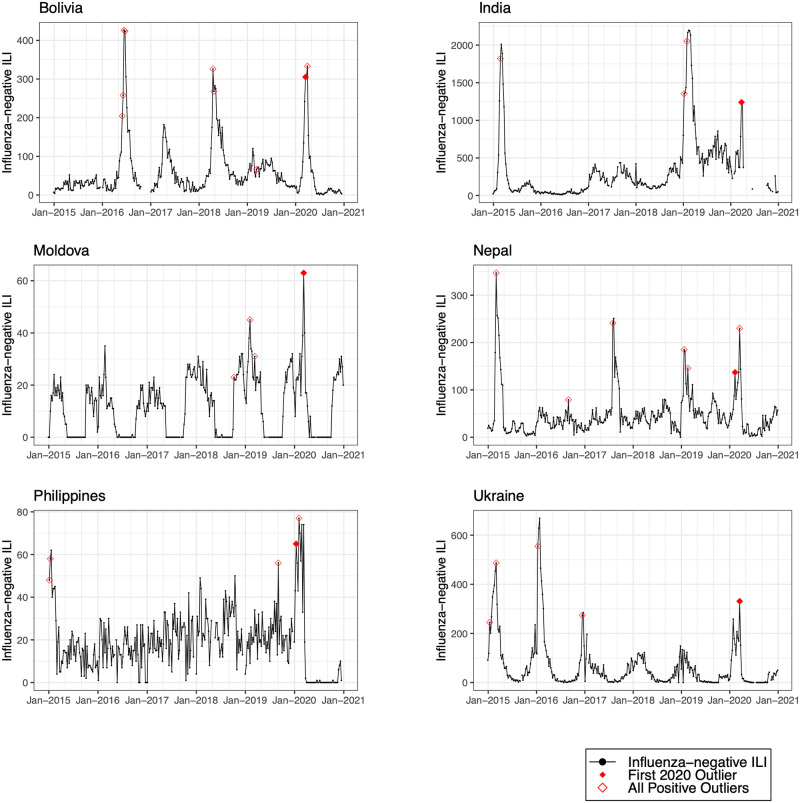
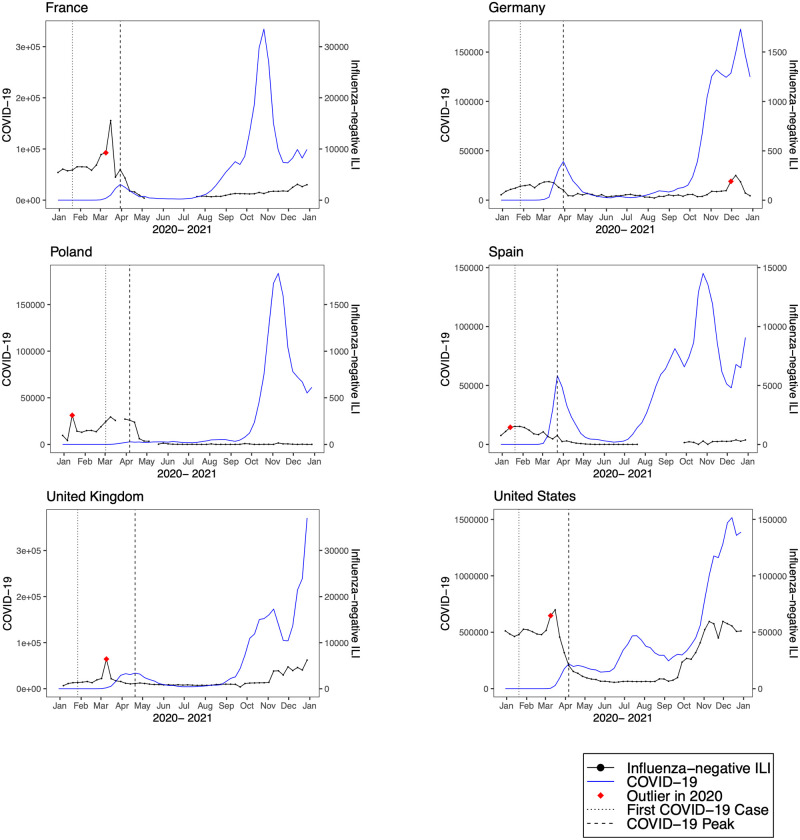
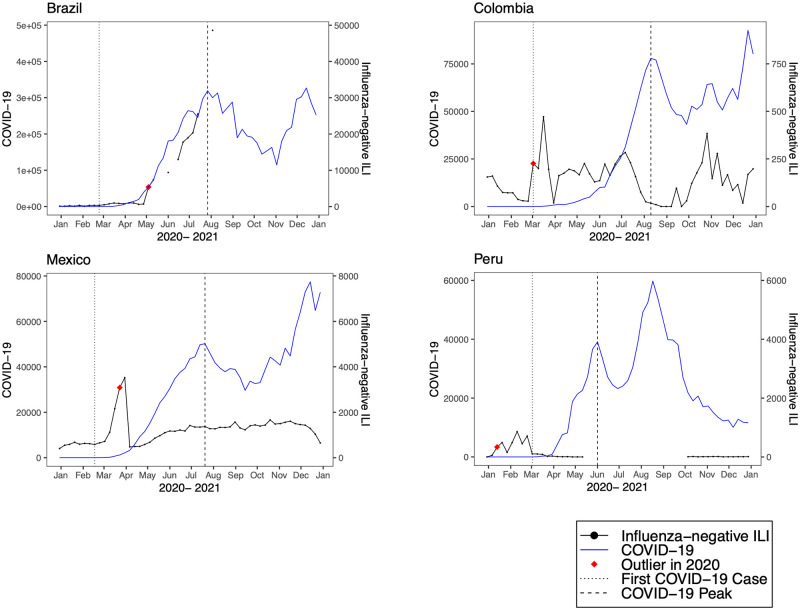
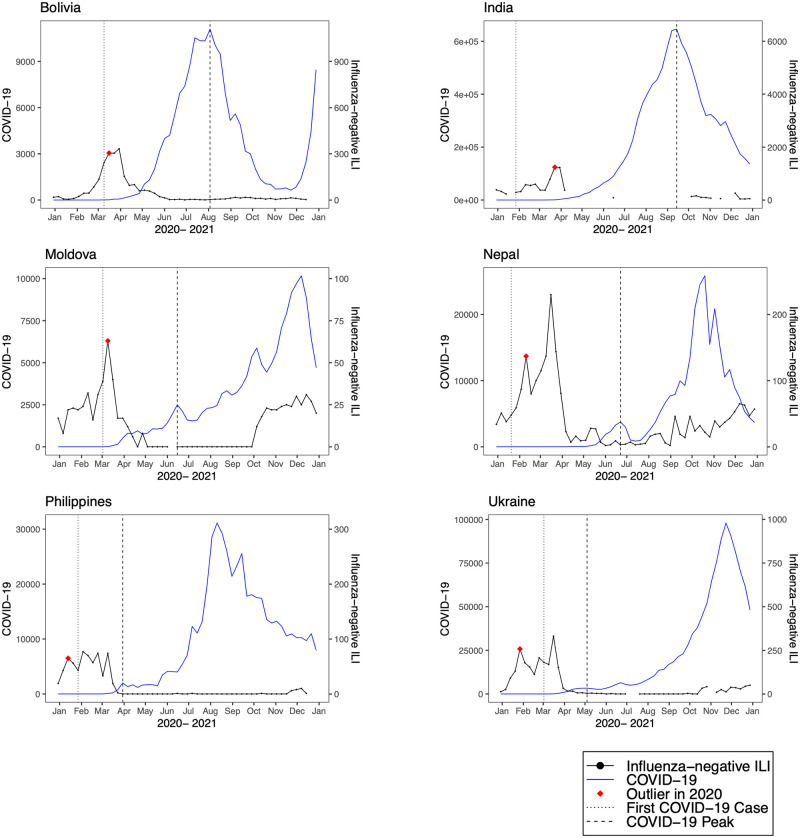
We used data from the World Health Organization's Global Influenza Surveillance and Response System to evaluate time series outliers in influenza-negative ILI. Using automated autoregressive integrated moving average (ARIMA) time series outlier detection models and baseline influenza-negative ILI training data from 2015-2019, we analyzed 8,792 country-weeks across 28 countries to identify the first week in 2020 with a positive outlier in influenza-negative ILI. We present the difference in weeks between identified outliers and the first reported COVID-19 peaks in these 28 countries with high levels of data completeness for influenza surveillance data and the highest number of reported COVID-19 cases globally in 2020. To account for missing data, we also performed a sensitivity analysis using linear interpolation for missing observations of influenza-negative ILI. In 16 of the 28 countries (57%) included in this study, we identified positive outliers in cases of influenza-negative ILI that predated the first reported COVID-19 peak in each country; the average lag between the first positive ILI outlier and the reported COVID-19 peak was 13.3 weeks (standard deviation 6.8). In our primary analysis, the earliest outliers occurred during the week of January 13, 2020, in Peru, the Philippines, Poland, and Spain. Using linear interpolation for missing data, the earliest outliers were detected during the weeks beginning December 30, 2019, and January 20, 2020, in Poland and Peru, respectively. This contrasts with the reported COVID-19 peaks, which occurred on April 6 in Poland and June 1 in Peru. In many low- and middle-income countries in particular, the lag between detected outliers and COVID-19 peaks exceeded 12 weeks. These outliers may represent undetected spread of SARS-CoV-2, although a limitation of this study is that we could not evaluate SARS-CoV-2 positivity.
Using an automated system of influenza-negative ILI outlier monitoring may have informed countries of the spread of COVID-19 more than 13 weeks before the first reported COVID-19 peaks. This proof-of-concept paper suggests that a system of influenza-negative ILI outlier monitoring could have informed national and global responses to SARS-CoV-2 during the rapid spread of this novel pathogen in early 2020.
监测系统对于发现疾病模式的变化非常重要,并且可以作为新发传染病爆发的早期预警系统。我们假设,在 COVID-19 大流行的早期,对现有全球流感监测网络的数据进行分析,可以确定流感阴性流感样疾病(ILI)中的异常值。我们使用数据驱动的方法来检测 COVID-19 首次报告高峰之前的 ILI 异常值。
我们使用世界卫生组织全球流感监测和应对系统的数据,评估了流感阴性 ILI 的时间序列异常值。使用自动自回归综合移动平均(ARIMA)时间序列异常值检测模型和 2015-2019 年的基线流感阴性 ILI 训练数据,我们分析了 28 个国家的 8792 个国家周,以确定 2020 年第一周流感阴性 ILI 出现阳性异常值。我们在这些 28 个国家中报告了首例 COVID-19 高峰与异常值之间的差异,这些国家的流感监测数据完整性水平较高,全球 2020 年报告的 COVID-19 病例数最高。为了弥补数据缺失,我们还使用缺失观测值的线性插值对流感阴性 ILI 进行了敏感性分析。在本研究纳入的 28 个国家(57%)中的 16 个国家中,我们在每个国家的首例 COVID-19 报告高峰之前发现了流感阴性 ILI 的阳性异常值;首例阳性 ILI 异常值与报告 COVID-19 高峰之间的平均滞后时间为 13.3 周(标准差为 6.8)。在我们的主要分析中,最早的异常值出现在 2020 年 1 月 13 日的秘鲁、菲律宾、波兰和西班牙。使用缺失数据的线性插值,最早的异常值出现在 2019 年 12 月 30 日和 2020 年 1 月 20 日的波兰和秘鲁的周内。这与报告的 COVID-19 高峰形成对比,波兰的 COVID-19 高峰发生在 4 月 6 日,秘鲁的高峰发生在 6 月 1 日。在许多低收入和中等收入国家中,检测到的异常值与 COVID-19 高峰之间的滞后时间超过 12 周。这些异常值可能代表了 SARS-CoV-2 的未被发现的传播,尽管本研究的一个局限性是我们无法评估 SARS-CoV-2 的阳性率。
使用流感阴性 ILI 异常值监测的自动系统可能在首次报告 COVID-19 高峰之前超过 13 周就告知了各国 COVID-19 的传播情况。这篇概念验证论文表明,在 2020 年初这种新型病原体快速传播期间,流感阴性 ILI 异常值监测系统可以为 SARS-CoV-2 的国家和全球应对措施提供信息。