Cincinnati Children's Hospital Medical Center, University of Cincinnati College of Medicine, Cincinnati, OH, USA.
Department of Pediatrics, Division of Infectious Diseases, Nationwide Children's Hospital, The Ohio State University, Columbus, OH, USA.
J Appl Lab Med. 2023 Mar 6;8(2):353-371. doi: 10.1093/jalm/jfac058.
Nonpharmaceutical interventions to prevent the spread of coronavirus disease 2019 also decreased the spread of respiratory syncytial virus (RSV) and influenza. Viral diagnostic testing in patients with respiratory tract infections (RTI) is a necessary tool for patient management; therefore, sensitive and specific tests are required. This scoping literature review aimed to summarize the study characteristics of commercially available sample-to-answer RSV tests.
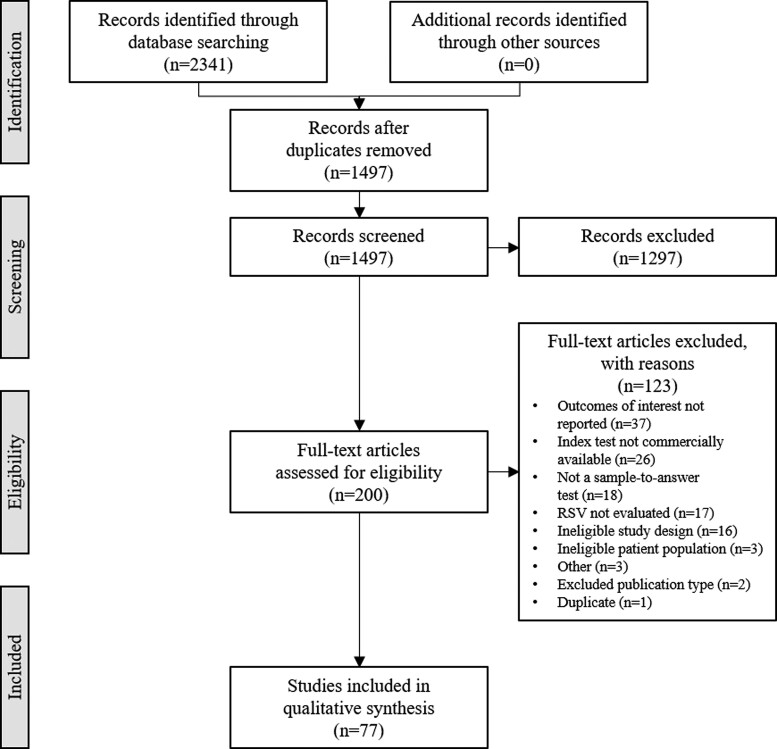
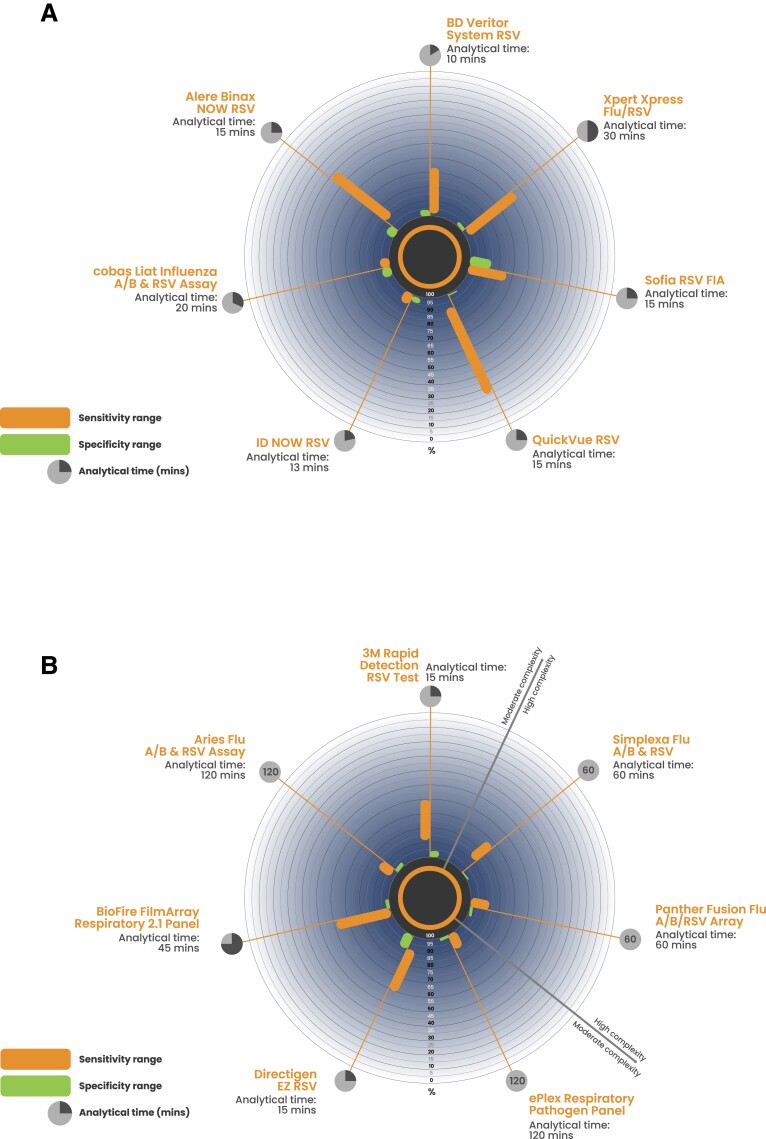
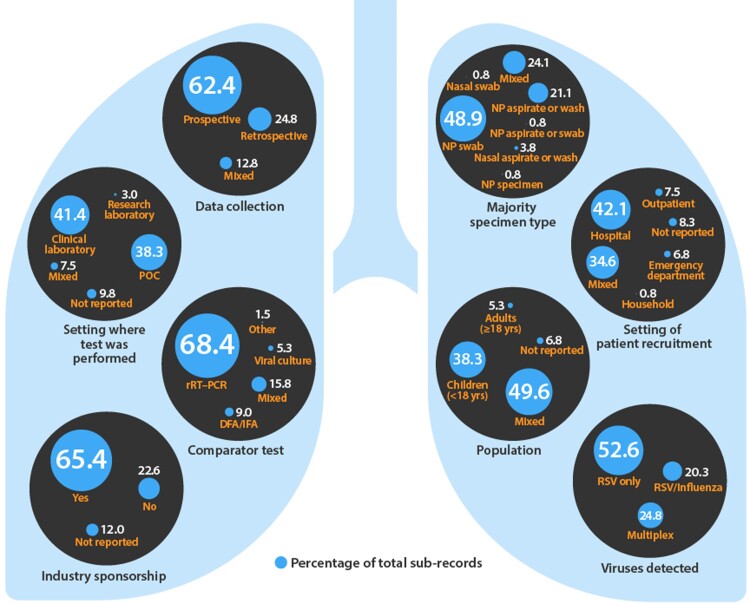
PubMed and Embase were queried for studies reporting on the diagnostic performance of tests for RSV in patients with RTI (published January 2005-January 2021). Information on study design, patient and setting characteristics, and published diagnostic performance of RSV tests were extracted from 77 studies that met predefined inclusion criteria. A literature gap was identified for studies of RSV tests conducted in adult-only populations (5.3% of total subrecords) and in outpatient (7.5%) or household (0.8%) settings. Overall, RSV tests with analytical time >30 min had higher published sensitivity (62.5%-100%) vs RSV tests with analytical time ≤30 min (25.7%-100%); this sensitivity range could be partially attributed to the different modalities (antigen vs molecular) used. Molecular-based rapid RSV tests had higher published sensitivity (66.7%-100%) and specificity (94.3%-100%) than antigen-based RSV tests (sensitivity: 25.7%-100%; specificity:80.3%-100%).
This scoping review reveals a paucity of literature on studies of RSV tests in specific populations and settings, highlighting the need for further assessments. Considering the implications of these results in the current pandemic landscape, the authors preliminarily suggest adopting molecular-based RSV tests for first-line use in these settings.
非药物干预措施可预防 2019 年冠状病毒病(COVID-19)的传播,也可减少呼吸道合胞病毒(RSV)和流感的传播。呼吸道感染(RTI)患者的病毒诊断检测是患者管理的必要工具;因此,需要灵敏和特异的检测方法。本范围界定文献综述旨在总结市售即时检测 RSV 检测方法的研究特征。
通过 PubMed 和 Embase 检索了 2005 年 1 月至 2021 年 1 月期间发表的关于 RTI 患者 RSV 检测诊断性能的研究。从符合预先设定纳入标准的 77 项研究中提取了研究设计、患者和环境特征以及已发表的 RSV 检测诊断性能信息。研究人员发现,仅在成人人群(占总子记录的 5.3%)、门诊(7.5%)或家庭(0.8%)环境中开展的 RSV 检测研究存在文献空白。总体而言,分析时间>30 分钟的 RSV 检测具有更高的发表敏感性(62.5%-100%),而分析时间≤30 分钟的 RSV 检测敏感性为 25.7%-100%;这种敏感性范围可能部分归因于不同的检测模式(抗原与分子)。基于分子的快速 RSV 检测具有更高的发表敏感性(66.7%-100%)和特异性(94.3%-100%),高于基于抗原的 RSV 检测(敏感性:25.7%-100%;特异性:80.3%-100%)。
本范围界定文献综述揭示了特定人群和环境中 RSV 检测研究文献的匮乏,突出了进一步评估的必要性。考虑到这些结果在当前大流行背景下的影响,作者初步建议在这些环境中采用基于分子的 RSV 检测作为一线检测方法。