Xu Benke, He Yun, Liu Lian, Ye Guosheng, Chen Lulu, Wang Qingning, Chen Michael, Chen Yuncai, Long Dahong
1Department of Human Anatomy, School of Basic Medical Sciences, Yangtze University, Hubei 434023, China.
2Department of Pharmacology, School of Basic Medical Sciences, Yangtze University, Hubei 434023, China.
Aging Dis. 2022 Jul 11;13(4):1293-1310. doi: 10.14336/AD.2022.0110.
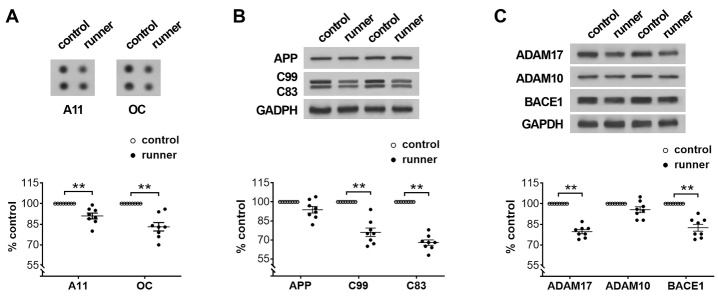
Memory loss is the key symptom of Alzheimer's disease (AD). As successful drug treatments have not yet been identified, non-pharmaceutical interventions such as physical exercise and training have been employed to improve the memory function of people with dementia. We investigated the effect of prolonged physical running on hippocampal-dependent spatial memory and its underlying mechanisms using a well-established rodent model of AD. 3xTg-AD transgenic mice and non-transgenic mice were subjected to voluntary wheel running for 5 months (1 hour per day, 5 days per week), followed by spatial memory testing. After the behavioral testing, dendritic spines, synapses, and synaptic proteins as well as amyloid-beta (Aβ) pathology were analyzed in the dorsal hippocampi. Running improved hippocampal-dependent spatial memory in 3xTg-AD mice. This running strategy prevented both thin and mushroom-type spines on CA1 pyramidal cells in 3xTg-AD mice, whereas the effects of running in non-transgenic mice were limited to thin spines. The enormous effects of running on spines were accompanied by an increased number of synapses and upregulated expression of synaptic proteins. Notably, running downregulated the processing of amyloid precursor protein, decreasing intracellular APP expression and extracellular Aβ accumulation, and spatial memory performance correlated with levels of Aβ peptides Aβ and Aβ. These data suggest that prolonged running may improve memory in preclinical AD via slowing down the amyloid pathology and preventing the loss of synaptic contacts.
记忆丧失是阿尔茨海默病(AD)的关键症状。由于尚未确定成功的药物治疗方法,因此已采用体育锻炼和训练等非药物干预措施来改善痴呆症患者的记忆功能。我们使用成熟的AD啮齿动物模型,研究了长期跑步对海马体依赖的空间记忆及其潜在机制的影响。将3xTg-AD转基因小鼠和非转基因小鼠进行为期5个月的自愿轮转跑步(每天1小时,每周5天),随后进行空间记忆测试。行为测试后,对背侧海马体中的树突棘、突触、突触蛋白以及β-淀粉样蛋白(Aβ)病理学进行分析。跑步改善了3xTg-AD小鼠中依赖海马体的空间记忆。这种跑步策略可防止3xTg-AD小鼠CA1锥体细胞上的细长型和蘑菇型树突棘减少,而在非转基因小鼠中跑步的影响仅限于细长型树突棘。跑步对树突棘的巨大影响伴随着突触数量的增加和突触蛋白表达的上调。值得注意的是,跑步下调了淀粉样前体蛋白的加工过程,降低了细胞内APP的表达和细胞外Aβ的积累,并且空间记忆表现与Aβ肽Aβ和Aβ的水平相关。这些数据表明,长期跑步可能通过减缓淀粉样蛋白病理学进程和防止突触联系丧失来改善临床前AD患者的记忆。